For most 30 amp rigs the Progressive Industries EMS-PT30X is the one to buy: full voltage protection, 1,790 joules of surge suppression and a lifetime warranty. Fifty amp owners want the EMS-PT50X. The real decision is not which brand, though — it is whether you buy a surge protector at all, or an Electrical Management System. They are sold side by side and they do very different jobs.
Quick picks
Best overall, 30 amp
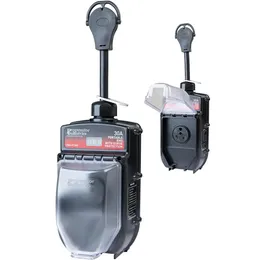
Progressive EMS-PT30X
Full EMS protection with a lifetime warranty, at a price the smart units can't match.
Best overall, 50 amp
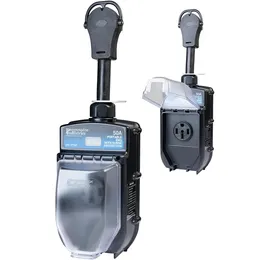
Progressive EMS-PT50X
The same protection logic as the PT30X, doubled up for 50 amp service.
Best remote monitoring
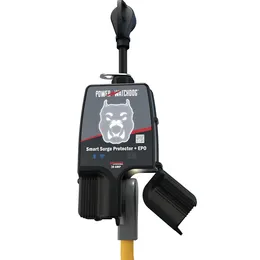
Power Watchdog Gen II (30A)
Live voltage over WiFi from anywhere, and a surge module you replace instead of the whole unit.
Best readout at the pedestal
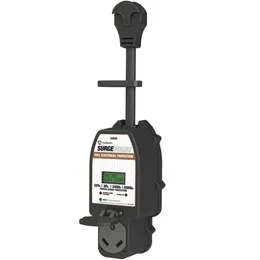
Surge Guard 34930
On-unit LCD showing live voltage and amp draw, plus connected-equipment cover.
Best permanent install
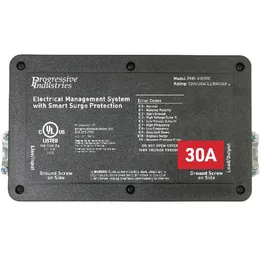
Progressive EMS-HW30C
Wires in behind the panel, so there is nothing to steal or forget.
How the eight units compare
| Model | Amps | Joules | Full EMS | Bluetooth | Replaceable module | Warranty | Price | Buy |
|---|---|---|---|---|---|---|---|---|
| Progressive EMS-PT30X | 30A | 1,790 | Yes | No | No | Lifetime, non-transferable, original owner only, and only on units bought from an authorised dealer or retailer | $$$ | Check price(opens in a new tab) |
| Power Watchdog Gen II (30A) | 30A | 3,000 | Yes | Yes | Yes | Limited lifetime, original purchaser only (does not transfer) | $$$$$ | Check price(opens in a new tab) |
| Surge Guard 34930 | 30A | 2,450 | Yes | No | No | Limited lifetime, plus a connected-equipment warranty with substantial conditions — see below | $$$ | Check price(opens in a new tab) |
| Camco 55301 | 30A | 2,800 | No | No | No | Not consistently published — see brand note | $$ | Check price(opens in a new tab) |
| Progressive EMS-HW30C | 30A | 1,790 | Yes | No | No | Lifetime, non-transferable, original owner and authorised dealers only. This model is named explicitly in PII's warranty document | $$$$ | Check price(opens in a new tab) |
| Progressive EMS-PT50X | 50A | 3,580 | Yes | No | No | Lifetime, non-transferable, original owner and authorised dealers only. Excludes the All-Weather Shield assembly | $$$$ | Check price(opens in a new tab) |
| Power Watchdog Gen II (50A) | 50A | 4,600–4,800 (published figures vary) | Yes | Yes | Yes | Lifetime | $$$$$ | Check price(opens in a new tab) |
| Surge Guard 44290 | 50A | 4,200 | Yes | No | No | Not clearly published for this model — confirm before relying on it | $$$$ | Check price(opens in a new tab) |
Surge protector or EMS? This is the decision that matters
Everything else on this page is detail. This is the part that decides whether your money was well spent.
A surge protector contains metal-oxide varistors that clamp voltage spikes and shunt the excess to ground. That is the whole function. Lightning strikes nearby, a spike travels down the line, the varistors absorb it.
An Electrical Management System does that too, then adds the part that matters more: it measures the incoming supply continuously and physically disconnects your rig when something is wrong. Voltage below roughly 104V. Voltage above roughly 132V. Open ground. Open neutral. Reverse polarity. A pedestal wired by someone in a hurry in 1987.
The reason this distinction matters is that actual surges are not what damages most RVs. Sustained low voltage is. A campground on a July afternoon with every rig running air conditioning can sag badly, and an air conditioner compressor fed low voltage draws more current to compensate, heats up, and eventually fails. A basic surge protector watches that happen and does nothing, because voltage is not what it measures.
The compressor is the usual casualty, but it is no longer the most expensive thing on the circuit. A converter feeding a lithium house bank is a four-figure electrical system that lives downstream of the same pedestal, and it is the part of a modern rig with the most to lose from a bad post.
Of the units here, the Progressive Industries, Surge Guard and Power Watchdog models are all full EMS units. The Camco 55301 is not — it has surge suppression and voltage disconnect but not the full fault-detection and timing logic of an EMS. It is included because it is a genuine step up from nothing at a much lower price, not because it is equivalent.
Thirty amp or fifty amp — get this right before anything else
Look at your shore power cord. A 30 amp rig has a three-prong TT-30 plug and a single 120V leg — 3,600 watts total. A 50 amp rig has a four-prong 14-50 plug and two 120V legs, giving 12,000 watts. That is not “a bit more power”, it is more than three times as much.
Buy the unit that matches your rig, not the pedestal you happen to be parked at. Adapters exist for plugging a 30 amp rig into a 50 amp post, and they are worth carrying, but adapting a 50 amp protector down to a 30 amp supply gets you nothing except a larger object to store. The capacity you paid for is not available. We cover the connectors, the power budgets and what adapters do and do not give you in 30 amp vs 50 amp RV. If you also want to know what that budget lets you run at once, the RV amp draw calculator works it out from your appliance list and shortlists the matching unit.
What joule ratings actually tell you
Joules measure how much surge energy the unit can absorb across its life before the varistors degrade. Higher is better, in the same sense that a bigger fuel tank is better: more headroom, longer service life.
What the number does not tell you is anything about voltage protection. This is where the specification sheets mislead people who are comparing on one figure. The Camco 55301 is rated at 2,800 joules and the Progressive EMS-PT30X at 1,790 — but the Progressive is the far more protective unit, because it disconnects on bad voltage and the Camco has no such logic. Ranking these two by joules alone gets you the wrong answer.
Compare joules within a class, not across classes. Among the 30 amp EMS units here, the Power Watchdog’s 3,000 joules is genuinely more headroom than the Progressive’s 1,790. Between an EMS and a basic suppressor, the joule figure is close to irrelevant.
One more thing worth knowing: varistors are consumable. Every surge they absorb degrades them slightly, and eventually the surge protection is spent even though the unit still passes power. Progressive units include a surge failure indicator for exactly this reason, and the Power Watchdog line lets you replace the surge module rather than the whole unit.
Portable or hardwired
Portable units plug in at the pedestal, between the post and your shore cord. They move between rigs, need no installation, and can be borrowed by a friend. They also sit outside in the weather, are exposed to whoever walks past in the night, and are one more thing to forget when you leave.
Hardwired units install inside the rig between the shore inlet and the distribution panel, usually with a remote display somewhere you can see it. Nothing to steal, nothing to forget, no weather exposure. The trade is that you need to do the wiring, and moving it to a different rig is a project rather than an afternoon.
Theft is not hypothetical here. A visible EMS at a pedestal is a few hundred dollars sitting unattended. Most portable units have a lock ring or bracket, and using it is worth the ten seconds. We go through the full trade-off — including a warranty asymmetry that works against hardwired units — in hardwired vs portable.
The units in detail
Best overall, 30 amp
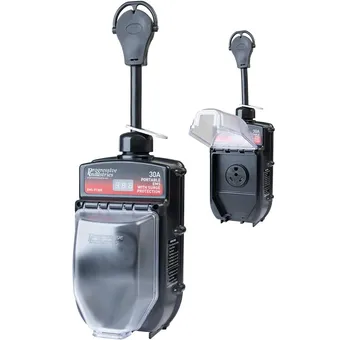
Progressive Industries EMS-PT30X Portable Electrical Management System
Why it's here
This is the unit most experienced RV owners end up recommending, and the specification explains why. Three-mode surge protection covers line-to-neutral, line-to-ground and neutral-to-ground. Low voltage protection cuts power below 104V sustained for six seconds. High voltage protection is staged — above 132V it waits three seconds, above 140V it acts within one second, and above 156V it disconnects within 60 milliseconds. That graduated response is more sophisticated than a single threshold, and it is the sort of detail that does not fit in a marketing bullet.
The lifetime warranty is the other half of the value. Progressive Industries now sits within Navico Group and the old domain redirects there, but the EMS line and its model numbers have carried over unchanged.
Full specifications
| Amperage | 30A |
|---|---|
| Voltage | 120V |
| Max watts | 3,600 |
| Joule rating | 1,790 |
| Max surge current | 44,000A |
| Protection modes | 3-mode (L-N, L-G, N-G) |
| Full EMS protection | Yes |
| Low-voltage cutoff | Below 104V for more than 6 seconds |
| High-voltage cutoff | Above 132V (staged; immediate above 156V) |
| Fault detection | Open ground, open neutral, reverse polarity, AC frequency |
| A/C compressor delay | Yes |
| Replaceable surge module | No |
| Bluetooth | No |
| Display | Digital error-code display |
| Operating temperature | -40°C to +105°C |
| Housing | Lexan |
| Warranty | Lifetime, non-transferable, original owner only, and only on units bought from an authorised dealer or retailer |
| Warranty Return Shipping | Paid by PII |
| Self Test Delay | About 2 minutes on connection |
Specifications verified August 10, 2026 from Progressive Industries EMS-PT30X instruction manual , Progressive Industries (PII) Lifetime Warranty document .
Strengths
- Full EMS protection — disconnects on low and high voltage, not just spikes
- Lifetime warranty with return shipping paid by the manufacturer
- Staged high-voltage response: faster cutoff the further out of range the supply goes
- Lexan housing rated from -40°C to +105°C
- Error-code display tells you what the pedestal is doing wrong
Weaknesses
- At 1,790 joules, lower surge headroom than the Power Watchdog or Surge Guard
- No app or remote monitoring — you read it at the post
- Surge module is not user-replaceable
- Warranty is non-transferable and only valid on units bought from an authorised dealer — owners have reported claims refused on that basis
Fit: For 30A TT-30 service. Will not accept a 50A pedestal without an adapter, and an adapter does not give you 50A capacity.
Buy it if
You have a 30 amp rig and want the most protection per pound spent. This is the default recommendation for a reason.
Choose something else if
You want live monitoring from inside the rig, or you would rather install something permanent.
Best remote monitoring, 30 amp
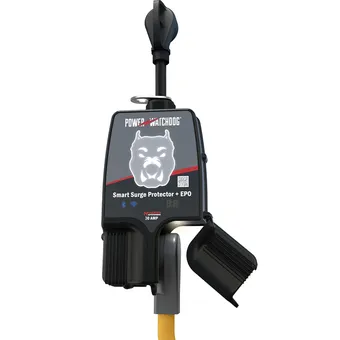
Hughes Power Watchdog Gen II PWD30EPOW Smart Surge Protector with Auto Shutoff
Why it's here
The replaceable surge module is the genuinely interesting design decision here. Every other unit on this page is disposable in the sense that once its varistors are spent, that is the end of it. The Power Watchdog is built so a large spike costs you a cartridge instead.
This is the Gen II unit, which replaced the Bluetooth-only PWD30-EPO. The substantive change is WiFi alongside Bluetooth: the older model could only be read from within Bluetooth range, which meant standing near the rig. Gen II can be checked while you are out for the day, which is when a voltage problem is most useful to know about.
The older PWD30-EPO is still on sale at some retailers. Hughes no longer lists it, so we do not recommend it — but if you already own one, nothing about it has stopped working.
Two things in Hughes’ documentation are worth knowing before you buy: the warranty covers the original purchaser only, and the WiFi needs a 2.4 GHz network. Both are covered in our Power Watchdog review.
Full specifications
| Amperage | 30A |
|---|---|
| Voltage | 120V |
| Joule rating | 3,000 |
| Full EMS protection | Yes |
| Emergency power off | Yes |
| Replaceable surge module | Yes |
| Bluetooth | Yes |
| Wifi | Yes |
| App monitoring | Live voltage, amperage and wattage in the Hughes app over WiFi as well as Bluetooth — so the rig can be checked from outside Bluetooth range |
| Fault detection | High and low voltage, open ground, open neutral, overcurrent |
| Weather rating | IP65 |
| Connection Bay | Lockable, lit clamshell |
| Display | Via smartphone app |
| Wifi Band | 2.4 GHz SSID only |
| Module Indicator | WatchDog logo turns red with an E9 code in the LCD window |
| App | Power WatchDog Gen2 (WiFi) — blue/white logo, Gen II units only |
| Warranty | Limited lifetime, original purchaser only (does not transfer) |
Specifications verified August 10, 2026 from Power Watchdog — Gen II surge protector range , Amazon listing, PWD30EPOW published specification , Power Watchdog FAQ — warranty, apps, WiFi band, module replacement .
Strengths
- 3,000 joules — meaningfully more surge headroom than the Progressive PT30X
- Replaceable surge module: after a big hit you swap a cartridge, not the unit
- WiFi as well as Bluetooth, so you can check the rig from outside Bluetooth range
- IP65 water resistance is an explicit published rating, which is uncommon here
- Lifetime warranty covering parts and labour
- Emergency power off cuts supply the moment a fault is detected
Weaknesses
- Substantially more expensive than the Progressive for protection that is comparable in practice
- Monitoring depends on an app — and WiFi monitoring needs the rig to have a connection
- You are paying for the EPO and the radios, not for better surge absorption
Fit: Portable 30A unit and the current generation. Replaces the Bluetooth-only PWD30-EPO. A hardwired Gen II variant (PWD30EPOHW) is also available.
Buy it if
You want to see what the pedestal is doing without walking to it — including when you are away from the rig — and you like that a surge hit means replacing a module rather than the whole unit.
Choose something else if
You will not use the app. Without it you are paying a large premium over the Progressive for protection that is broadly equivalent.
Best readout at the pedestal, 30 amp
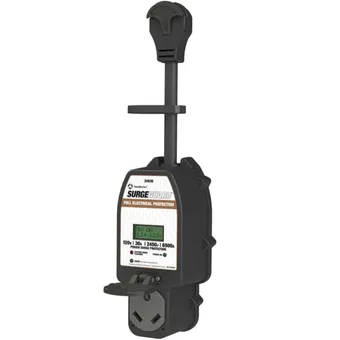
Southwire Surge Guard 34930 Full Protection Portable with LCD Display
Why it's here
The connected equipment coverage is the part worth reading carefully — and having read it, we would not buy this unit for that reason. Southwire’s warranty document excludes damage caused by sustained low voltage, excludes direct lightning, pays out only where Southwire judges that the protector itself was defective, requires you to claim on your home insurance first, and permits one claim per household. Low voltage is the most common way park power damages a rig, so the exclusion removes the main scenario.
The separate limited lifetime warranty on the unit is also void once the protector has sacrificed itself — which is how these devices are designed to end their lives. Full detail in Surge Guard vs Progressive.
Buy this one for the LCD and the overheat detection, which are genuinely good. Not for the warranty.
The 128-second delay before restoring power after a fault exists to protect the air conditioning compressor, which needs its head pressure to equalise before restarting. It feels slow standing at the post. It is doing something useful.
Full specifications
| Amperage | 30A |
|---|---|
| Voltage | 120V |
| Max watts | 3,600 |
| Joule rating | 2,450 |
| Full EMS protection | Yes |
| Protection modes | 3-mode (L-N, L-G, N-G) |
| Clamping Voltage | Under 300 VAC |
| Max Spike Current | 6,500A per MOV |
| Low-voltage cutoff | Below 102V for more than 7 seconds |
| High-voltage cutoff | Above 136V for more than 7 seconds |
| Fault detection | Open ground, open neutral, reverse polarity, voltage on ground, overheating receptacle, overcurrent |
| High Neutral Current Trip | No |
| Receptacle Temp Trip | Yes |
| A/C compressor delay | 128-second reset delay |
| Replaceable surge module | No |
| Bluetooth | No |
| Display | LCD showing voltage and RMS amp draw |
| Anti-theft | Lock ring on cord |
| Receptacle | Commercial-grade brass |
| Warranty | Limited lifetime, plus a connected-equipment warranty with substantial conditions — see below |
| Warranty Notes | The limited lifetime warranty is void once the unit sacrifices itself, which is its normal end of life. The connected-equipment warranty excludes damage from sustained low voltage and from direct lightning, pays only where Southwire judges the protector itself defective, requires you to claim on home insurance first, and is limited to one claim per household. Non-transferable unless factory-fitted to the RV |
| Warranty Doc | Southwire 90606 G, Limited Lifetime & Connected Equipment Warranties |
Specifications verified August 10, 2026 from Southwire installation & operating instructions, models 34930/34950 (505-00152A) , Southwire product listing, model 34930 , Surge Guard Limited Lifetime & Connected Equipment Warranties (90606 G) .
Strengths
- LCD shows live voltage and RMS amp draw on the unit itself, no phone needed
- Detects an overheating plug or receptacle — a genuine fire risk the others do not check for
- 128-second reset delay protects the air conditioning compressor after a fault
- Anti-theft lock ring built into the cord
- Commercial-grade brass receptacle
Weaknesses
- Reading the display means walking to the pedestal
- Low-voltage cutoff at 102V is slightly lower than the Progressive units, so it tolerates worse supply for longer
- No replaceable surge module
- The connected-equipment warranty is far narrower than it sounds — it excludes low voltage and lightning, and the lifetime warranty voids once the unit does its job
Fit: 30A TT-30 service. The 50A equivalent in this range is the 44290.
Buy it if
You want the numbers visible without an app, and you value the connected-equipment cover.
Choose something else if
Your pedestal is awkward to reach, or you would rather monitor from inside.
Cheapest step up from nothing
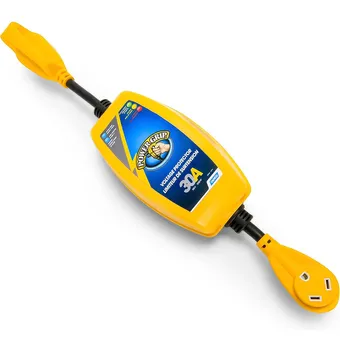
Camco PowerGrip 55301 30-Amp Voltage Protector with Surge Protection
Why it's here
Included honestly: this is entry-level equipment, not a cheaper equivalent of the units above. It suppresses surges and it will disconnect on voltage it considers unsafe, and that already puts you ahead of an unprotected rig.
Be careful with model numbers across this range, because they are not interchangeable. The 55310 is a circuit analyzer at 1,050 joules that indicates faults but does not protect against them, and the 55306 is the 50 amp version at 4,200 joules. Buying by range name rather than model number is how people end up with a fault indicator when they wanted a protector.
Full specifications
| Amperage | 30A |
|---|---|
| Voltage | 120V |
| Joule rating | 2,800 |
| Full EMS protection | No |
| Voltage protection | Disconnects on detected high or low voltage |
| Fault detection | Diagnostic LEDs for wiring faults |
| A/C compressor delay | No |
| Replaceable surge module | No |
| Bluetooth | No |
| Display | LED indicators only |
| Warranty | Not consistently published — see brand note |
Specifications verified August 10, 2026 from Camco 55301 published specification .
Strengths
- 2,800 joules of surge suppression at a fraction of the price of an EMS
- Disconnects on detected high or low voltage
- Diagnostic LEDs flag wiring faults before you plug the rig in
- Small and light enough to keep in a bay without thinking about it
Weaknesses
- Not a full EMS — no compressor timing delay, no error codes, limited fault logic
- LED indicators only, so no voltage or current readout
- Warranty terms are not consistently published
Fit: Entry-level protection. Related models differ substantially: the 55310 circuit analyzer is 1,050 joules and provides fault indication only, and the 55306 is the 50A version at 4,200 joules. Check the model number, not the range name.
Buy it if
You currently plug in with no protection at all and the EMS price is genuinely out of reach. Something is very much better than nothing here.
Choose something else if
You can stretch to an EMS. The gap in what they protect against is larger than the gap in price.
Best permanent installation, 30 amp
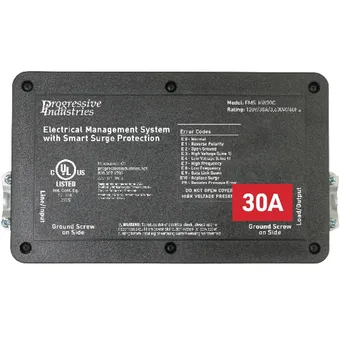
Progressive Industries EMS-HW30C Hardwired Electrical Management System
Why it's here
Everything the PT30X does, permanently mounted, with a display you can read without going outside. For a rig you intend to keep, this is the version that stops being something you think about.
The stored error history is the underrated feature. If your air conditioning cut out overnight and you want to know whether the pedestal dipped, the unit can tell you. A portable unit that has since been unplugged cannot.
The 50 amp equivalent is the EMS-HW50C, rated at 3,580 joules and 88,000A.
Full specifications
| Amperage | 30A |
|---|---|
| Voltage | 120V |
| Joule rating | 1,790 |
| Max surge current | 44,000A |
| Protection modes | 3-mode |
| Response time | Under 1 nanosecond |
| Full EMS protection | Yes |
| Safe voltage range | Shuts down outside 104–132V |
| Fault detection | Open ground, open neutral, reverse polarity, miswired pedestal |
| A/C compressor delay | Yes |
| Installation | Hardwired inside the rig |
| Display | Remote scrolling display — voltage, current, frequency, error codes |
| Replaceable surge module | No |
| Bluetooth | No |
| Warranty | Lifetime, non-transferable, original owner and authorised dealers only. This model is named explicitly in PII's warranty document |
Specifications verified August 10, 2026 from Progressive Industries EMS-HW30C & EMS-HW50C instruction manual .
Strengths
- Installed inside the rig — cannot be stolen, cannot be left behind, never rained on
- Remote display scrolls voltage, current, frequency and stored error codes
- Lifetime manufacturer warranty
- Surge response under one nanosecond, 44,000A surge current rating
Weaknesses
- Requires wiring work between the shore inlet and the distribution panel
- Moving it to another rig is a job, not a decision
- Same 1,790 joules as the portable PT30X, at a higher price for the installation convenience
Fit: Permanent installation between the shore cord and the distribution panel. Cannot be stolen from a pedestal and is not exposed to weather, but requires wiring work and is not transferable between rigs in an afternoon. The 50A equivalent is the EMS-HW50C at 3,580 joules.
Buy it if
The rig is a keeper and you are tired of carrying a portable unit in and out. The stored error-code history is genuinely useful for diagnosing an intermittent pedestal.
Choose something else if
You are not comfortable doing the wiring and would need to pay for installation, or you change rigs often.
Best overall, 50 amp
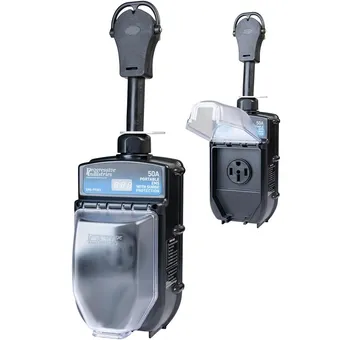
Progressive Industries EMS-PT50X Portable Electrical Management System
Why it's here
The direct 50 amp equivalent of our overall pick, and it earns the same recommendation for the same reasons. Rated at 50A across 120/240V service for a 12,000 watt capacity, with the full fault-detection set: over and under voltage, open ground, open neutral, reverse polarity and AC frequency monitoring.
Note the warranty carve-out. The lifetime cover applies to the unit, but Progressive excludes the All-Weather Shield assembly from it. That is a reasonable exclusion for a weather-exposed plastic part, and it is better to know now than at the point of claiming.
Full specifications
| Amperage | 50A |
|---|---|
| Voltage | 120/240V |
| Max watts | 12,000 |
| Joule rating | 3,580 |
| Max surge current | 88,000A |
| Protection modes | Multi-mode |
| Full EMS protection | Yes |
| Low-voltage cutoff | Below 104V |
| High-voltage cutoff | Above 132V |
| Fault detection | Open ground, open neutral, reverse polarity, AC frequency |
| A/C compressor delay | Yes |
| Replaceable surge module | No |
| Bluetooth | No |
| Display | Digital error-code display |
| Operating temperature | -40°C to +105°C |
| Housing | Lexan |
| Warranty | Lifetime, non-transferable, original owner and authorised dealers only. Excludes the All-Weather Shield assembly |
Specifications verified August 10, 2026 from Progressive Industries EMS-PT30X & EMS-PT50X instruction manual .
Strengths
- 3,580 joules and an 88,000A surge current rating
- Same EMS protection logic as the 30 amp version, across both legs
- Lifetime warranty on the unit
- Rugged pull handle and locking bracket — small details that matter at a pedestal
Weaknesses
- The All-Weather Shield assembly is explicitly excluded from the lifetime warranty
- Bulky and heavy relative to the 30 amp units
- No app monitoring
Fit: For 50A NEMA 14-50 service, which is two 120V legs rather than 240V to the coach. Not a substitute for a 30A unit if your rig is 30A.
Buy it if
You have 50 amp service and want the same protection the PT30X gives 30 amp owners.
Choose something else if
You want live remote monitoring, in which case the Power Watchdog PWD50-EPO is the comparison to make.
Most surge headroom, 50 amp
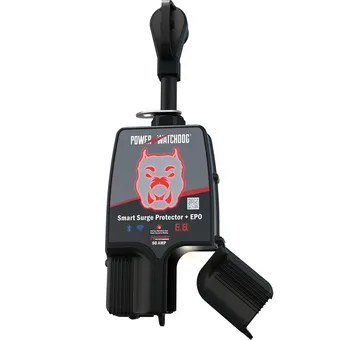
Hughes Power Watchdog Gen II PWD50EPOW Smart Surge Protector with Auto Shutoff
Why it's here
The 50 amp Gen II Power Watchdog, replacing the Bluetooth-only PWD50-EPO. It publishes the highest surge rating in this group, adds WiFi to the Bluetooth monitoring, and keeps the replaceable surge module.
On the joule figure: retailer listings publish both 4,600 and 4,800 for this model and we could not find manufacturer documentation confirming either. We show the range rather than picking the flattering number. If the distinction matters to your decision, ask Hughes before buying — and treat any site quoting a single precise figure with confidence as having done less checking than it appears.
Full specifications
| Amperage | 50A |
|---|---|
| Voltage | 120/240V |
| Joule rating | 4,600–4,800 (published figures vary) |
| Full EMS protection | Yes |
| Emergency power off | Yes |
| Replaceable surge module | Yes |
| Bluetooth | Yes |
| Wifi | Yes |
| App monitoring | Live voltage, amperage and wattage over WiFi and Bluetooth |
| Low-voltage cutoff | Below 104V |
| High-voltage cutoff | Above 132V |
| Restore Delay | 90 seconds of stable supply |
| Fault detection | High and low voltage, open ground, open neutral, overcurrent |
| Weather rating | IP65 |
| Display | Via smartphone app |
| Warranty | Lifetime |
Specifications verified August 10, 2026 from Power Watchdog — Gen II surge protector range , Amazon listing, PWD50EPOW published specification .
Strengths
- The highest published surge rating of the units here, at 4,600–4,800 joules
- Replaceable surge module
- WiFi and Bluetooth monitoring of live voltage, amperage and wattage
- Emergency power off cuts supply immediately on a fault
- Lifetime warranty
Weaknesses
- The most expensive unit on this page by a clear margin
- Published joule figures disagree between retailers — see below
- The premium buys radios and EPO, not fundamentally better protection
Fit: Portable 50A unit and the current generation, replacing the Bluetooth-only PWD50-EPO.
Buy it if
You have 50 amp service, you will genuinely use remote monitoring, and you want the most surge absorption available in a portable unit.
Choose something else if
You want the lowest cost route to full EMS protection. The Progressive PT50X protects against the same faults for considerably less.
Most complete fault detection, 50 amp
Southwire Surge Guard 44290 Portable Surge Protector with Enhanced Diagnostics
Why it's here
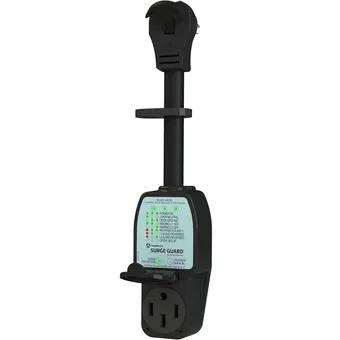
Southwire publishes an unusually complete fault list for this unit: high and low voltage, miswired pedestals, open neutral, open ground, reverse polarity, high neutral current, surges, and overheating plug or receptacle. Overheating detection in particular is worth having, because a pedestal receptacle that has been arcing for years is a genuine fire risk and is not something you would notice from inside.
The gap is warranty documentation. The 34930 clearly states limited lifetime cover with connected equipment; we could not find equivalent published terms for the 44290. Related model 44390 is the version with a rain-proof covered outlet.
Full specifications
| Amperage | 50A |
|---|---|
| Voltage | 120/240V |
| Joule rating | 4,200 |
| Full EMS protection | Yes |
| Fault detection | High/low voltage, miswired pedestal, open neutral, open ground, reverse polarity, high neutral current, overheating plug/receptacle |
| Open ground indicator | Yes |
| Replaceable surge module | No |
| Bluetooth | No |
| Display | Diagnostic indicators |
| Warranty | Not clearly published for this model — confirm before relying on it |
Specifications verified August 10, 2026 from Southwire product listing, model 44290 .
Strengths
- 4,200 joules across 120/240V service
- The broadest published fault list here — including high neutral current and overheating plug or receptacle
- Open ground and open neutral testing with indicators
Weaknesses
- Warranty terms are not clearly published for this model, unlike the 34930
- Diagnostic indicators rather than a full readout
- No replaceable module or app
Fit: 50A NEMA 14-50 service. Model 44390 is the closely related version with a rain-proof covered outlet.
Buy it if
You want thorough pedestal fault detection on 50 amp service and do not need monitoring.
Choose something else if
Warranty clarity matters to you — in which case the Progressive PT50X states its terms plainly.
How to choose
Start with your service. Thirty amp or fifty amp, determined by your rig, not by preference. Everything else is secondary.
Then decide EMS or basic. If the budget reaches an EMS, buy the EMS. The Camco is a reasonable purchase only when the alternative is no protection at all.
Then decide where you want to read it. On the unit at the pedestal, on your phone, on a remote display inside, or not at all. This is the axis that separates the three EMS brands more than protection does — they all disconnect on bad voltage; they differ in how they tell you about it.
Then look at warranty, carefully. Progressive states lifetime cover plainly, with one named exclusion on the PT50X. Southwire’s 34930 includes connected equipment, which is the strongest cover here if you ever need it. Hughes and the Surge Guard 44290 both have warranty documentation we could not pin down to a single published term, which is not a reason to avoid them but is a question to ask before buying.
Only then compare joules, and only within the same class.
What the readouts are telling you
An EMS that refuses to pass power is not faulty. It is doing the job. The common causes, in roughly the order you will meet them:
- Low voltage. Below roughly 104V, usually a busy park on a hot day, or a long undersized feed from the pedestal. Wait, or move to another post.
- Open ground. The pedestal has no ground connection. This is a shock hazard, not an inconvenience — report it and use a different post.
- Open neutral. Potentially the most damaging pedestal fault there is, and the reason full fault detection is worth paying for.
- Reverse polarity. Hot and neutral swapped at the post. Common in older parks.
- High voltage. Rarer than low, but faster to do damage.
If a unit cuts power and then takes a minute or two to restore it after the supply recovers, that is the air conditioning compressor delay working as designed, not a fault. Every code these units display is listed in RV surge protector error codes. And if power stops with no error code and nothing physically tripped, work through why your RV breaker keeps tripping instead — that is a different problem.
Related guides
- Progressive vs Power Watchdog — the two leading 30 amp units head to head, with a verdict.
- Surge Guard vs Progressive — voltage thresholds, overheat detection, and what the warranties actually cover.
- Hughes Power Watchdog review — the Gen II unit in detail, and what owners report about living with it.
- Progressive EMS-PT30X review — our overall pick examined closely, including the warranty small print.
- Hardwired vs portable — form factor decided honestly, including what installation really involves.
- Do I need one at all? — check your transfer switch model before buying anything.
- 9 buying mistakes — what we found reading every manufacturer’s warranty document.
- EMS vs surge protector — the difference in full, why joule ratings mislead, and when a basic unit is genuinely enough.
- 30 amp vs 50 amp RV — the connectors, the power budgets, and what adapters actually change.
- Best RV lithium batteries — seven LiFePO4 batteries compared on charge temperature, BMS current and warranty terms, from the manufacturers’ own datasheets.
- Why does my RV breaker keep tripping? — overload against genuine fault, and when to stop and call someone.
- RV surge protector error codes — every Progressive E-code and Surge Guard message, from the manufacturers’ own charts.
- The electrical section collects everything published so far.
For how products on this site are selected and what we do not claim about them, see the editorial policy.
Questions worth answering
Do I really need an RV surge protector, or is it just insurance?
The name undersells what the good ones do. Actual lightning surges are rare. Miswired pedestals, low voltage under campground load and open neutrals are common, and those are what damage air conditioners and converters. A basic surge suppressor does nothing about any of them — an EMS disconnects.
What is the difference between a surge protector and an EMS?
A surge protector clamps voltage spikes and nothing more. An Electrical Management System also measures the supply continuously and cuts power when voltage goes out of range or the pedestal is miswired. Most of the damage an RV suffers from park power comes from sustained bad voltage rather than spikes, which is why the EMS is the one worth paying for.
Will a 50 amp surge protector work on a 30 amp hookup?
Not directly, and adapting one down is the wrong way round. Buy the unit that matches your rig's service. A 50 amp unit on a 30 amp pedestal through an adapter still only has 30 amps available, and you have paid extra for capacity you cannot use.
How many joules do I actually need?
Joules only describe how much surge energy the unit can absorb before it degrades, so more is better in the same way a bigger fuel tank is better. It says nothing about voltage protection, which matters more day to day. Do not choose a basic 4,200-joule suppressor over a 1,790-joule EMS on that number alone.
Can a surge protector be stolen from the pedestal?
Yes, and it happens. Portable units sit in the open at the post. Most have a lock ring or bracket for a padlock, and hardwired units remove the problem entirely by living inside the rig.
Does a surge protector protect against low voltage?
Only if it is an EMS. Low voltage is the more common threat — a busy campground on a hot afternoon can sag well below 104V, and running an air conditioner on that will cook the compressor. Basic suppressors ignore voltage completely.