A surge protector absorbs voltage spikes. An Electrical Management System does that as well, then adds the part that matters more: it measures the incoming supply continuously and cuts power when the voltage is unsafe or the pedestal is miswired.
That difference sounds academic until you notice which fault actually destroys RV air conditioners. It is almost never a lightning spike. It is a campground sagging to 104 volts on a hot afternoon — and a surge protector will pass that straight through to your rig without complaint.
The difference at a glance
| What it handles | Surge protector | EMS |
|---|---|---|
| Voltage spikes and surges | Yes | Yes |
| Sustained low voltage (brownout) | No | Yes |
| Sustained high voltage | No | Yes |
| Open ground | Indicator only | Disconnects |
| Open neutral | Indicator only | Disconnects |
| Reverse polarity | Indicator only | Disconnects |
| AC frequency problems | No | Yes |
| Delay to protect the A/C compressor | No | Yes |
| Tells you what is wrong | Rarely | Error codes or a readout |
| Typical price | Low | Three to five times higher |
What a surge protector actually does
Inside a surge protector are metal-oxide varistors. At normal voltage they behave like an insulator and do nothing at all. When voltage climbs past their clamping threshold their resistance collapses and they shunt the excess energy to ground, holding the voltage your rig sees down to something survivable.
That is the entire mechanism. It is fast — response times under a nanosecond are typical — and it works well for what it is designed to do.
Two consequences follow from how varistors work, and both matter.
They are consumable. Every surge degrades them slightly. Eventually the surge protection is exhausted while the unit still happily passes power, which is why better units include a surge failure indicator, and why the Power Watchdog line was designed with a replaceable surge module.
They only see voltage going up. A varistor has no concept of voltage being too low. It cannot react to something it is not built to detect.
What an EMS adds
An Electrical Management System contains the same surge suppression, plus a microprocessor watching the supply continuously and a relay that can physically disconnect your rig.
Published thresholds from units we have specifications for:
- The Progressive Industries EMS-PT30X cuts power below 104V sustained for more than six seconds. On the high side it is staged — above 132V it waits three seconds, above 140V it acts within one second, and above 156V it disconnects within 60 milliseconds.
- The Surge Guard 34930 cuts power below 102V or above 136V, in both cases after seven seconds, with a 128-second delay before restoring it so an air conditioning compressor is not restarted against its own head pressure.
Alongside voltage, an EMS detects wiring faults at the pedestal — open ground, open neutral, reverse polarity — and refuses to connect rather than merely lighting a warning lamp you may not look at.
The same fault, two responses
What actually damages RVs
Here is the reasoning that should decide your purchase.
Genuine lightning-induced surges are rare events. Most RV owners will go years without meeting one. Meanwhile:
Low voltage is routine. A campground’s distribution has finite capacity. Fill every site on a July afternoon with air conditioners running and the supply sags. Long runs of undersized cable to distant pedestals make it worse. Below about 104V you are outside what most RV appliances are designed for.
Low voltage is what kills compressors. An air conditioner motor fed insufficient voltage draws more current to produce the same work. More current means more heat in the windings. Do that repeatedly across a season and the compressor fails — not dramatically, just early. Nothing about that failure looks like an electrical fault, which is why the cause frequently goes unidentified.
Worth separating two things that get confused here: this is the park’s load, not yours. Your own consumption is a different question, and the RV amp draw calculator answers that one — what you can run at once before your own breaker goes.
Pedestal wiring faults are common in older parks. Reverse polarity and open grounds are not exotic. They are what you find when connections have been baked and frozen for thirty years and repaired by whoever was available.
A surge protector addresses none of these. It is guarding the door against the rare visitor while the common one walks in through the window.
The joule trap
Joule ratings are the most misread number in this category, because they are the easiest to compare and they invite a false conclusion.
Joules measure how much surge energy a unit can absorb across its life before its varistors degrade. More is genuinely better — but the figure describes surge capacity only, and says nothing about voltage protection.
Which produces this:
| Unit | Joules | Full EMS? |
|---|---|---|
| Camco 55301 | 2,800 | No |
| Progressive EMS-PT30X | 1,790 | Yes |
Sorted by joules, the Camco wins. In terms of what will actually protect your rig, it is not close — the Progressive disconnects on low voltage and the Camco has no such logic.
Compare joules within a category, never across one. Among 30 amp EMS units, the Power Watchdog’s 3,000 joules really is more headroom than the Progressive’s 1,790. Between an EMS and a basic suppressor, the number is close to noise.
Which one do you need?
Work down this list and stop at the first line that describes you.
-
You currently plug in with no protection at all
Buy something today
Even a basic unit is a large improvement over nothing. Upgrade later if the budget is the constraint.
-
You stay at campgrounds with shore power more than a few times a year
Buy an EMS
This is most RV owners. Voltage problems are the normal case, not the edge case.
-
Your rig has residential appliances, a residential fridge, or two air conditioners
Buy an EMS, hardwired if practical
More expensive equipment behind the panel means a larger loss when park power misbehaves.
-
You boondock almost exclusively and rarely connect to shore power
A basic unit is defensible
Your exposure is genuinely low. Protect the few times you do plug in without overspending.
-
You store the rig on a home outlet and travel occasionally
A basic unit is usually enough
A domestic supply is far more predictable than a campground pedestal.
When a basic surge protector is genuinely enough
The honest counter-case, because “always buy the expensive one” is not advice.
If you plug into shore power a handful of times a year, mostly at home or at newer parks, and your rig has a single air conditioner and no residential appliances, your realistic exposure is low. A basic unit at a fraction of the price is a reasonable decision rather than a mistake.
The calculation changes as soon as you are in campgrounds regularly, because the exposure is cumulative. Every hot afternoon on a loaded park is another chance for the sag your basic unit will not act on.
How to tell which one you already own
If you have a unit and are not sure what it is:
- Can it show you a voltage? A display reading 117V, or error codes, means an EMS. Indicator lamps alone generally mean a basic protector.
- Does it delay before passing power? A countdown of ten seconds at connection, or a longer delay after a fault, is EMS compressor-protection behaviour.
- Does it ever refuse to connect? A unit that declines a pedestal and tells you why is detecting faults, not just suppressing spikes. The codes it uses are listed in RV surge protector error codes.
- Check the model number against the manufacturer’s specification. Range names are marketing; model numbers are the product. Camco’s 55301, 55306 and 55310 sit in the same family and differ substantially in what they do.
If you have decided
If you want an EMS, 30 amp
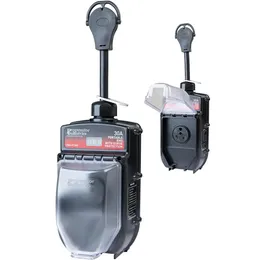
Progressive EMS-PT30X
Full voltage protection and a lifetime warranty, at the low end of EMS pricing.
If you want an EMS, 50 amp
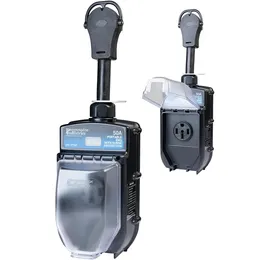
Progressive EMS-PT50X
The same protection logic across both legs of 50 amp service.
If a basic unit is genuinely all you can fit
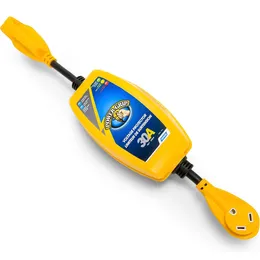
Camco 55301
Surge suppression and a voltage disconnect, without the full EMS fault logic.
For the full comparison of eight units across both amperages — including Bluetooth monitoring, hardwired options and the warranty differences that separate them — see our guide to the best RV surge protectors.
Related guides
- Best RV surge protectors — eight units compared on published specifications, for 30 and 50 amp service.
- Progressive vs Power Watchdog — once you have decided on an EMS, these are the two brands to choose between.
- Hardwired vs portable — and then the form factor, which changes nothing about protection and everything else.
- Do I need a surge protector at all? — including how to check whether your rig already has one.
- 9 buying mistakes — the joule trap is only the first of them.
- 30 amp vs 50 amp RV — which service you have, what each will run, and why adapters do not add capacity.
- Why does my RV breaker keep tripping? — including how to tell an EMS disconnect from an actual breaker trip.
- RV surge protector error codes — every Progressive E-code and Surge Guard message explained.
- The electrical section collects everything published so far.
Questions worth answering
Is an EMS just an expensive surge protector?
No. They overlap on one function — clamping voltage spikes — and the EMS adds continuous voltage monitoring and an automatic disconnect. The extra money buys protection against a different and much more common category of fault, not a better version of the same thing.
Does every EMS protect against surges too?
Yes. An EMS includes surge suppression as one of its functions, so you are not choosing between spike protection and voltage protection. Buying an EMS means you have both.
How do I tell which one I already own?
Look for a display or error codes. Basic surge protectors have indicator lights only and no way to show voltage. If your unit can tell you the supply is at 108V, it is an EMS. If it can only tell you something is wrong, it probably is not.
Can I add an EMS if I already have a surge protector?
You can, but there is little reason to run both, because the EMS already does the surge protection. The more useful upgrade path is to keep the basic unit as a spare or for a second rig.
Do I need an EMS if I only stay at newer, well-maintained parks?
It lowers the risk but does not remove it. Low voltage is caused by demand on the park's supply rather than by poor maintenance, so a modern park on a hot afternoon with every site occupied can still sag below safe voltage.
Will an EMS cut power for no reason?
What looks like no reason is usually the unit doing its job. A delay of a minute or two before restoring power after a fault is the air conditioning compressor protection, not a malfunction. Persistent cutouts at one pedestal generally mean that pedestal has a problem.