Neither protects better. The same manufacturers sell both, with the same joule ratings and the same fault detection. What differs is everything around the protection: theft, weather, installation effort, and what happens when the unit itself needs replacing.
Portable if you might change rigs or want to be able to swap the unit out in five minutes. Hardwired if the rig is a keeper and you are tired of carrying a few hundred dollars of electronics in and out.
Where each one actually sits
The differences at a glance
| What it handles | Portable | Hardwired |
|---|---|---|
| Protection quality | Identical | Identical |
| Can be stolen | Yes — use the lock | No |
| Exposed to weather | Yes | No |
| Can be left behind at a site | Yes | No |
| Moves between rigs | Minutes | A job |
| Installation needed | None | Wiring, or a technician |
| Replacing a failed unit | Unplug it | Uninstall it |
| Status visible from inside | No, unless it has an app | Yes, via remote display |
| Stored fault history | Lost when unplugged | Retained |
| Typical cost | Lower | Higher, plus fitting |
The theft problem is real
A portable EMS is several hundred dollars of equipment sitting at a public post, often overnight, frequently in a place where people walk past it.
Manufacturers have priced this in. Every serious portable unit has a lock ring, a bracket or a padlock point, and Surge Guard builds an anti-theft ring into the cord. That is not a marketing feature — it is an admission of the failure mode.
Use it. Ten seconds with a padlock is the entire mitigation, and the number of forum threads that begin “someone took my surge protector” suggests a lot of people skip it.
There is a second-order point here. If a portable unit is stolen you are not just out the money — you are unprotected for the rest of the trip, usually without a convenient way to buy a replacement. Hardwired removes the category.
Weather and wear
Portable units live outside. They are rained on, baked, frozen and splashed by whatever the site does.
Manufacturers respond differently: Hughes publishes an IP65 rating on the Gen II portables, Progressive publishes an operating range of −40°C to +105°C and a Lexan housing but no IP figure, and Surge Guard offers rain-proof covered variants of some models.
Even so, owners of portable units across brands report weather-related niggles — display windows fogging, connection points corroding, water reaching places it should not. A hardwired unit inside the rig simply never meets any of it.
What installation actually involves
Being honest about this matters, because “hardwired” is often described as though it were a purchase rather than a project.
A hardwired installation, roughly
-
Disconnect from shore power entirely
Not "switch things off". Unplug from the pedestal, and isolate any inverter or generator that could back-feed the panel.
-
Find the run between the shore inlet and the distribution panel
The unit goes in this run. Accessibility varies enormously by rig — some are a basement panel away, some mean removing interior trim.
-
Cut in and terminate the unit
Line side from the inlet, load side to the panel. Correct conductor sizing and secure terminations are the whole job.
-
Mount the remote display where you will see it
Usually near the panel or in a cabinet. Routing this cable is often the fiddliest part of the installation.
-
Test before closing anything up
Reconnect, watch the self-test run, and confirm you get a normal-condition reading before refitting trim.
If that reads as routine, you can probably do it. If any step made you uncomfortable, pay an RV technician — and add that cost to the comparison, because it is part of the real price.
The warranty asymmetry nobody mentions
This is the argument that ought to feature in these comparisons and never does.
Progressive’s warranty procedure requires you to contact them, then ship the unit back, with the original dated receipt, postage paid by you and refunded by them. It also specifies units must be returned free of any personal locks or chains.
For a portable unit that is trivial: unplug, remove padlock, box, post.
For a hardwired unit it means isolating the supply, uninstalling the unit, shipping it, and reinstalling the replacement — a second round of the work you paid for the first time, plus however long you are without protection.
That does not make hardwired the wrong answer. It does mean the lifetime warranty is worth less in practice on a hardwired unit than the identical warranty on a portable, and nobody says so.
The remote display is the underrated benefit
Everyone frames hardwired as “cannot be stolen”. The more useful daily benefit is that you can see it.
A hardwired Progressive scrolls voltage, current, frequency and stored error codes on a display inside the rig. That means you can watch supply voltage sag through a hot afternoon and ease off before the EMS makes the decision for you. And critically, it retains fault history — if your air conditioning stopped overnight, the unit can tell you why. A portable unit that has since been unplugged cannot, because unplugging clears it.
The Hughes hardwired Gen II gets to the same place differently, reporting to the app over WiFi and Bluetooth.
If you have ever wanted to know what happened at 3am, that is the feature you are buying.
The cost, honestly
Hardwired units generally cost more than their portable equivalents from the same brand, and then installation sits on top — either your afternoon or a technician’s invoice.
Set against that, a portable unit carries an ongoing risk cost: the chance of theft, the chance of leaving it behind, and weather exposure shortening its life. Nobody can price those precisely for your situation, but they are real and they recur.
The rough rule: if you expect to keep the rig for years, hardwired usually wins over that horizon. If you might change rigs, portable does.
Which one
Stop at the first line that matches.
-
You might change rigs in the next few years
Portable
It moves with you in minutes. A hardwired unit is a removal job, and its warranty will not transfer with the rig anyway.
-
The rig is a keeper and you camp frequently
Hardwired
Nothing to steal, nothing to forget, no weather exposure, and a display you can actually read.
-
You have had one stolen already
Hardwired
You have already paid the tuition on this one.
-
You are not confident working in a distribution panel and do not want to pay a technician
Portable
A portable unit fitted today protects more than a hardwired unit you never get round to installing.
-
You want to know what the supply did overnight
Hardwired, or portable with an app
Stored fault history needs a unit that stays powered — or one that reports to your phone.
The verdict
For most owners: portable, because most owners are not certain they will keep the rig for a decade, and because the unit fitted today beats the better unit fitted eventually.
For settled owners who camp often: hardwired, mainly for the remote display and the stored fault history, with theft and weather immunity as the bonus rather than the headline.
What should not decide it: any claim that one protects better than the other. Within a manufacturer’s range they are the same electronics in a different box.
Choosing a unit
Best portable
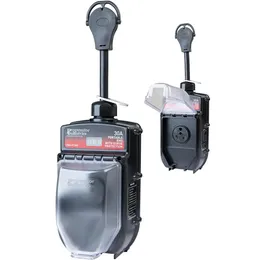
Progressive EMS-PT30X
Full EMS protection at the lowest sensible price, and it moves between rigs.
Best hardwired
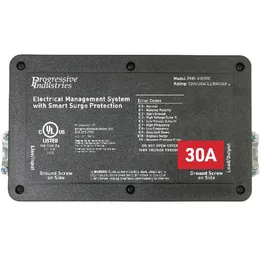
Progressive EMS-HW30C
Same protection permanently installed, with a remote display and stored error history.
Hardwired with monitoring
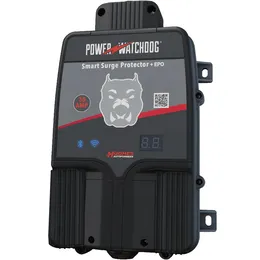
Power Watchdog Gen II Hardwired (30A)
WiFi and Bluetooth reporting from a unit that cannot be stolen.
Related guides
- Best RV surge protectors — eight units, both form factors, both amperages.
- EMS vs surge protector — settle this before worrying about form factor.
- Do I need one at all? — worth reading first if your rig might already have protection fitted.
- Progressive EMS-PT30X review — the portable we recommend most often, with its warranty small print.
- 30 amp vs 50 amp RV — buy for the right service whichever form factor you choose.
Questions worth answering
Is a hardwired surge protector better than a portable one?
Not at protecting. The same model families offer both, with identical protection. Hardwired is better at surviving — it cannot be stolen, cannot be rained on and cannot be left behind. Portable is better at flexibility and at being replaced when something goes wrong.
Can I install a hardwired RV surge protector myself?
If you are competent with 120V wiring and comfortable working in a distribution panel, yes. If either half of that sentence gives you pause, pay an RV technician. This is shore power at up to 50 amps, not a 12V accessory.
Do portable surge protectors get stolen often enough to worry about?
Often enough that every manufacturer builds in a lock point and every forum has threads about it. A portable EMS is several hundred dollars sitting unattended at a public post overnight. Use the lock ring.
What happens if a hardwired unit fails under warranty?
You uninstall it and ship it back. Progressive's warranty procedure requires the unit to be returned, so a hardwired failure means wiring work at both ends plus the time without protection. Portable units unplug.
Can I move a hardwired unit to a new RV?
Physically yes, but it is a removal and a reinstallation rather than an afternoon. And note that neither Progressive's nor Hughes' warranty transfers to a new owner, so selling the rig with it fitted ends the cover.
Do I still need to worry about voltage if it is hardwired inside?
Yes — the fault is at the pedestal, not in your rig, so where the protector sits changes nothing about what it detects. The only difference is that a hardwired unit is protected from the weather while it does it.