The EMS-PT30X is the unit most experienced RV owners end up recommending, and the specification explains why: full Electrical Management System behaviour, a graduated response to high voltage that most competitors do not document, and a lifetime warranty that pays your return shipping.
It is still the best protection per pound in the category. The reservations are not about how it protects — they are about the warranty’s conditions, and about a brand that has changed hands.
Who it is for
A good fit if you want the most protection per pound spent, you are content to read status at the pedestal, and you will buy from an authorised retailer and keep the receipt.
A poor fit if you want to see live voltage from inside the rig, or you are buying second-hand — the warranty, which is a substantial part of the value here, does not come with it.
The staged response nobody else documents
This is the technical detail that distinguishes the unit, and it rarely appears in reviews because it takes reading the manual to find.
Most protectors treat high voltage as a single threshold: above X, disconnect. Progressive grades its reaction to how bad the overvoltage is.
High-voltage response, as published
-
Above 132V — waits three seconds
Mildly high. Brief excursions are tolerated rather than nuisance-tripping your rig off a usable pedestal.
-
Above 140V — acts within one second
Now genuinely damaging territory, so the tolerance drops sharply.
-
Above 156V — disconnects within 60 milliseconds
This is open-neutral territory, where damage is measured in seconds. The unit stops waiting.
Low voltage is handled with a single threshold: below 104V sustained for more than six seconds. The asymmetry is sensible — low voltage damages equipment gradually through heat, high voltage can destroy it immediately.
For a device whose entire job is deciding when to act, publishing this is worth more than a joule rating. It is also the main reason we favour Progressive on the voltage rows in the head-to-head against the Power Watchdog.
The specification
| Surge protection | 1,790 joules, 44,000A max surge current |
| Protection modes | 3-mode: line-to-neutral, line-to-ground, neutral-to-ground |
| Service | 30 amp, 120V, 3,600W |
| Low voltage | Disconnects below 104V sustained over 6 seconds |
| High voltage | Staged: 132V / 140V / 156V |
| Fault detection | Open ground, open neutral, reverse polarity, AC frequency |
| Housing | Lexan, rated −40°C to +105°C |
| Display | On-unit digital error codes |
| Warranty | Lifetime, conditions below |
At 1,790 joules it has less surge headroom than the Power Watchdog’s 3,000 or the Surge Guard 34930’s 2,450. That is a real difference, but a secondary one — surges are the rarer threat and all three handle the common one.
The warranty reality
Progressive’s own warranty document is more restrictive than “lifetime warranty” suggests, and the conditions have caused owners genuine trouble.
What is good:
- Lifetime cover on defects in materials and workmanship
- PII pays return shipping on warranty claims, which is unusual and worth real money
- Technical support seven days a week
What to know before you buy:
- Non-transferable. Original owner only. A used unit has no warranty.
- Authorised dealers only. The warranty covers products bought from an authorised dealer, retailer or seller. Owners have reported claims refused on marketplace purchases.
- Driving off while plugged in is explicitly excluded. Which is a real scenario, and now an expensive one.
- Failure to keep the pedestal plug clean and maintaining a snug fit is excluded — and that is precisely the condition that causes resistance heating and kills these units.
- Liability is capped at the purchase price. It does not cover your appliances.
The Navico question
Progressive Industries is now part of Navico Group, following Brunswick’s acquisition of Navico and its subsequent merger with Brunswick’s Advanced Systems Group. The old progressiveindustries.net address redirects there.
That is a fair thing to ask about when the product’s main non-technical selling point is a lifetime commitment. A lifetime warranty is only worth what the company behind it chooses to honour, and the company behind this one is not the one that wrote the policy.
The honest answer is that the evidence is mixed. Forum threads titled “customer service A+++++” sit alongside threads titled “won’t stand by their product”. Owners report both outcomes, and there is no reliable way to tell from outside which you will get.
What we can say: the product line, model numbers and published specifications have carried over unchanged, and support runs through Navico’s power systems line.
What owners report
Reported by owners, not observed by us. Recurring themes across iRV2, Keystone Forums, Airstream Forums, Forest River Forums and Good Sam community discussion, August 2026.
What owners consistently praise
- It does the job it exists for The dominant positive theme is owners reporting the unit refused a bad pedestal or disconnected during a sag.
- Technical support is responsive Multiple owners report helpful phone diagnosis, and at least one thread is dedicated to praising the service.
- Error codes are readable Once owners learn the code list, the on-unit display is reported as genuinely useful for diagnosing a pedestal.
What comes up repeatedly as a complaint
- Display failures Reports of the screen going black while power continues to pass — leaving the owner unsure whether protection is active.
- Screen fogging in rain Condensation inside the display window is reported despite the weather-resistant design.
- Warranty claims refused The authorised-dealer condition catches people who bought through marketplaces, and this generates the angriest threads.
- Suspect units on arrival Some owners report units arriving dirty, re-boxed or with cord compression nuts only half-tightened.
That last theme is worth acting on rather than just noting: check the cord compression nuts are tight when the unit arrives. A loose one lets water in, and water ingress is not a warranty-covered failure if it traces back to installation condition.
The two-minute delay that is not a fault
The single most common false alarm with this unit.
Plug it in and nothing happens for around two minutes. No power to the rig. To a new owner this looks exactly like a dead unit, and a proportion of the “faulty on arrival” reports resolve when the owner learns what it is doing.
The unit is testing the pedestal before it will connect your rig to it — and after any fault, waiting before restoring power so an air conditioning compressor is not restarted against pressure. Both behaviours are the product working.
If it still shows nothing after several minutes, read the error code before concluding anything. Every Progressive code is listed in our error code guide.
Alternatives
The unit reviewed here
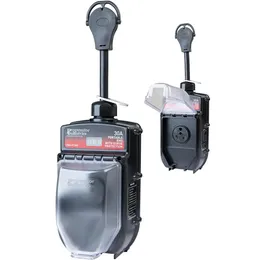
Progressive EMS-PT30X
Full EMS protection, staged voltage response, lifetime warranty with return shipping paid.
If you want monitoring
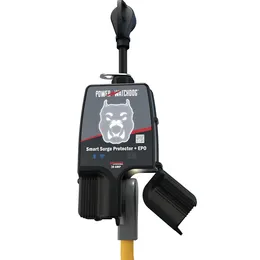
Power Watchdog Gen II (30A)
WiFi and Bluetooth reporting, replaceable surge module, at a considerable premium.
If you want the readout on the unit
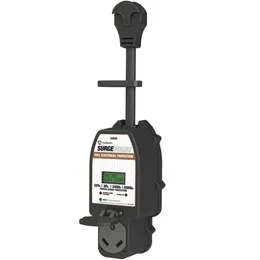
Surge Guard 34930
LCD showing live voltage and amp draw, plus connected-equipment warranty cover.
Hughes Power Watchdog Gen II is the monitoring alternative — WiFi and Bluetooth reporting, more surge headroom, a replaceable module, at a considerable premium. Compared directly in Progressive vs Power Watchdog.
Surge Guard 34930 splits the difference: an LCD on the unit showing live voltage and amp draw without needing a phone, plus overheating-receptacle detection that neither Progressive nor Hughes offers. Its headline connected-equipment warranty is much narrower than it sounds — we go through it in Surge Guard vs Progressive.
Progressive EMS-HW30C is the same protection wired in permanently, with a remote display inside the rig. Nothing to steal, nothing to forget, and it is named explicitly in the warranty document — though a warranty claim then means uninstalling it. That trade-off in full: hardwired vs portable.
The verdict
Still the default recommendation for a 30 amp rig, and still the best protection per pound in this category. The staged voltage response is genuinely better engineering than the competition documents, and paid return shipping on a lifetime warranty is a real benefit.
Buy it new, from an authorised retailer, and keep the receipt. Those are not incidental instructions — they are the difference between having the warranty you paid for and not.
And if what you actually want is to see what the pedestal is doing without walking to it, buy something else. This unit will not do that, and no amount of protection quality changes it.
Related guides
- Progressive vs Power Watchdog — the two head to head, with a verdict.
- Hughes Power Watchdog review — the monitoring alternative in detail.
- Best RV surge protectors — eight units across both amperages.
- RV surge protector error codes — the full E-code list for this unit.
Questions worth answering
Is the Progressive EMS-PT30X still worth buying?
For most 30 amp owners, yes. It remains the best protection per pound in the category — full EMS behaviour, a documented staged voltage response, and a lifetime warranty that includes return shipping. What it does not have is any form of remote monitoring.
Why does it take two minutes before power comes on?
That is the self-test and time delay working as designed, not a fault. The unit checks the pedestal before connecting, then waits before restoring power so an air conditioning compressor is not restarted against its own head pressure. New owners frequently mistake this for a defective unit.
Is the lifetime warranty transferable?
No. Progressive's warranty document states it is non-transferable and exclusive to the original owner, and covers only products bought from an authorised dealer, retailer or seller. A second-hand unit carries no warranty.
What voids the warranty?
Beyond the usual exclusions, two are worth knowing. Driving the RV away without unplugging the unit is explicitly excluded, and so is failure to keep the pedestal plug clean and snug — which is the exact condition that causes resistance heating.
Does Progressive still support these after the Navico acquisition?
Yes. Progressive Industries is now part of Navico Group, and warranty and technical support run through Navico's power systems line. Owners have reported both excellent service and refused claims, so the pattern is mixed rather than uniformly good or bad.
What is the difference between the PT30X and the PT30C?
They are different generations of the same portable 30 amp EMS. Worth noting because the warranty document we can cite lists the C-series models by name, not the X-series, so check which one your paperwork covers.