Progressive EMS-PT30X for protection. Surge Guard 34930 for information.
Progressive disconnects sooner at both ends of the voltage range and publishes a graduated high-voltage response nobody else documents. Surge Guard gives you more surge headroom, a live readout on the unit, and detection of an overheating pedestal receptacle — which is a fire risk neither of the other major brands checks for.
The one thing that should not decide it is the connected-equipment warranty, and that is the thing most buyers think decides it.
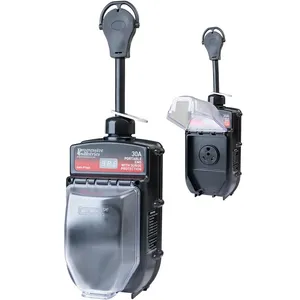
Progressive EMS-PT30X
EMS-PT30X
Tighter thresholds, staged response, more published detail.
$$$
Check price at Amazon(opens in a new tab)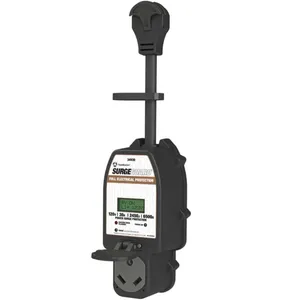
Surge Guard 34930
34930
More joules, live LCD readout, overheat detection.
$$$
Check price at Amazon(opens in a new tab)Specification by specification
| Specification | Progressive EMS-PT30X | Surge Guard 34930 |
|---|---|---|
| Joule rating Surge absorption capacity | 1,790 | 2,450 Better |
| Low-voltage cutoff Cutting at 104V tolerates less than cutting at 102V | Below 104V for more than 6 seconds Better | Below 102V for more than 7 seconds |
| High-voltage cutoff Staged, and starts at 132V rather than 136V | Above 132V (staged; immediate above 156V) Better | Above 136V for more than 7 seconds |
| Protection modes | 3-mode (L-N, L-G, N-G) | 3-mode (L-N, L-G, N-G) |
| Fault detection Surge Guard adds receptacle overheat and voltage-on-ground | Open ground, open neutral, reverse polarity, AC frequency | Open ground, open neutral, reverse polarity, voltage on ground, overheating receptacle, overcurrent Better |
| A/C compressor delay | Yes | 128-second reset delay |
| Display Live voltage and amps against status codes | Digital error-code display | LCD showing voltage and RMS amp draw Better |
| Anti-theft | — | Lock ring on cord Better |
| Operating temperature | -40°C to +105°C | — |
| Warranty Read the section below before trusting either headline | Lifetime, non-transferable, original owner only, and only on units bought from an authorised dealer or retailer Better | Limited lifetime, plus a connected-equipment warranty with substantial conditions — see below |
| Price | $$$ | $$$ |
Thresholds: the difference that matters daily
Both units disconnect on out-of-range voltage. They disagree about where the range ends, and that disagreement is not trivial.
| Progressive EMS-PT30X | Surge Guard 34930 | |
|---|---|---|
| Low cutoff | Below 104V, sustained 6 seconds | Below 102V, sustained 7 seconds |
| High cutoff | Above 132V — staged, faster the worse it gets | Above 136V, sustained 7 seconds |
Progressive is the more cautious device at both ends. Two volts at the bottom and four at the top sound marginal, but they define the band of bad supply your air conditioner is asked to run on before anything intervenes.
Progressive also grades its high-voltage reaction — three seconds above 132V, one second above 140V, and 60 milliseconds above 156V. Surge Guard applies a single seven-second delay across the board. Above 156V, seven seconds is a long time.
The overheat detection is genuinely worth something
Surge Guard’s 34930 monitors for an overheating plug or receptacle and
displays RECEPT OVERHEAT.
This deserves more attention than it gets. A pedestal receptacle whose contacts have loosened over twenty years develops resistance, resistance produces heat, and heat at a 30 amp connection is how pedestal fires start. You cannot see it, the voltage looks fine, and no purely electrical fault is present for a voltage-based EMS to detect.
Progressive does not list this capability. If your camping is mostly older parks, it is a real argument for Surge Guard — arguably a better one than the joule difference.
The warranty most people buy it for
Surge Guard’s headline is a limited lifetime warranty including connected equipment coverage — cover for the appliances damaged through the unit, not just the unit. Progressive caps liability at the purchase price. On paper that looks decisive.
We read Southwire’s warranty document. It is not decisive.
What the connected-equipment warranty excludes:
- Damage caused by sustained low voltage. Stated twice — in the exclusions and again as a nullification condition. This is the most common way park power damages an RV.
- Direct lightning strikes. “No surge protector will protect against a direct lightning strike thus voiding all warranties.”
- Anything covered by your home or renters insurance — Southwire’s liability is limited to losses not covered by such a policy, you must claim there first, and you must hand Southwire your insurance details.
- Anything where the unit was daisy-chained with adaptors, extension cords or other protectors. RV owners routinely use dogbone adaptors.
- Satellite dishes and receivers.
And the conditions on what remains:
- It pays only where Southwire determines, in its sole discretion, that the protector did not function properly because it was defective — so it covers their manufacturing failure, not your bad pedestal.
- The protector must show clear signs of damage, and both it and the damaged equipment must be shipped to Southwire at your cost for inspection.
- One claim per household.
One point in Southwire’s favour: its warranty is transferable if the unit was factory-fitted to the RV, passing with the coach. Progressive’s transfers under no circumstances. For a retrofit unit you bought yourself, neither transfers.
None of this makes Surge Guard a bad product. It makes the warranty a bad reason to choose it.
The display difference
Progressive shows status and numbered error codes. Surge Guard’s LCD
continuously alternates between live voltage and amp draw, and the fault
messages are written in English — L1 LOW WAS 99V rather than E-4.
For diagnosing a pedestal, Surge Guard’s readout is easier. For knowing how much current you are drawing — genuinely useful on a 30 amp rig where 3,600 watts goes quickly — Surge Guard tells you and Progressive does not.
Both require walking to the post. Neither is a substitute for app monitoring, which is a different comparison entirely.
Which one
Stop at the first line that matches.
-
You want the tightest voltage protection available
Progressive EMS-PT30X
Cuts sooner at both ends, and the staged high-voltage response is better engineering than a single threshold.
-
You camp mostly at older parks with ageing pedestals
Surge Guard 34930
Receptacle overheat detection addresses a real hazard that no voltage-based EMS will catch.
-
You want to see your actual current draw
Surge Guard 34930
Live amps on the display is genuinely useful on 30 amp service. Progressive does not show it.
-
You are choosing based on the connected-equipment warranty
Choose on something else
Read the exclusions above. It will not cover the scenario you are imagining.
-
You want monitoring from inside the rig
Neither — look at the Power Watchdog
Both of these need you at the pedestal to read anything.
The verdict
Progressive EMS-PT30X if you are optimising for protection. It intervenes sooner at both ends of the voltage range, documents its behaviour in more detail, and its warranty — though narrower than the phrase “lifetime” implies — at least covers the unit rather than voiding when the unit works.
Surge Guard 34930 if you value information and camp where pedestals are old. The live voltage and amp readout is more useful day to day, and overheat detection covers a genuine hazard the others ignore.
They are close, and either is a substantially better purchase than a basic surge suppressor. Just do not let the warranty language pick for you.
Related guides
- Best RV surge protectors — eight units across both amperages, including Hughes and hardwired options.
- Progressive EMS-PT30X review — the unit in detail, and its own warranty small print.
- Progressive vs Power Watchdog — if app monitoring is what you actually want.
- RV surge protector error codes — both brands’ codes and messages, side by side.
- 9 buying mistakes — the warranty pattern across all three major brands, summarised.
Questions worth answering
Does the Surge Guard connected-equipment warranty actually pay out?
Rarely, on the evidence of its own terms. It excludes damage from sustained low voltage and from direct lightning, pays only where Southwire judges its own protector was defective, requires you to claim on home insurance first, and allows one claim per household. Low voltage is the most common cause of RV electrical damage, so the main scenario is out.
Which brand cuts power sooner?
Progressive. It disconnects below 104V against Surge Guard's 102V, and above 132V against Surge Guard's 136V. Cutting sooner means tolerating less bad supply, which is the point of the device.
Which has more surge protection?
Surge Guard, at 2,450 joules against Progressive's 1,790. That is real headroom, though joules only measure surge absorption capacity, not protection against the voltage problems that cause most damage.
Is the Surge Guard LCD worth it over Progressive's error codes?
If you want to see live voltage and current, yes — Surge Guard shows both continuously, Progressive shows status and error codes. Both need you to walk to the pedestal, so neither replaces app monitoring.
Does either warranty transfer if I sell the RV?
Progressive's does not. Southwire's does not either, with one exception — if the unit was factory-fitted to the RV it transfers with the coach. Retrofit units bought by you do not transfer.
Which brand detects an overheating pedestal?
Surge Guard. The 34930 includes receptacle temperature detection, which Progressive does not list. A pedestal receptacle that has been arcing for years is a genuine fire risk, so this is a meaningful feature rather than a specification-sheet line.