Most bad purchases in this category come from three places: comparing the wrong number, believing a product name, and trusting a warranty headline without reading the document behind it.
Everything below comes from manufacturer documentation we have read directly while building this section of the site — spec sheets, instruction manuals and warranty PDFs from Progressive Industries, Hughes and Southwire.
The nine mistakes
-
Comparing units on joule ratings
Why it happens It is the one number every listing shows, and bigger obviously looks better. It is also the easiest specification to compare across products that are not comparable.
Do this instead Compare joules only within a class. Between an EMS and a basic suppressor the figure is close to irrelevant — check whether the unit disconnects on low voltage first, then look at joules.
The Camco 55301 publishes 2,800 joules against the Progressive EMS-PT30X's 1,790, yet the Progressive is far more protective because it disconnects on bad voltage and the Camco has no such logic.
-
Buying a surge protector when you needed an EMS
Why it happens The category is named after surges, so buyers assume surges are the threat. They are the rarest of the threats.
Do this instead Buy an Electrical Management System unless your exposure is genuinely low. Sustained low voltage on a busy campground afternoon is the common damage mechanism, and a basic suppressor ignores voltage entirely.
-
Assuming your rig already has protection because it has a transfer switch
Why it happens Transfer switches sit in the same bay, look similar, and in Southwire's case carry the Surge Guard brand name on the box.
Do this instead Read the model number, not the brand. Then check your build sheet for whether protection was specified — it is frequently a cost option manufacturers did not fit.
Surge Guard 41300 (30A) and 40100 (50A) are basic automatic transfer switches with no surge protection at all.
-
Trusting the warranty headline
Why it happens "Lifetime warranty" and "connected equipment coverage" are strong phrases, and almost nobody reads the document behind them — including, until recently, us.
Do this instead Read the actual warranty PDF before letting it influence the decision. The table below summarises what we found for all three major brands.
We corrected three of our own published pages after reading these documents.
-
Buying second-hand to save money
Why it happens These units hold value and appear regularly on marketplaces, often barely used.
Do this instead Buy new unless the discount is steep enough to write the warranty off entirely. You are purchasing a device whose main non-technical value is its warranty, without the warranty.
Progressive's warranty is non-transferable and original-owner only. Hughes' is original-purchaser only. Southwire's transfers only if the unit was factory-fitted to the RV.
-
Buying from whichever seller is cheapest
Why it happens The unit is identical, so the seller looks irrelevant.
Do this instead Buy from an authorised dealer or retailer and keep the dated receipt. Both Progressive and Southwire limit warranty cover to products bought through authorised channels.
Progressive owners have reported warranty claims refused on marketplace purchases.
-
Buying a 50 amp unit for a 30 amp rig, or adapting one down
Why it happens Bigger sounds like more headroom, and adapters make it physically possible.
Do this instead Count the pins on your shore power cord — three is 30 amp, four is 50 amp — and buy to match. An adapter changes the plug shape and nothing else.
-
Buying a model the manufacturer has already replaced
Why it happens Retailers keep selling old stock long after a range is superseded, and the listings do not say so.
Do this instead Check the manufacturer's own product page before buying, not just the retailer's.
Hughes' Bluetooth-only Power Watchdog units remain widely stocked but no longer appear on Hughes' site, which now lists only the Gen II WiFi range.
-
Leaving a portable unit unlocked at the pedestal
Why it happens It feels like a low-crime environment, and the lock is an extra ten seconds at the end of a long drive.
Do this instead Use the lock ring or bracket every time. Every serious portable unit has one, which tells you how common the problem is.
The warranty pattern
We read the warranty documentation for all three major brands. In every case the cover is narrower than the phrase used to sell it — and in one case the warranty ends at the moment the product does its job.
| Brand | What it says | What the document says |
|---|---|---|
| Progressive Industries | “Lifetime warranty” | Non-transferable, original owner only, authorised sellers only. Excludes driving off while still plugged in, and failing to keep the pedestal plug clean and snug. Liability capped at purchase price. Return shipping paid by PII |
| Hughes / Power Watchdog | “Limited lifetime warranty” | Original purchaser only, does not transfer. Power Centers carry a 3-year term rather than lifetime |
| Southwire / Surge Guard | “Limited lifetime + connected equipment coverage” | Connected-equipment cover excludes sustained low voltage and direct lightning, pays only where Southwire judges its own unit defective, requires you to claim on home insurance first, one claim per household. The lifetime warranty is void once the unit sacrifices itself |
None of this means the warranties are worthless, or that these are bad products. It means the warranty should be worth roughly what the document says, not what the box says — and on that basis it is rarely the tiebreaker people treat it as.
A pre-purchase checklist
Ten minutes before you spend anything
-
Confirm your service
Count the pins on your shore power cord. Three is 30 amp, four is 50 amp. Buy to match, not to the pedestal you happen to use.
-
Check what the rig already has
Find the transfer switch, read its model number, and check the build sheet. Some rigs are already protected; many owners believe they are and are not.
-
Decide EMS or basic, deliberately
If the budget reaches an EMS, buy the EMS. A basic suppressor is a reasonable purchase only when the alternative is nothing.
-
Confirm the model is current
Look it up on the manufacturer's own site, not the retailer's. Superseded ranges stay on shelves for a long time.
-
Read the actual warranty document
Not the retailer's summary. Check transferability, whether authorised-dealer purchase is required, and what is excluded.
-
Buy from an authorised seller and keep the receipt
This is the difference between having the warranty you paid for and not having it.
If you have avoided all nine
Avoids most of these mistakes
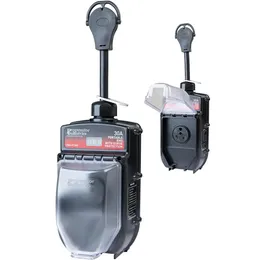
Progressive EMS-PT30X
Full EMS, published thresholds, clear warranty terms — for a 30 amp rig.
The 50 amp equivalent
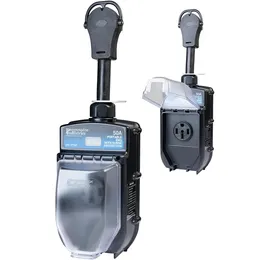
Progressive EMS-PT50X
Same protection logic across both legs.
For the full comparison across brands, amperages and form factors, see the best RV surge protectors.
Related guides
- Do I need one at all? — start here if you have not confirmed what your rig already has.
- EMS vs surge protector — the decision behind mistake two.
- Best RV surge protectors — eight units compared on published specifications.
- Surge Guard vs Progressive — the warranty documents in full.
- 30 amp vs 50 amp RV — the sizing mistake, explained properly.
Questions worth answering
What is the single most common mistake?
Comparing on joule ratings. It is the easiest number to line up and it describes only surge absorption capacity, not protection against the voltage problems that cause most RV electrical damage. A 2,800-joule basic unit protects you less than a 1,790-joule EMS.
Are the warranties on these products worth anything?
They are worth something, but consistently less than the headline implies. Every major brand's warranty is non-transferable, most require purchase from an authorised seller, and Southwire's connected-equipment cover excludes the two scenarios most buyers imagine it is for.
How do I know if I am buying a superseded model?
Check the manufacturer's own website rather than the retailer's. Hughes' Bluetooth-only Power Watchdog range is still widely stocked but no longer appears on Hughes' site, having been replaced by the Gen II WiFi range.
Does buying a bigger unit than I need help?
No. A 50 amp protector on a 30 amp rig gives you 30 amps, a larger object to store, and a higher price. Buy for your rig's service, which you can identify by counting the pins on your shore cord.
Is it worth buying used to save money?
Rarely. Neither Progressive's nor Hughes' warranty transfers to a second owner, and Southwire's transfers only if the unit was factory-fitted to the RV. You are buying a device whose main non-technical value is its warranty, without the warranty.
My new unit does not seem to work. Is it faulty?
Probably not. Both Progressive and Surge Guard units run a self-test and time delay before passing power — around two minutes on a Progressive, 128 seconds on a Surge Guard. A proportion of "dead on arrival" reports are this behaviour working correctly.