Pick your service, tick what runs at once, and the calculator tells you whether it holds — in amps against your actual limit, with the start-up surge modelled separately, because that momentary spike is what trips a breaker far more often than the running total does.
On 30 amp you have one 120V circuit and 3,600 watts. On 50 amp you have two 120V legs of 6,000 watts each, and the calculator splits your loads across them, because 12,000 watts total does not mean 12,000 watts available to whichever leg your air conditioner happens to sit on. That distinction is the one most load calculators skip.
Step 1 of 3
Which service does your rig have?
Count the pins on your shore power cord — three means 30 amp, four means 50 amp. This is your rig's service, not the pedestal you happen to be parked at.
Step 2 of 3
Tick everything that could run at the same time
Not everything you own — everything that could be on together on a hot afternoon. Change any wattage to what your own appliance label says.
| Include | Appliance | Watts | Amps |
|---|---|---|---|
| The single biggest load on almost every rig, and the one that trips breakers on start-up | — | ||
| Two air conditioners is effectively a 50A-only proposition | — | ||
| Switch to propane and this whole row disappears | — | ||
| Draws most when the batteries are low, tapering as they fill | — | ||
| On propane instead, this is nearly nothing | — | ||
| — | |||
| A "1,000W" microwave draws about 1,500W from the outlet | — | ||
| — | |||
| — | |||
| — | |||
| — | |||
| — | |||
| — | |||
| On high. Most have a 750W setting that changes the answer | — | ||
| — | |||
| — | |||
| — | |||
| — | |||
| Anything else — type it in | |||
| — | |||
| — | |||
Step 3 of 3 — the verdict
—
The part that targets the start-up spike
Micro-Air EasyStart Breeze RV Soft Starter
Cuts compressor start-up current 50–70% per Micro-Air's FAQ
Check price at Micro-Air(opens in a new tab)Protection sized to your service

Camco PowerGrip 55301 30-Amp Voltage Protector with Surge Protection
30A · surge only · portable · 2,800J
Check price at Amazon(opens in a new tab)
Hughes Power Watchdog Gen II PWD30EPOHW Hardwired Smart Surge Protector
30A · full EMS · hardwired · 3,000J · Bluetooth
Check price at Amazon(opens in a new tab)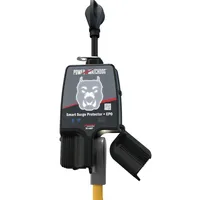
Hughes Power Watchdog Gen II PWD30EPOW Smart Surge Protector with Auto Shutoff
30A · full EMS · portable · 3,000J · Bluetooth
Check price at Amazon(opens in a new tab)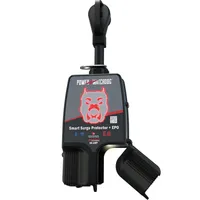
Hughes Power Watchdog Gen II PWD50EPOW Smart Surge Protector with Auto Shutoff
50A · full EMS · portable · 4,600J · Bluetooth
Check price at Amazon(opens in a new tab)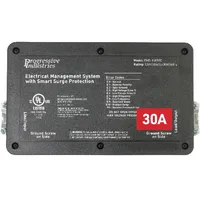
Progressive Industries EMS-HW30C Hardwired Electrical Management System
30A · full EMS · hardwired · 1,790J
Check price at Amazon(opens in a new tab)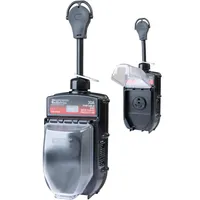
Progressive Industries EMS-PT30X Portable Electrical Management System
30A · full EMS · portable · 1,790J
Check price at Amazon(opens in a new tab)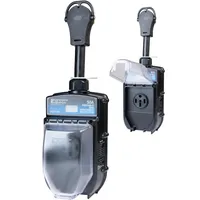
Progressive Industries EMS-PT50X Portable Electrical Management System
50A · full EMS · portable · 3,580J
Check price at Amazon(opens in a new tab)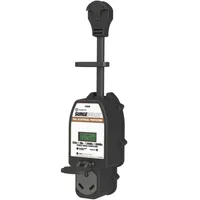
Southwire Surge Guard 34930 Full Protection Portable with LCD Display
30A · full EMS · portable · 2,450J
Check price at Amazon(opens in a new tab)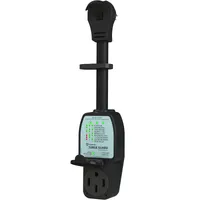
Southwire Surge Guard 44290 Portable Surge Protector with Enhanced Diagnostics
50A · full EMS · portable · 4,200J
Check price at Amazon(opens in a new tab)Arithmetic on the wattages you entered, at 120V, against the published capacity of each service. Appliance figures are typical, not measured; a breaker's real trip point depends on its temperature and age. Nothing here is a substitute for your own panel labels.
What the calculator is doing
Four steps, all of it arithmetic you can check:
- Amps = watts ÷ 120. Every RV appliance runs at 120V, on both services. A 1,500W air conditioner is 12.5 amps.
- The running total is everything ticked, added up. On 30 amp that goes against a single 30 amp limit. On 50 amp it is split across two legs of 50 amps each.
- The start-up moment is the running total plus the worst single surge on your list — the extra current one motor pulls as it starts while everything else is already going. Air conditioners are modelled at 3.5× their running draw for that instant, other compressors at 3×, and a washer/dryer motor at 2×. A soft starter, if you tick it, cuts that extra by 60% — the middle of Micro-Air’s published 50–70%.
- The comfortable line at 80% of the supply. A breaker is a thermal device: it will carry 95% of its rating for a while and then open on a hot afternoon with nothing having changed. The calculator marks that line and treats anything above it as tight rather than fine.
On the third point, the calculator is deliberately less alarmist than most. A breaker’s instantaneous trip threshold sits many times its rating, so a compressor’s fraction-of-a-second inrush is normally ridden out without complaint — that is why motors work at all. It only warns about the start-up spike when the sustained load has already eaten the thermal margin, above about 70% of the supply. If your running total is comfortable, a big peak figure is not something to act on, and the calculator says so.
The 3,600W and 12,000W figures are not our arithmetic alone — Progressive Industries publishes exactly those as the maximums for its 30 amp and 50 amp EMS units, which is the equipment built for each service.
The surge is the part nobody accounts for
Here is the pattern that produces most “my breaker trips for no reason” posts. Your load is fine. You have 28 amps of a 30 amp supply and it has been running happily for an hour — long enough for the breaker to be thoroughly warm. Then the air conditioner’s compressor cycles back on and briefly pulls several times its running current. The breaker opens.
The important nuance, and the reason the calculator does not flag this on every rig: that same inrush at 15 amps of running load would have been absorbed without complaint. A breaker is a thermal device with an instantaneous trip set many times above its rating, so brief surges are exactly what it is built to tolerate. What it cannot tolerate is a brief surge on top of a sustained load that has already used up its margin. The spike is the trigger; the sustained load is the cause. Three practical consequences:
- Order matters. Start the air conditioner first, let the compressor settle, then run the microwave. Free, and it solves a lot of trips.
- Cycling is worse than continuous. An air conditioner that reaches temperature and cycles is starting repeatedly, so each cycle is another chance to trip. Running it slightly colder and continuously can be more reliable than letting it cycle against a tight supply.
- A soft starter removes the problem rather than managing it. It is the one purchase on this page that changes what you can run, and the calculator only suggests it when your running load fits and the spike is the sole reason you would trip.
On a generator rather than a pedestal the same surge is a sizing question instead of a tripping one, and it is answered from a different document: what size generator an RV air conditioner needs works from Dometic’s published minimum, then subtracts what altitude and heat take off the generator.
30 amp: one circuit, and one big appliance at a time
Thirty amps at 120V is 3,600 watts, in a single circuit. The useful way to think about it is that your air conditioner takes about 1,500W of that and leaves you roughly 2,000W for everything else — which is exactly one heating appliance, not two.
| Combination on 30A | Watts | Amps | Verdict |
|---|---|---|---|
| A/C + lights + TV + converter | 2,350 | 19.6 | Comfortable |
| The above + absorption fridge on electric | 2,700 | 22.5 | Comfortable |
| A/C + water heater + lights + TV + converter | 3,750 | 31.3 | Over the limit — trips |
| Everything electric: A/C, water heater, fridge, converter, lights, TV | 4,100 | 34.2 | Trips |
| A/C + microwave + lights + TV | 3,350 | 27.9 | Runs — until the A/C compressor restarts |
| Water heater + microwave + lights + TV, no A/C | 3,250 | 27.1 | Fits — this is the trade you are making |
The fourth row is the calculator’s starting state, and it is deliberately the most common real configuration: everything switched to electric because shore power is “free”. It is also 4.2 amps past what the supply can give you. The third row shows that the electric water heater alone is enough to do it — which leads to the cheapest fix on this page.
50 amp: two legs, and why balance beats total
A 50 amp supply is not one big circuit. It is two 120V legs at 50 amps each, and your distribution panel assigns some circuits to one leg and some to the other. Each leg tops out at 6,000W.
That means the honest question is not “am I under 12,000 watts?” but “is either leg over 6,000?” Two air conditioners and an electric water heater on the same leg is 4,600W before anything else joins them — fine on paper against a 12,000W total, and uncomfortably close to a single leg’s limit.
The calculator balances your loads as evenly as the arithmetic allows and shows both legs. Your rig’s real split is fixed by its panel and may be worse than that. If you have ever tripped one leg while the other side of the coach carried on working, this is the reason. Worth spending ten minutes with the panel labels once, so you know which side your heavy circuits are on.
The propane trick, which costs nothing
Two of the biggest draws on most rigs do not have to be electric at all:
- The water heater element is about 1,400W — nearly 12 amps, a third of a 30 amp supply. On propane it is essentially zero.
- An absorption fridge on electric is around 350W. On propane, near nothing. On either supply it wants the rig level — Norcold allows its refrigerators 3° side to side, and our leveling block calculator turns that into blocks.
Switching both takes the calculator’s starting configuration from 34.2 amps to 19.6 — from tripping to comfortable, with no purchase and no compromise beyond remembering to flip them. Try it: untick those two rows and watch the verdict change. The heat then comes from the cylinder instead, and our propane calculator shows how many days a cylinder lasts with it.
This is the honest first answer to “what can I run at once”, and it is why the calculator suggests it before it suggests buying anything. If you take away one thing from this page and it is “put the water heater on propane when it is hot”, the page has done its job.
Why voltage sags, and what that has to do with your load
There is a second failure mode that a load calculation does not show, and it is the one that actually destroys equipment.
On a hot afternoon, a campground’s supply sags under the total load of every rig in the park. Your pedestal voltage drops — 108V, sometimes lower — and that has nothing to do with your own consumption. Low voltage is dangerous to motors specifically: an air conditioner compressor fed under-voltage draws more current to do the same work, heats up, and eventually fails. The appliance you would most like to protect is the one most at risk.
A long extension cord takes more off on top of the park’s sag — 5.6 V at 30 amps through a 25 ft shore cord and a 50 ft extension. Our extension cord calculator works it out for your run, and shows why a portable EMS at the pedestal cannot see it.
This is the distinction between the two things people call “a surge protector”:
- A surge protector watches for voltage spikes and clamps them. Useful, cheap, and blind to a sag.
- An EMS monitors voltage continuously and disconnects your rig when it goes out of range, reconnecting when it recovers. That is the feature that matters at a busy park in August.
Both are compared properly in EMS vs surge protector, and the calculator ranks EMS units first for this reason. And buy for your rig’s service, not the pedestal you are visiting: a 50 amp unit adapted down to 30 is a bigger, costlier object delivering exactly 30 amps.
Five ways the sums go wrong
- Adding up everything you own. The number that matters is what runs simultaneously on a hot afternoon, which is a much shorter list.
- Using the microwave’s cooking power. A “1,000W” microwave draws about 1,500W from the outlet. That 500W gap has tripped a lot of breakers.
- Treating 50 amp as one 12,000W circuit. It is two 6,000W legs, and the balance is set by your panel, not by you.
- Ignoring the converter. It draws hardest exactly when you have just arrived, plugged in, and turned everything on with low batteries.
- Expecting a surge protector to add capacity. It protects; it does not supply. The only product here that changes what you can run is the soft starter, and only by removing a spike.
The products this points at
Three purchases follow honestly from the calculator, and one of them is usually unnecessary:
Full EMS for a 30A rig
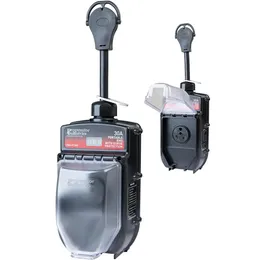
Progressive EMS-PT30X
Disconnects on low voltage, which is what a busy park under load actually does to you.
Full EMS for a 50A rig
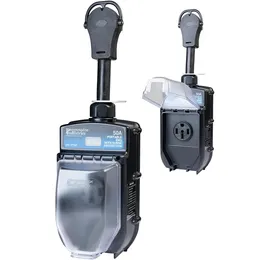
Progressive EMS-PT50X
3,580 joules and both legs monitored, including the open neutral that damages a whole rig.
Stops the air conditioner tripping the breaker
EasyStart Breeze
Cuts compressor start-up current 50–70%, which is the spike this calculator flags.
The 30A floor, if an EMS is out of reach

Camco 55301
Surge and a voltage cutoff without the EMS price — the minimum, not the recommendation.
Related guides
- 30 amp vs 50 amp RV — the connectors, the two legs, and the adapter misconception, in full.
- Best RV surge protectors — eight units across both services, compared on joules, cutoffs and warranty.
- EMS vs surge protector — the more important question of which type you actually want.
- Why your RV breaker keeps tripping — the diagnostic version of this page, for when the load is not the cause.
- Can you run an RV air conditioner on batteries? — the same air conditioner, the other side of the transfer switch.
- RV battery calculator — the equivalent arithmetic for when you unplug and run off the bank.
- The electrical section collects everything published so far.
For how products on this site are selected and what we do not claim about them, see the editorial policy.
Questions worth answering
What can you run on 30 amp RV service?
Three thousand six hundred watts, total — 30 amps at 120 volts. In practice that is your air conditioner plus about 2,000W of everything else, so an air conditioner and a microwave together is fine for a couple of minutes, and an air conditioner plus an electric water heater plus a microwave is not. The reliable combination is one big heating appliance at a time on top of the air conditioner.
Can I run my air conditioner and microwave at the same time on 30 amp?
Usually yes, briefly. A 13,500 BTU air conditioner runs at roughly 1,500W and a "1,000W" microwave draws about 1,500W from the outlet, so together they are near 3,000W of your 3,600W — tight but inside it. What catches people is the order of operations: if the air conditioner's compressor starts while the microwave is already running, the momentary surge can push past 30 amps and trip the breaker. Start the air conditioner first, let it settle, then use the microwave.
How many amps does my RV use?
Add up the wattage of everything running at once and divide by 120. A 30 amp rig with the air conditioner, the water heater and fridge on electric, the converter charging and normal lights and electronics comes to about 4,100W — 34.2 amps, which is past what the supply can give and exactly why that combination trips. Switch the water heater and fridge to propane and the same rig drops to 2,350W, or 19.6 amps.
How many watts can a 30 amp RV handle?
3,600W is the nameplate figure, and Progressive Industries publishes exactly that as the maximum for its 30 amp EMS. Treat about 2,900W as the number you can sit at all afternoon, though — breakers are thermal devices, and one that has been carrying 95% of its rating in the heat will eventually open even though nothing changed.
Is 50 amp service really 12,000 watts?
Total, yes, but not in one lump. A 50 amp supply is two separate 120V legs of 50 amps each, so it is 6,000W per leg and your distribution panel decides which circuits sit on which leg. If both air conditioners and the water heater happen to land on the same leg, you can trip that leg at 6,000W while the other side is barely used. The total is real; the availability depends on the balance.
Why does my breaker trip when the air conditioner starts but not while it runs?
Because starting a compressor draws several times the current of running one, for a fraction of a second. On its own that inrush is harmless — a breaker's instantaneous trip is set well above its rating precisely so motors can start. It becomes a trip when the sustained load has already used up the breaker's thermal margin, which is why this happens on a hot afternoon with the water heater on and not on a cool morning. Either shed load, or fit a soft starter: Micro-Air publishes a 50 to 70% reduction in start-up current on the EasyStart Breeze, which removes the spike without giving up any appliance.
Will a bigger surge protector let me run more?
No, and this is worth being clear about because the two things get confused constantly. A surge protector or EMS protects your rig from the pedestal — surges, low voltage, miswiring, an open neutral. It does not add capacity. Buying a 50 amp protector for a 30 amp rig gets you a larger, more expensive object and exactly 30 amps of usable power.
Does a 50 amp to 30 amp adapter give me more power?
No. Plugging a 30 amp rig into a 50 amp pedestal through an adapter still gives you 30 amps, because your rig's cord, breaker and panel are the limit. The adapter changes the plug shape, not the capacity. It does often give you *better* power — a 50 amp pedestal is usually on a less loaded circuit — but the amp figure is unchanged.
Should I get a hardwired or portable surge protector?
Portable is easier and moves between rigs; hardwired cannot be stolen off the pedestal and does not sit in the weather. Theft is the deciding factor for most people, since a portable unit at an unattended site is a visible $200–400 object on the end of a cord. The calculator lets you filter to either, and both types appear in the roundup.
What actually causes low voltage at a campground?
Everyone else's air conditioners. On a hot afternoon a park's supply sags under total load, and voltage drops across the whole loop — nothing to do with your own consumption. Sustained low voltage is what kills air conditioner compressors, because a motor fed under-voltage draws more current to do the same work and overheats. That is the case for an EMS that disconnects, rather than a surge protector that only watches for spikes.