Yes — with a 3,000W inverter, a soft starter on the air conditioner, and a battery bank most rigs do not carry. The parts to do it are on this page, and they work. The honest arithmetic is also on this page, and it is why most owners end up running everything except the air conditioner on batteries: at a typical 1,500W running draw, every hour of compressor time costs a 12V bank roughly 138Ah — an entire 100Ah battery every 45 minutes or so.
Air conditioning on batteries is not a trick question about equipment. It is a budget question about energy, and it deserves real numbers instead of the “yes, just add a soft starter” the topic usually gets.
It is two problems, not one
Every discussion of this topic collapses two very different problems into one question.
The start problem is electrical: an RV air conditioner’s compressor draws several times its running current for the moment it starts, and that spike defeats inverters whose surge ratings are shorter than they look. This problem is solvable, cheaply, and the fix is a genuine buy-it-once part.
The energy problem is arithmetic: cooling is one of the most power-hungry things an RV does, continuously, for hours. This problem is not solvable with a gadget — only with battery capacity, and the numbers get large quickly.
Answer the first without the second and you build a system that starts the air conditioner perfectly, runs it beautifully, and is flat before dinner.
The start problem, and the part that fixes it
A 13,500 BTU rooftop unit runs at roughly 1,300–1,700W, but its compressor start pulls far more for a fraction of a second. Inverter surge windows are shorter than buyers assume — Renogy’s 6,000W is rated for one second, Xantrex’s 4,000W for five — and a hard compressor start on a hot roof is exactly the event that trips them.
The fix is a soft starter wired to the compressor: it ramps the motor up instead of slamming it across the line. Micro-Air’s EasyStart Breeze is the documented pick — the product page claims up to 75% starting current reduction (its FAQ says 50 to 70%, and we note both), it is rated for all RV rooftop units, and Micro-Air states that close to 80% of buyers install it themselves. One unit per air conditioner.
One buying note from the documentation: the EasyStart 364 that older articles still recommend is superseded — its product page now redirects to the Breeze, and Micro-Air’s own selector routes every RV rooftop unit to the newer model.
The energy problem, which nothing fixes
Here is the arithmetic, with its assumptions in the open: a 13,500 BTU unit running at a typical 1,500W, drawn through an inverter at 85% full-load efficiency from a 12.8V bank, costs about 138Ah for every hour the compressor actually runs.
| Bank | Continuous compressor time |
|---|---|
| 1 × 100Ah battery | ~40 minutes — and a 100A BMS cannot feed the load anyway |
| 2 × 100Ah (200Ah) | ~1.4 hours |
| Battle Born GC3 (270Ah) | ~2 hours |
| 3 × 100Ah (300Ah) | ~2.2 hours |
| 600Ah bank | ~4.3 hours |
Compressor time is not clock time: on a mild evening the unit cycles and you get perhaps double these hours on the clock; in the afternoon heat that actually motivates this project, the compressor runs close to continuously and the table reads as written. Cooler climates, a small high-efficiency unit, or aggressive pre-cooling shift the numbers — the method stands either way, and it is the same watt-hours arithmetic as sizing the rest of the bank. The air conditioner is a row in the RV battery calculator for exactly this reason — set its hours and watch what happens to the bank.
That is the whole story of why this is rare: the soft starter costs a few hundred dollars; the hours cost a battery bank.
The parts list, if you are doing it
The soft starter
EasyStart Breeze
Cuts compressor starting current by up to 75% per Micro-Air — the part that makes the start survivable.
The inverter
Renogy 3000W P2
A true 3,000W continuous, which is what a 13,500 BTU unit's running load plus margin requires.
The single-battery bank
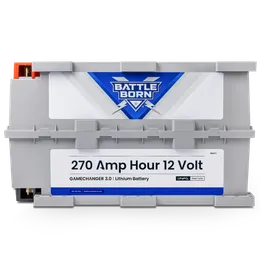
Battle Born BBGC3
270Ah with a 300A BMS — the one-case route to a bank that can actually feed this system.
- Inverter: a true 3,000W — the running load plus margin. Our pick and the reasons are in the Renogy 3000W review; the alternatives are in the roundup.
- Bank: at least 300A of continuous BMS rating to feed it — three 100Ah batteries in parallel or a GC3 — and as many amp hours beyond that as the runtime table demands.
- Soft starter: the EasyStart Breeze, one per air conditioner.
- Copper: 4/0 AWG cable and a 400A Class T fuse, per the inverter manual — the DC-side arithmetic covers why.
- If the converter is being replaced in the same project, fold it in properly: inverter vs inverter/charger.
When it genuinely makes sense
- Travel-day bursts. Pre-cool at lunch stops without running a generator. A DC-DC charger feeding 400–600W back while driving stretches the window — the compressor still outruns it three to one.
- Big-solar rigs that can refill 300–600Ah daily and treat afternoon cooling as a spendable surplus.
- Generator-restricted places — quiet hours and generator bans are when a silent two hours of cooling is worth what the bank costs.
For everyone else the economics point the other way: run the microwave, the coffee maker and everything else on a right-sized inverter, and give the air conditioner the pedestal or a generator. The soft starter is still worth fitting — it is what lets a weak pedestal, a small generator, or two air conditioners on a 30A cord work at all.
If the generator is the plan, size it on Dometic’s own published figure rather than a starting-watt chart: what size generator an RV air conditioner needs is 3.5 kW by Dometic’s minimum, before altitude and heat take their cut — and a 4,500-watt unit is already short of it on a 95°F day.
Related guides
- Best RV inverters — the seven units compared, including the two that could anchor this system.
- What size inverter do I need? — the bank-first sizing method this page leans on.
- Renogy 3000W inverter review — the full accounting of this page’s inverter pick.
- Best RV lithium batteries — the BMS figures that decide whether the load can be fed at all.
- What size lithium battery do I need? — the watt-hours method, applied to the whole rig.
- Do I need a DC-DC charger? — the driving-day supplement, honestly sized.
- The electrical section collects everything published so far.
For how products on this site are selected and what we do not claim about them, see the editorial policy.
Questions worth answering
How many batteries do I need to run an RV air conditioner?
For the load, about 300A of BMS rating — three 100Ah lithium batteries or one Battle Born GC3. For the runtime, far more than that: at a typical 1,500W running draw the compressor consumes roughly 138Ah per hour of actual run time from a 12V bank, so even 600Ah buys about four hours of continuous compressor. Size for the hours you want, not just the watts.
Will a 2,000W inverter run a 13,500 BTU air conditioner?
Not dependably. The running load of 1,300–1,700W sits at the top of a 2,000W unit's range, and the compressor start exceeds it even with a soft starter fitted. This is 3,000W-class territory — and the bank behind the inverter has to hold up its end too.
Do I need a soft starter if I only use shore power?
It still earns its keep on weak power. Micro-Air's own use case is running two air conditioners on one 30A hookup, and the same start reduction is what lets a small generator or a sagging campground pedestal start a compressor it would otherwise stall on. On batteries it moves from useful to effectively mandatory.
Can I run the air conditioner while driving, off the alternator?
Not from the alternator alone. A DC-DC charger delivers 30–50A — roughly 400–600W — against a compressor drawing 1,500W, so the bank supplies the difference and drains while you drive. A large bank plus DC-DC input stretches a travel-day cooling window; it does not create an all-day one.
How long will a 100Ah battery run an RV air conditioner?
About forty minutes of compressor run time, using the typical figures on this page — before accounting for the fact that a single 100A BMS cannot feed the load in the first place. One battery is not an air conditioning bank; treat that forty minutes as arithmetic rather than advice.