One 100Ah lithium battery covers most weekend RVing. It replaces about two 100Ah lead acid batteries in usable terms, fits the Group 24 or Group 27 tray most rigs already have, and handles a night of lights, a furnace fan, a water pump and some charging with room to spare.
You need more than that if you run a residential fridge, an inverter for anything with a heating element, or you stay out for days without shore power or sun.
That is the capacity answer. The other half of “what size” is whether the case physically goes in the hole, and that one is decided with a tape measure.
“Size” is two questions wearing one word
Ask a shop what size battery you need and you will get one of two answers, because the word covers both:
- Physical size — the BCI group number, which describes a case’s dimensions and terminal layout. Group 24, Group 27, Group 31, Group 22NF, GC3.
- Capacity — amp hours, which describes how much energy is stored. 100Ah, 200Ah, 300Ah.
They are independent. You can buy 100Ah in almost any group, and the same group number can hold anything from 50Ah to 130Ah depending on the maker. Getting the capacity right and the group wrong leaves you with a battery that does not fit; getting the group right and the capacity wrong leaves you flat at 3am.
Do the physical one first. It is quicker and it eliminates options.
What actually fits: real cases, drawn to scale
Group standards describe a nominal envelope, and manufacturers use the space differently within it. These are the published dimensions of specific batteries, not nominal group figures, drawn against one scale:
-
Group 22NF
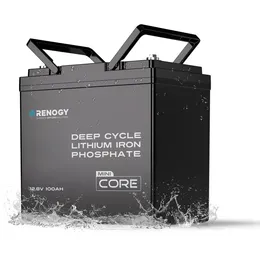
Renogy Core Mini 100Ah
9.02″ × 5.43″ -
Group 24
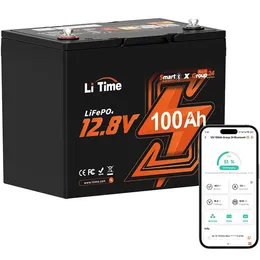
LiTime 100Ah Group 24
10.24″ × 6.61″ -
Group 24
Dakota Lithium 100Ah Heated
10.23″ × 6.6″ -
Group 31
LiTime 100Ah Group 31
13″ × 6.77″ -
Group 27 / 31
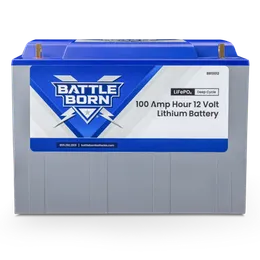
Battle Born BB10012
12.76″ × 6.86″ -
GC3
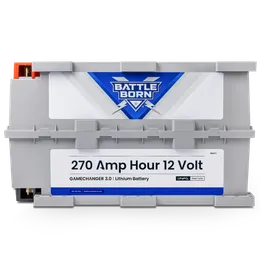
Battle Born BBGC3 270Ah
22.83″ × 7.09″
Footprints drawn to one shared scale — widest case here is 22.83″ long by 7.09″ deep. Heights are listed rather than drawn, and they catch people out more often than the footprint does.
Two things worth taking from that chart.
The same capacity comes in very different cases. LiTime sells 100Ah in a Group 24 case and a Group 31 case that is nearly three inches longer. Neither is better; one fits your rig and one may not.
Weight does not track size. The LiTime Group 24 is the lightest here at 21.9 lb while the Dakota shares its footprint at 27.55 lb, because the Dakota has a heater inside. And the GC3 at 80.8 lb is a two-person lift into a tray that has to be rated for it.
How to identify what you have
-
Read the label on the old battery
Most lead acid batteries state the group number on the top label — "Group 24", "24F", "27", "31". That is the fastest answer and it is usually right.
-
If there is no label, measure the tray, not the battery
Length, width and height of the space, including the lid or any strap that closes over it. The battery has to go in the tray, not merely exist near it.
-
Measure the height twice
Include terminal height and any cable that has to bend over the top. Height is what catches people out — the GC3 above is 13.15 inches before you add a lug and a cable.
-
Check what the tray is rated to hold
Lithium is lighter than lead acid at the same capacity, so a straight swap is usually fine. Going from one 100Ah lead acid to a 270Ah GC3 at 80 lb is not a straight swap.
Working out the capacity you need
The arithmetic is one line:
watts × hours ÷ 12.8 = amp hours
Add up everything you run between charges, convert to amp hours, and that is your minimum before derates. If you would rather tick boxes than add columns, the RV battery calculator runs exactly this arithmetic — inverter losses, usable depth and days of autonomy included — and turns the result into a battery count.
Do it in watt-hours rather than amp hours where you can, because appliance labels are in watts and 12V amp figures get confusing once an inverter is in the path. A 1,000W microwave run for six minutes is 100Wh, which is about 7.8Ah — far less than people expect. A 60W fridge running half the time for 24 hours is 720Wh, or 56Ah, which is far more.
Typical overnight loads
These are planning figures for working out a starting point, not measured specifications — actual draw varies with the appliance, the temperature and how you use it. If you want your real numbers, a shunt-based monitor will tell you inside a week.
| Load | Typical draw | Typical use | Approx. per day |
|---|---|---|---|
| LED lights | 3–8W each | 4–5 hours | 5–10Ah |
| Furnace fan | 70–110W | 3–6 hours cycling | 20–40Ah |
| Water pump | 50–90W | minutes at a time | 2–5Ah |
| Phones, tablets, laptop | 10–60W | intermittent | 5–15Ah |
| 12V compressor fridge | 40–60W | cycling, ~50% duty | 40–60Ah |
| Residential fridge via inverter | 100–150W | cycling, ~40% duty | 70–110Ah |
| TV | 30–60W | 2–3 hours | 6–14Ah |
| CPAP without humidifier | 30–60W | 7–8 hours | 20–35Ah |
The water pump row is one you can check against a data sheet. SHURflo publishes its 3.0 GPM pump drawing 5.1 A at 30 psi and its 4.0 GPM pump 7.3 A — about 61W and 88W at 12V, the two ends of that row. Our water pump calculator reads the figure off the maker’s curve for the taps you actually run.
A weekend trailer with lights, furnace, pump and charging comes out at roughly 50–90Ah a night. Add a compressor fridge and you are near 150Ah. Add a residential fridge and an inverter and 200Ah is a floor, not a target.
Three things that shrink the battery you just sized
Usable capacity, in your favour. Lead acid should not be taken below about half charge, so a 100Ah lead acid battery is really 50Ah. Battle Born publishes 100% usable depth of discharge on the BB10012, and LiTime rates 4,000+ cycles at full depth of discharge. If you are sizing from what your lead acid bank used to do, halve the number you thought you needed. The full comparison, including where AGM is still the better buy, is in lithium vs AGM.
Cold, against you. Victron publishes the clearest figures in the category: 100Ah at 77°F becomes 80Ah at 32°F and 50Ah at -4°F. Nothing is lost permanently, but a bank sized exactly for July will be short in January — when the furnace fan is also running far more. The winter runs against you twice over if you charge from solar, because the sun does the same thing: how much solar an RV needs puts Denver at 2.29 peak sun hours in December against 7.22 in June. If you camp cold, add headroom and read charging lithium in cold weather, because the charging limits matter more than the capacity does.
The BMS current ceiling, which capacity does not fix. A 100A continuous BMS at 12.8V is about 1,280W, whatever the amp hours behind it. A 2,000W inverter run near its rating will shut the battery down, so it needs two batteries in parallel or one with a bigger BMS — the GC3 above is rated at 300A continuous for exactly this reason. Size the bank for your inverter as well as for your night. Every bank-to-inverter pairing is drawn out, with the units to buy at each size, in the RV inverter roundup, and the load-by-load method for choosing the wattage is in what size inverter do I need.
Three worked examples
Weekend travel trailer, shore power most nights. LED lights, furnace fan, water pump, phone charging — call it 70Ah a night, and you are plugged in regularly. One 100Ah battery in whatever group fits the tray. This is the majority of RV owners, and the honest answer is that they are done.
Fifth wheel, boondocking a few nights at a time, compressor fridge. The fridge alone is 40–60Ah a day on top of a 70Ah baseline. Two nights without sun means roughly 260Ah of demand. Two 100Ah batteries minimum, three if you want to run the furnace hard in shoulder season, plus solar to keep up. Group 24 cases usually make this easier than one large case.
Van or Class B with an inverter and a residential fridge. The fridge is 70–110Ah a day and the inverter can pull well over 1,280W on startup. 200–300Ah, and check the BMS current before the capacity — this is the setup where a single 100A battery fails on current while still holding charge.
Batteries by the size you need
Smallest 100Ah — tight bays
Renogy Core Mini 100Ah
Group 22NF at 9.02 inches long, for teardrops and van builds where nothing else goes in.
The common RV size
LiTime 100Ah Group 24 BT
Group 24 at 21.9 lb — the tray most travel trailers actually have.
Filling a Group 27 or 31 tray
Battle Born BB10012
12.76 inches long, sized for the larger opening rather than rattling around in it.
Most capacity in one case
Battle Born BBGC3
270Ah, but 13.15 inches tall and 80 lb — measure headroom before anything else.
All four, and two others, are compared on charge temperature, BMS current and warranty in the best RV lithium batteries.
Related guides
- Best RV lithium batteries — six batteries compared on the specifications that decide between them.
- Battle Born vs Dakota Lithium — two Group 24-versus-Group 31 answers to the same question, head to head.
- Charging lithium in cold weather — why a winter bank needs headroom, and what the charge limits are.
- Best RV converter for lithium batteries — sizing the charger to the bank you just sized.
- Do I need a DC to DC charger? — the same question for charging while you drive, which a converter cannot do.
- 30 amp vs 50 amp RV — what your shore supply gives you while all of this is charging.
- The electrical section collects everything published so far.
For how products on this site are selected and what we do not claim about them, see the editorial policy.
Questions worth answering
How many amp hours do I need for RV boondocking?
Add up what you actually run overnight in watt-hours, then divide by 12.8 to get amp hours. Most weekend trailers with LED lights, a furnace fan, a water pump and phone charging land between 50 and 90Ah a night, which one 100Ah lithium battery covers. Add a residential fridge or an inverter running a coffee maker and you are into 200Ah territory quickly.
Is 100Ah of lithium the same as 100Ah of lead acid?
No — it is roughly double in usable terms. A lead acid battery should not go below about half charge, so a 100Ah lead acid battery gives you about 50Ah in practice. Battle Born publishes 100% usable depth of discharge on its 100Ah battery. If you are replacing two 100Ah lead acid batteries, one 100Ah lithium is close to a like-for-like swap.
What is the difference between Group 24, 27 and 31?
Physical size, not capacity. On the batteries measured here, a Group 24 case runs about 10.2 inches long, a Group 31 about 13, and the smaller Group 22NF about 9. Lithium batteries in all three are commonly 100Ah, so the group number tells you what fits your tray rather than how much energy you get.
Can I fit a smaller battery in a bigger tray?
Yes, and it is the safer way round if you are unsure — but pack it or bracket it so it cannot move. A battery sliding around a bay puts strain on the terminals and the cables, and lithium terminals are not designed to take that load.
Do I need more capacity for winter?
Yes. Victron publishes the clearest figures: the same battery rated at 100Ah at 77°F delivers 80Ah at 32°F. That capacity comes back as the pack warms, but a bank sized exactly for summer will feel undersized in January, before you account for the furnace fan running more.
Should I buy one big battery or several small ones?
Several smaller batteries usually fit an RV better, because RV bays are awkward and two Group 24 cases will go places one GC3 case will not. Paralleling also shares the BMS current limit, which is what actually caps your inverter. One big battery means fewer connections to fail — a real advantage, if it physically fits.