You can use a lithium battery in the cold. You mostly cannot charge one. That single distinction explains almost every winter lithium problem, and it is the one most guides blur.
The threshold is not the same for every battery either. The advice repeated across most of the internet is “never charge a lithium battery below 32°F”, which is safe but not accurate: Battle Born permits charging down to 25°F, Victron refuses below 41°F, and LiTime and Renogy sit at 32°F. That is a sixteen degree spread between batteries sold for the same job, and it is published in the manufacturers’ own documents.
What cold actually does to the cell
When you push current into a LiFePO4 cell that is too cold, the lithium ions arriving at the anode cannot intercalate into the graphite quickly enough. They plate out as metallic lithium on the surface instead.
Two things follow. The plated lithium is not available to store energy any more, so capacity drops permanently. And over repeated cold charges the deposits can build into dendrites, which is a safety problem rather than a performance one.
This is why the battery management system refuses the charge instead of warning you. It is not being cautious — the damage is real and it does not reverse when the weather warms. It is also the one respect in which an AGM battery, which has no management system to refuse anything, is easier to live with in winter — covered in lithium vs AGM.
Discharging is a different chemistry with no equivalent failure mode, which is why the discharge window is so much wider on every datasheet.
The spread nobody publishes
Manufacturers all publish two temperature ranges, and the category consistently reports one of them. Here is what the datasheets for the batteries we cover actually say:
| Battery | Will supply power | Will accept charge |
|---|---|---|
| Battle Born BB10012 | -4°F to 135°F | 25°F to 135°F |
| Dakota Lithium 100Ah Heated | -4°F to 140°F | Heats to 41°F first, then charges |
| LiTime 100Ah Group 24 | -4°F to 140°F | 32°F to 122°F |
| Renogy 100Ah Smart | -4°F to 140°F | 32°F to 131°F |
| Victron LFP Smart 12.8/100 | -4°F to 122°F | 41°F to 122°F |
Two things stand out. Battle Born’s 25°F floor is genuinely useful — it covers a frosty morning that would stop the others. And Victron, the manufacturer most willing to publish inconvenient numbers, has the strictest limit of the group at 41°F, which is nine degrees above freezing.
The same figures drawn against one scale, alongside the products they belong to, are in the best RV lithium batteries.
LiTime deserves credit for stating the consequence plainly on its own product page: this model should only be charged above 32°F, charging in freezing temperatures will damage the cells, and on cold days the best practice is to bring the battery indoors. That is a manufacturer talking a customer out of a purchase, and it is more candour than most of the pages ranking for this question manage.
Capacity falls too, and that is a separate problem
Even above the charging threshold, a cold battery holds less.
Victron is the only manufacturer among these that publishes the figures rather than the reassurance. The same 12.8V/100Ah battery is rated at:
- 100Ah at 77°F
- 80Ah at 32°F
- 50Ah at -4°F
Half the battery, at a temperature plenty of people camp in. Nothing is lost permanently — the capacity returns as the pack warms — but a bank sized for July will not behave the same way in January, and the state-of-charge reading will not warn you, because lithium’s voltage curve stays flat regardless.
Nothing about this is Victron-specific. It is what LiFePO4 does. The other manufacturers simply do not print it.
The practical consequence is that a winter bank needs headroom a summer one does not — which is one of the derates built into what size lithium battery do I need.
Is it safe to charge right now?
Work down this list and stop at the first line that applies.
-
Your battery has internal heating and it is enabled
Charge normally
The heater brings the cells up before charging begins. Dakota Lithium warms to 41°F first; Battle Born activates at around 35°F internal.
-
The battery is above its published charge threshold — check yours, it may not be 32°F
Charge normally
Battery temperature, not air temperature. A pack in an enclosed bay lags outside air by hours in both directions.
-
The battery is below the threshold and the BMS is refusing charge
Leave it — this is correct behaviour
Nothing is broken. Use the battery, let the day warm it, and it will start accepting charge on its own.
-
The battery is below the threshold and something is charging it anyway
Stop charging now
A charge source connected directly with no BMS between it and the cells is the one genuinely damaging case. This is the scenario external-BMS batteries like the Victron are exposed to if the BMS is not wired correctly.
Three ways to charge through a winter
-
Buy a heated battery
The only option that needs no thought once installed. The heater runs off the battery, so the cost is capacity rather than money — see below. Dakota Lithium includes it in the standard 100Ah model; Battle Born sells the BB10012H alongside the standard unit.
-
Bring the battery somewhere warm
LiTime recommends this for its own non-heated models. Practical for a single Group 24 battery at 21 lb and a weekend trip. Much less practical for a bank of three, or a battery wired into a bay behind a panel.
-
Keep the compartment above the threshold
Batteries living inside a heated coach often already are, and need nothing further. An exterior bay is harder: it has to stay above the threshold for the whole charging window, not just when you check it, and an unheated bay tracks outside air within a few hours.
There is a fourth option people reach for that does not work: charging faster to “warm it up”. Charge current is what the BMS is blocking, so there is nothing to turn up. And on a battery without that protection, higher current into a cold cell is the most damaging thing you can do.
What a heater actually costs you
This is the number that decides whether a heated battery solves your winter or just moves the problem, and Battle Born is the only manufacturer here that publishes it.
The BB10012H’s element switches on at an internal temperature of about 35°F and draws 28W continuously while enabled. Battle Born’s own table gives the 24-hour cost:
| Outside temperature | Heating draw per 24 hours |
|---|---|
| 25°F | 20.8Ah |
| 20°F | 23.7Ah |
| 15°F | 31.9Ah |
At 15°F a heated 100Ah battery spends roughly a third of its own capacity keeping itself warm. On a single-battery rig running lights and a furnace fan as well, that is the difference between comfortable and flat by morning.
The conclusion is not to avoid heated batteries. It is to size the bank for winter rather than for summer, and to understand why the state of charge falls overnight when nothing appears to be switched on.
Dakota Lithium takes a different approach: rather than running a heater to keep the pack warm continuously, its Even-Heat system warms the cells to 41°F when a charge is attempted below freezing, then allows the charge. Dakota does not publish the power that costs, which is the one thing Battle Born does better here.
Storing a lithium battery through a freeze
Storage is the easier half, with one caveat worth knowing.
Battle Born’s guidance is to bring the battery to 100% charge and then disconnect it completely. Self-discharge runs at 2–3% per month, so after six months in storage it expects the pack to still hold 75–80%.
The caveat is the case, not the cells: Battle Born warns that storing at -15°F or below risks cracking the ABS housing, and can cause capacity loss well beyond the normal monthly figure. If your winter storage gets that cold, the battery is better off indoors — which for most people means one trip to the garage in November rather than any equipment at all.
If you are winterizing the rest of the rig at the same time, note that a disconnected battery is also not powering anything that might otherwise keep an eye on the shore supply.
If you camp in the cold, start here
Best heated battery
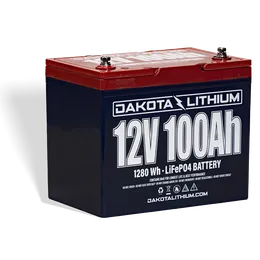
Dakota Lithium 100Ah Heated
Heating built into the standard model rather than sold as an upgrade, behind an eleven-year warranty.
If you want the numbers published
Battle Born BB10012H
The only heated battery here whose manufacturer publishes what the heater actually draws.
Both are covered in full, alongside four batteries without heating, in the best RV lithium batteries — and if these two are your shortlist, they go head to head on heating, fitment and warranty in Battle Born vs Dakota Lithium.
A budget note in the interest of completeness: LiTime lists a self-heating version of its Group 24 battery at a considerably lower price than either of these. We have not recommended it here because we could not resolve a purchase page for that specific variant — the nearest matching product on LiTime’s site turned out to be a trolling-motor battery with a low-temperature cutoff, which is the opposite feature. If you find the right listing, the specification is sound; just confirm the model before ordering.
Related guides
- Best RV lithium batteries — all six compared, including the charge-window chart these figures come from.
- Best RV converter for lithium batteries — the other reason a bank never reaches 100%, and it applies year round.
- 30 amp vs 50 amp RV — what your shore supply provides when a furnace, a heater and a converter all want it at once.
- Best RV surge protectors — winter campgrounds run on the same tired pedestals as summer ones.
- The electrical section collects everything published so far.
For how products on this site are selected and what we do not claim about them, see the editorial policy.
Questions worth answering
Can you charge a lithium battery below freezing?
Not without an internal heater, and the exact limit is not 32°F for every battery. Battle Born permits charging down to 25°F. LiTime and Renogy block it below 32°F. Victron will not accept charge below 41°F. The rule of thumb the internet repeats — never below freezing — is close enough to be safe and wrong often enough to matter. Check your own battery.
Will cold damage my battery if I just leave it in the RV?
Sitting in the cold is fine. Charging in the cold is what causes harm. Every battery here will discharge happily down to -4°F. Battle Born does warn that storing below about -15°F risks cracking the ABS case, which is a storage concern rather than a running one.
My solar controller says it is charging but the battery is not filling. Why?
On a cold morning that is usually the BMS doing its job. The charge source is producing power and the battery is refusing to accept it, so the controller reports output while the state of charge stays flat. It normally resolves itself as the day warms.
Does a heated battery use my power to warm itself?
Yes, and the amount is worth planning around. Battle Born publishes 28W of continuous draw while the heater is enabled, which works out at about 20.8Ah over 24 hours at 25°F and 31.9Ah at 15°F. On a single 100Ah battery that is roughly a third of its capacity spent staying warm.
Can I just warm the battery compartment instead of buying a heated battery?
For a battery living inside a heated coach, that is often exactly what happens already and no further action is needed. For a battery in an exterior bay it is harder than it sounds — the compartment has to stay above the threshold continuously while charging, not just be warm when you check it.
Is 100Ah still 100Ah in winter?
No, and this is separate from the charging question. Victron publishes the only clear figures here: the same battery rated at 100Ah at 77°F delivers 80Ah at 32°F and 50Ah at -4°F. Capacity returns as the battery warms — nothing is lost permanently — but a winter bank should be sized for winter.