Lithium, if you camp away from hookups. Roughly twice the usable capacity, a third of the weight, and thousands of cycles instead of hundreds. For boondocking it is not a close comparison.
AGM, if you mostly plug in. It is a fraction of the price, it tolerates the charger already fitted to your rig, and it has no electronics that can decide to stop working. If the battery’s job is running lights and a water pump between campgrounds, the lithium premium will never pay you back.
The part both sides skip is that the battery is the cheapest part of switching to lithium.
Notice who writes these comparisons
Search this question and look at who ranks: Power Queen, Vatrer, LiTime, Go Power. Battery manufacturers, all of whom sell lithium. Their conclusion is not exactly a surprise, and the sections where AGM might come out ahead tend to be brief.
This site earns commission on both chemistries, which does not make us disinterested, but it does mean there is no reason to steer you. What follows is where each genuinely wins, using published figures where they exist and saying so where they do not.
The one number that settles most of it
Two batteries, both sold as 12V 100Ah:
| Renogy 100Ah AGM | LiTime 100Ah Group 24 | |
|---|---|---|
| Weight | 63.9 lb | 21.9 lb |
| Usable capacity | ~50Ah | 100Ah |
| Usable energy per pound | ~0.8Ah/lb | ~4.6Ah/lb |
Both figures are the manufacturers’ own. The AGM weighs nearly three times as much and gives you half as much, which is close to a six-fold difference in usable energy per pound.
For a travel trailer where tongue weight matters, or a van where every pound is argued over, that is the comparison. Two AGM batteries to get 100Ah usable is 128 lb; one lithium battery is 22. To see it on your own loads, run the RV battery calculator once in each chemistry — it shows the bank, the count and the weight side by side.
If the reason you are looking at weight is that the trailer is near its GVWR, check that before buying anything. The cargo capacity calculator puts this battery saving next to the one that costs nothing — towing with the fresh tank empty. On its example trailer, the empty tank frees about three times what the swap does.
Where lithium genuinely wins
| What it handles | AGM | LiFePO4 lithium |
|---|---|---|
| Usable capacity from 100Ah | About 50Ah | 100Ah — Battle Born publishes 100% depth of discharge |
| Weight for that capacity | 63.9 lb for ~50Ah usable | 21.9 lb for 100Ah usable |
| Cycle life | Conventionally a few hundred at 50% depth | 3,000–5,000 (Battle Born), 4,000+ at full depth (LiTime) |
| Voltage under load | Sags as it discharges — lights dim, inverters complain | Flat until nearly empty |
| Charge speed | Slow, and slower still above 80% | Accepts 50A to the end of the charge on most 100Ah units |
| Maintenance | Sealed and maintenance-free | Sealed and maintenance-free |
The flat voltage curve is underrated. A lead acid bank tells you it is dying by dimming, which people read as a warning. Lithium holds its voltage almost to the end, which is better to live with but means the state-of-charge gauge matters much more — you get less warning.
The charge speed row deserves a number rather than an adjective, because it is the difference generator owners feel most. A 200Ah AGM bank charging from half takes roughly five hours on a 45 amp converter, and three and a half of those hours are the last 20% — the stretch where the current has tapered to a trickle and no larger charger can help. The same-sized lithium bank takes about four hours from a deeper 20%, with a tail of twenty minutes. Both cases are worked through in the battery charge time calculator.
Where AGM still wins
Not consolation prizes. Real advantages, and the reason we have not deleted AGM from the site.
Price. An AGM battery is a fraction of the cost, and the gap widens once you count the charging equipment below.
It tolerates the charger you already own. This is the big one. Your existing converter will charge an AGM correctly. It will charge lithium to about 80% and stop — Dakota Lithium states exactly that for its own batteries. AGM asks nothing of your rig.
No BMS means nothing can lock you out. A lithium battery’s management system will refuse to charge below its threshold — 25°F on a Battle Born, 32°F on LiTime and Renogy, 41°F on Victron. On a cold morning that is a battery that simply will not accept the solar you are generating. An AGM has no such electronics. Both chemistries lose capacity in the cold; only lithium can decide to stop participating.
No current ceiling to trip over. A 100A BMS caps you at roughly 1,280W — a size class of inverter, in practice — regardless of capacity, and it disconnects when you exceed it. An AGM under the same surge sags — badly — but keeps delivering.
It is the right answer for a rig you are selling, or one used a few weekends a year on full hookups. Lithium’s advantages are all realised by cycling it. If you do not cycle it, you have bought an expensive way to do the same job.
What switching actually costs
The comparison everyone runs is battery against battery. The real comparison is battery-plus-charging-system against battery.
Going lithium properly means:
- The batteries. The visible cost, and the one every comparison uses.
- A lithium-capable converter, or a setting change. Lead acid converters sit around 13.6V and LiFePO4 wants 14.2–14.6V. Sometimes this is free — several Progressive Dynamics units have a lithium profile that just needs selecting, and they ship set to flooded lead acid. Sometimes it is a new converter. See the best RV converter for lithium batteries.
- A DC-DC charger, if you charge while driving. Modern alternators drop their voltage — Renogy publishes an input window as low as 12V for smart alternators — and lithium will not charge properly through a relay. Whether you need one is worked through in do I need a DC to DC charger?.
None of that applies if you buy AGM. That is the honest arithmetic, and it is what turns a straightforward-looking upgrade into a project. It is also why the answer depends so much on how you camp rather than on which chemistry is better in the abstract.
Which one, for you
Stop at the first line that describes how you actually use the rig.
-
You boondock, dry camp, or regularly go a night or more without hookups
Lithium
This is what the extra usable capacity and the cycle life are for. Budget for the converter as well as the battery.
-
You have a residential fridge, an inverter, or weight is a real constraint
Lithium
Two AGM batteries to match one lithium is 128 lb, and the inverter will pull the AGM voltage down under load.
-
You stay on shore power and the battery just covers travel days and outages
AGM
You would be buying capacity you never discharge and cycles you never use. Spend the difference on something you will notice.
-
The rig is going up for sale, or the budget will not stretch past the battery itself
AGM
A half-finished lithium install — new battery, old converter — performs worse than a correct AGM one and costs more.
The two we would buy
If lithium is right for you
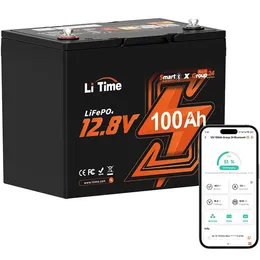
LiTime 100Ah Group 24 BT
The most usable capacity per dollar, in the Group 24 case most RVs already have.
If AGM is right for you
Renogy 100Ah AGM
Cheap, sealed, no electronics to lock you out, and it tolerates the charger you already own.
The LiTime is the value pick from our lithium roundup — Group 24, 21.9 lb, 4,000+ cycles at full depth of discharge. Five other lithium batteries, including the premium options, are compared in the best RV lithium batteries.
The Renogy AGM is here because sometimes it is the right answer. Note that Renogy’s battery warranties are prorated: free replacement inside 12 months, then you pay a share of the original price scaled to the time remaining.
Related guides
- Best RV lithium batteries — six compared on charge temperature, BMS current and warranty.
- What size lithium battery do I need — if you have decided on lithium, this sizes it.
- Best RV converter for lithium batteries — the cost most switchers forget.
- Do I need a DC to DC charger? — the other one.
- Charging lithium in cold weather — the one area where AGM’s lack of electronics is an advantage.
- The electrical section collects everything published so far.
For how products on this site are selected and what we do not claim about them, see the editorial policy.
Questions worth answering
Is lithium really worth it over AGM for an RV?
If you camp without hookups, yes — you get roughly twice the usable capacity for a third of the weight, and several thousand cycles instead of several hundred. If you stay on shore power and use the battery mainly to run lights between sites, AGM does that job for a fraction of the price and the difference will never pay you back.
How much more usable capacity does lithium give?
About double, at the same nominal rating. Lead acid should not be routinely taken below roughly 50% state of charge, so a 100Ah AGM is about 50Ah in practice. Battle Born publishes 100% usable depth of discharge on its 100Ah lithium battery. Same number on the label, twice the energy you can actually use.
Can I just drop lithium in where my AGM was?
Physically, usually. Electrically, not quite. Your converter almost certainly holds around 13.6V, which will only fill a lithium battery to about 80% — Dakota Lithium states this plainly for its own batteries. And if you charge from the vehicle while driving, a modern alternator will not charge lithium properly through a relay. Budget for both.
Does AGM handle cold better than lithium?
In one specific and important way, yes: an AGM has no battery management system, so it never refuses a charge. A lithium battery's BMS will block charging below its threshold — between 25°F and 41°F depending on the brand — and there is nothing you can do about it at the time. Both chemistries lose capacity in the cold; only one of them can lock you out.
How long does each actually last?
Cycle counts are quoted against different tests, so treat them as orders of magnitude rather than precise. Lithium makers publish figures in the thousands — Battle Born 3,000–5,000, LiTime 4,000+ at full depth of discharge. Deep cycle lead acid is conventionally a few hundred cycles at 50% depth. The gap is real and large, but it only pays off if you cycle the battery regularly.
Is AGM ever the better buy in 2026?
Yes — for occasional use on shore power, for a rig you are about to sell, where the budget genuinely will not stretch to lithium plus a converter, or where the battery lives somewhere that freezes and gets charged anyway. Those are real situations, not consolation prizes.