Enter your bank, where it sits now, and what is charging it. The calculator splits the answer into the two phases a charge actually has — constant current until the battery is nearly full, then a tapering tail that no charger can hurry — and tells you which of the two ceilings is setting your pace: the charger’s output, or what the battery will accept.
That second number is the one almost nobody checks, and it decides whether a bigger converter is money well spent or money wasted. Battle Born publishes a 50A maximum charge current for its 100Ah battery. Put one of those on an 80A converter instead of a 45A one and you finish twelve minutes sooner.
Step 1 of 3
What are you charging?
Chemistry decides more than capacity does — it sets how much current the bank will accept and how long the tail at the end lasts.
Step 2 of 3
The bank, and where it is now
Step 3 of 3
What is doing the charging
Tick everything running at once. Sources add up until the bank's acceptance limit stops them.
The answer
Time to charge
—
The converter that matches this bank
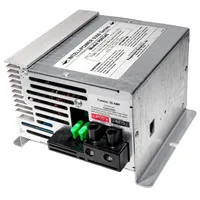
Progressive Dynamics Inteli-Power PD9345 45 Amp Converter Charger
45A output · lithium profile
Check price at Progressive Dynamics(opens in a new tab)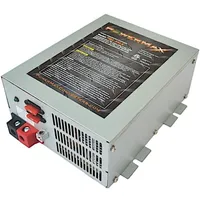
PowerMax PM3-55LK 55 Amp Deck Mount RV Converter Charger
55A output · no published lithium profile
Check price at Amazon(opens in a new tab)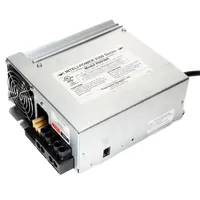
Progressive Dynamics Inteli-Power PD9360 60 Amp Converter Charger
60A output · lithium profile
Check price at Progressive Dynamics(opens in a new tab)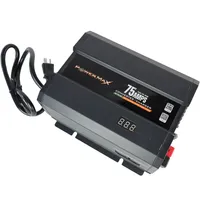
PowerMax PM3-75LK 75 Amp RV Power Converter
75A output · no published lithium profile
Check price at Amazon(opens in a new tab)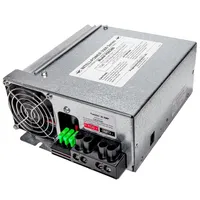
Progressive Dynamics Inteli-Power PD9380 80 Amp Converter Charger
80A output · lithium profile
Check price at Progressive Dynamics(opens in a new tab)
Victron Energy Orion-Tr Smart 12/12-30A DC-DC Charger, Non-Isolated
30A from the alternator
Check price at Amazon(opens in a new tab)
Renogy DCC50S 12V 50A Dual Input DC-DC On-Board Battery Charger with MPPT
50A from the alternator
Check price at Renogy(opens in a new tab)What the calculator is doing
Four steps, and you can check every one:
- Amp hours to put back. Capacity × the gap between where you are and where you want to be. A 200Ah bank from 20% to 100% needs 160Ah.
- The current that will actually flow — the lower of what your charge sources supply and what the bank accepts. Sources add together; the acceptance limit caps the total.
- Bulk phase, at that constant current, divided by charge efficiency. Not every amp hour you push in comes back out: lithium is about 99% efficient, lead-acid nearer 80–85%.
- Absorption phase, from the point the battery switches to constant voltage up to your target. Current tapers here, so this stretch is modelled at an average of about 30% of the bulk current.
Steps 3 and 4 are where this parts company with the usual answer. Amp hours divided by amps is step 3 alone, which is close enough on lithium and hours out on lead-acid.
Two ceilings, and only one of them is yours to raise
Charging runs at the lower of two numbers. Most calculators model the charger and assume the battery will take whatever it is given.
- The charger ceiling is your converter’s output, plus a DC-DC charger and solar if they are running.
- The battery ceiling is charge acceptance, and it is published. Battle Born states 50A maximum for its 100Ah battery — 0.5C, which is also its recommended rate.
Whichever is lower is what flows. Same 100Ah Battle Born, from 20% to full:
| Converter | Current that flows | Time to full |
|---|---|---|
| 45A | 45A | 2 hr 3 min |
| 55A | 50A | 1 hr 51 min |
| 60A | 50A | 1 hr 51 min |
| 80A | 50A | 1 hr 51 min |
Everything from 55A upwards gives an identical answer, because the battery stops accepting at 50 amps. Nearly doubling the converter buys twelve minutes, and going beyond 55A buys nothing whatsoever.
Now the same two converters on a 200Ah lithium bank, which accepts 100A:
| Converter | Time to full |
|---|---|
| 45A | 4 hr 7 min |
| 80A | 2 hr 19 min |
An hour and 48 minutes saved. Identical products, opposite verdicts, and the bank is what decides. This is why the calculator names the binding ceiling before it names a product.
The tail nobody budgets for
Near the top of a charge the system switches from constant current to constant voltage, and the current falls away as the battery fills. On lithium this is brief. On lead-acid it dominates.
A 200Ah AGM bank charging from 50%:
| Phase | Range | Time |
|---|---|---|
| Bulk | 50% → 80% | 1 hr 34 min |
| Absorption | 80% → 100% | 3 hr 29 min |
| Total | 5 hr 3 min |
The last fifth of the charge is 40% of the amp hours and roughly 69% of the time. It is also the part a bigger converter cannot touch, because the battery is limiting the current, not the charger — which is why the same bank on an 80A converter still takes 4 hours 33 minutes.
Stop at 80% instead and the whole thing takes 1 hour 34 minutes. That is a genuine option on a travel day and a bad habit as a routine: lead-acid left habitually part-charged sulfates, and sulfation costs capacity permanently. Lithium has no such objection, and no meaningful tail to skip either.
What chemistry actually decides
Three numbers change with chemistry, and together they explain most of the difference between a lithium charge and a lead-acid one.
| Lithium (LiFePO4) | AGM | Flooded | |
|---|---|---|---|
| Charge acceptance | 0.5C | ~0.25C | ~0.13C |
| Constant current holds to | 95% | 80% | 80% |
| Charge efficiency | ~99% | ~85% | ~80% |
A 200Ah lithium bank accepts 100A; a 200Ah AGM bank accepts about 50. Lithium holds constant current almost to the top; lead-acid hands over at 80% and crawls. And lead-acid needs roughly 118Ah pushed in to store 100Ah, where lithium needs about 101.
When the datasheet gives two different answers
LiTime publishes both a 100A maximum and a 20A recommended charge current for the same 100Ah battery. A fivefold spread, both from its own documentation, and the calculator will happily give you either:
| Charge current | 20% to full |
|---|---|
| 100A — its published maximum | 56 min |
| 20A — its published recommendation | 4 hr 38 min |
Neither figure is wrong. The maximum is what the cells will tolerate without damage; the recommendation is what the manufacturer thinks will deliver the cycle life on the label. Which you design around is a real decision with a real cost, and it is not one the marketing copy will make for you.
The practical reading: size your charging to the recommended figure where the manufacturer publishes one, and treat the maximum as headroom for the odd fast turnaround rather than as the number to buy against.
Charging from more than one source
Shore power, alternator and solar add together, and the calculator lets you tick all three. Two things worth knowing before you do:
- They add until they hit the acceptance ceiling. A 45A converter and a 30A DC-DC charger is 75A on paper, and exactly 50A into a single 100Ah Battle Born. Combining sources helps a large bank and does nothing for a small one.
- Solar’s nameplate is not its output. A 400W array contributes roughly 22A in full sun once you allow for the gap between laboratory conditions and a roof — and only while the sun is on it, which is the assumption doing the most work in any solar figure — and it varies by month more than by rig, which is what how much solar an RV needs works out. The same gap between laboratory and roof runs the other way on voltage: a charge controller is sized on the open-circuit voltage a cold morning produces, not the one in the specification table.
The alternator is the source most people underuse. It costs nothing extra while you are already driving, and a DC-DC charger is what makes it usable on a lithium bank.
Five ways the estimate goes wrong
- Amp hours ÷ amps. That is bulk only. It is close on lithium and hours short on lead-acid.
- Assuming the charger sets the pace. Check the battery’s acceptance first; on a small bank it is usually the binding number.
- Forgetting charge efficiency. On lead-acid you push in about 18% more than you store.
- Reading the generator’s watts instead of the converter’s amps. The converter is what talks to the battery. The generator’s watts decide a different question — what size generator an RV air conditioner needs — and there the figure that matters is running watts after altitude and heat, not the number on the box.
- Expecting a warm-weather answer in the cold. Most lithium BMS designs refuse charge below freezing, and the cutoffs differ by brand.
The converters this points at
Four purchases, and which is right depends entirely on the bank you are charging:
Matched to a single 100Ah lithium battery
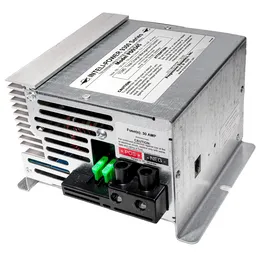
Progressive Dynamics PD9345
45A into a battery that accepts 50A — the whole output goes in, and nothing is paid for twice.
The size that suits a 200Ah lithium bank
Progressive Dynamics PD9360
60A is usable headroom at 200Ah, where a 45A unit leaves better than an hour on the table.
Only worth its price above 200Ah
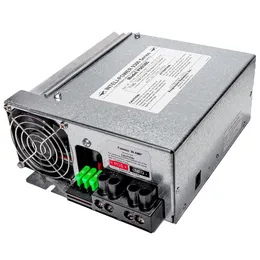
Progressive Dynamics PD9380
80A needs a bank that accepts 80A. On one 100Ah battery it finishes twelve minutes sooner than a 45A unit.
Charges while you drive, not while you sit

Renogy DCC50S
50A from the alternator, additive to whatever else is running — the source that works with no shore power at all.
Related guides
- Best RV converter for lithium batteries — which converters have a real lithium profile, which is a separate question from how fast they charge.
- Do I need a DC-DC charger? — the alternator source, and whether it is worth fitting.
- RV battery calculator — how big the bank needs to be in the first place, and the discharge side of the same numbers.
- Lithium vs AGM for RV — the charging difference on this page is one of the strongest arguments in that comparison.
- 12V wire size calculator — the cable between the charger and the bank, which has to carry every one of these amps.
- Charging lithium in cold weather — the per-brand temperature cutoffs this calculator deliberately does not model.
- The electrical section collects everything published so far.
For how products on this site are selected and what we do not claim about them, see the editorial policy.
Questions worth answering
How long does it take to charge a 100Ah lithium battery?
From 20% to full on a typical 45A converter, about 2 hours — roughly 1 hour 40 minutes of bulk charging plus a short 20-minute tail. What surprises people is that a much bigger converter barely improves it. Battle Born publishes a 50A maximum charge current for its 100Ah battery, so anything above 50A is refused: an 80A converter finishes in 1 hour 51 minutes, twelve minutes sooner than the 45A unit and no faster than a 55A one.
Will a bigger converter charge my batteries faster?
Only if your bank can accept the extra current, and that is the question almost nobody asks. Charging happens at the lower of two numbers: what the charger can supply and what the battery will take. On a 200Ah lithium bank accepting 100A, going from a 45A to an 80A converter takes the charge from 4 hours 7 minutes to 2 hours 19 minutes — a real upgrade. On a single 100Ah battery accepting 50A, the same upgrade buys twelve minutes. Same two converters, opposite verdicts, decided entirely by the bank.
Why does the last 20% take so long?
Because charging switches from constant current to constant voltage near the top, and under constant voltage the current tapers away as the battery fills. On a 200Ah AGM bank charging from 50%, the first stretch to 80% takes about 1 hour 34 minutes and the last 20% takes about 3 hours 29 minutes. That final fifth is 40% of the amp hours and roughly 69% of the time, and no charger can speed it up — the battery is doing the limiting.
Is amp hours divided by amps a good enough estimate?
It is the bulk phase only, so it is reasonable for lithium and badly wrong for lead-acid. A 200Ah AGM bank from 50% needs 100Ah put back; at 45A the naive sum says 2 hours 13 minutes, and the real answer is closer to 5 hours once charge efficiency and the absorption taper are counted. For lithium the same sum is much closer, because the tail is short and the charge efficiency is near perfect.
Can I stop charging at 80% to save time?
On lead-acid it saves an enormous amount of time — 1 hour 34 minutes instead of 5 hours 3 minutes on the example above — but it is not free. Lead-acid that habitually sits part-charged sulfates, which permanently costs capacity, so this is a trick for a travel day rather than a routine. Lithium is the opposite: it does not mind being left part-charged at all, and the tail you would be skipping is only about twenty minutes anyway.
Does charging from solar and shore power at the same time help?
Yes, the sources add up — right until they hit the bank's acceptance limit, at which point the extra has nowhere to go. Tick more than one source in the calculator and it adds them, then caps the total. A 400W solar array contributes roughly 22A in full sun once you allow for the gap between nameplate and reality, which is a meaningful addition to a 45A converter and irrelevant next to a bank that is already at its limit.
What is charge efficiency and why does it make the sum longer?
Not every amp hour you push in comes back out. Lithium is close to perfect at about 99%, so the loss barely registers. Lead-acid runs around 80–85%, meaning you have to put in roughly 118Ah to store 100Ah. That difference alone adds the better part of an hour to a large AGM charge, and it is one of the two reasons the naive sum understates lead-acid so badly.
How long will a generator take to charge my batteries?
Exactly as long as the converter it is feeding takes — the generator supplies the converter, and the converter's output is what reaches the battery. Enter your converter's amps, not the generator's watts. This is also why generator runs feel so unproductive on lead-acid: you are running an engine through the long absorption tail, when the current has already dropped to a trickle.
Does temperature change the answer?
Substantially, and the calculator does not model it. Lithium is the strict case: most BMS designs refuse charge below freezing entirely, and manufacturers set different cutoffs — Battle Born permits charging down to 25°F while Victron refuses below 41°F. Lead-acid will accept charge when cold but takes longer. Treat every figure here as a warm-weather number.
My battery says 100A maximum but 20A recommended. Which do I use?
Both are real, and the gap is why the calculator lets you type your own figure. LiTime publishes exactly that pair for its 100Ah battery, and the difference is not academic: 100A fills it from 20% in about 56 minutes, 20A takes about 4 hours 38 minutes. The maximum is what the cells tolerate; the recommendation is what the manufacturer thinks will get you the published cycle life. Charging at the recommended rate is the conservative choice, and enter whichever figure you have decided to design around.