For most rigs the Progressive Dynamics PD9360 is the one to buy: 60 amps, a genuine lithium charge profile rather than a voltage dial, and an owner’s manual that actually documents what the profile does. Thirty amp rigs are better served by the PD9345, which draws less from the pedestal. If price is the deciding factor, the PowerMax PM3-55LK does the job for roughly half, provided you are willing to set the output voltage yourself.
Before any of that, though: there is a decent chance the converter you already own is the reason your new batteries never reach 100%, and a smaller chance that you do not need to replace it at all.
Will the converter you already have charge lithium?
It will charge it. It probably will not fill it.
A converter built for flooded lead acid typically settles around 13.6V. LiFePO4 needs roughly 14.2V to 14.6V of absorption to complete a charge. Feed a lithium battery 13.6V and it charges quickly to around 80% and then essentially stops, because from the battery’s point of view the charger has already backed off.
Nothing breaks. No warning appears. The bank simply behaves as though it were smaller than you paid for, and because lithium holds such a flat voltage under load, the state-of-charge reading looks reassuring right up until it doesn’t.
Dakota Lithium says it outright in its own product documentation: a lead acid charger will work, but will only charge the battery to about 80% of capacity. That is the manufacturer of the battery telling you the charger is the problem.
One boundary worth drawing before going further: a converter runs off shore power, so it does nothing at all while you are driving. Charging from the vehicle alternator is a separate device and a separate decision — do I need a DC to DC charger?
Quick picks
Best overall
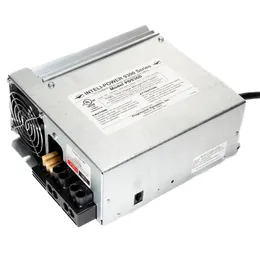
Progressive Dynamics PD9360
A real lithium charge profile rather than an adjustable dial, 60 amps, and the only manual in this category that documents what it does.
Best for a 30 amp rig
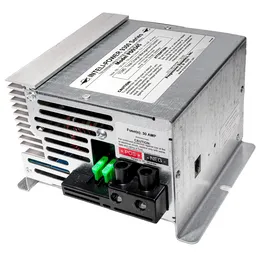
Progressive Dynamics PD9345
725W of input draw instead of 1,000W or 1,300W, which matters when the pedestal only gives you 3,600W.
Best value
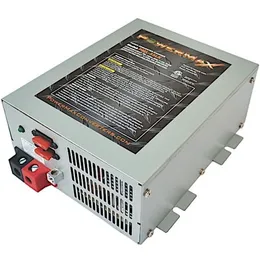
PowerMax PM3-55LK
55 amps at roughly half the price, if you are willing to set the output voltage yourself.
Most output
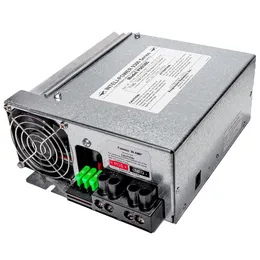
Progressive Dynamics PD9380
80 amps for a large bank — on 50 amp service, because it needs a 20 amp AC plug.
How the five compare
| Model | Output | Output voltage | Lithium profile | AC plug | Mounting | Price | Buy |
|---|---|---|---|---|---|---|---|
| Progressive Dynamics PD9345 | 45A | 13.2V to 14.7V DC | Yes | 15 amp | Deck mount | $$ | Check price(opens in a new tab) |
| Progressive Dynamics PD9360 | 60A | 13.2V to 14.7V DC | Yes | 15 amp | Deck mount | $$$ | Check price(opens in a new tab) |
| Progressive Dynamics PD9380 | 80A | 13.2V to 14.7V DC | Yes | 20 amp — not the 15 amp plug the smaller units use | Deck mount | $$$$ | Check price(opens in a new tab) |
| PowerMax PM3-55LK | 55A | Adjustable — no fixed lithium profile published | No | — | Deck mount | $$ | Check price(opens in a new tab) |
| PowerMax PM3-75LK | 75A | Adjustable — no fixed lithium profile published | No | — | Deck mount | $$$ | Check price(opens in a new tab) |
Which one physically fits is decided before anything else
This is the part every roundup in this category skips, and it is the part that determines what you are allowed to buy.
RV converters come in three fitment classes, and they are not interchangeable:
Find your existing converter, then stop at the line that describes it.
-
A standalone box sitting on a shelf, under a bed or in a bay, with wires running to it
Deck mount — the easiest case
Everything on this page except the section replacements fits here. Iota DLS, Parallax 74xx, PowerMax PM3/PM4 and WFCO WF-98xx units are all this type. Match the output and check the dimensions.
-
A removable module inside the panel where your 12V fuses and 120V breakers live
Converter section only — buy a section, not a box
WFCO WF-8945MBA, WF-8955MBA and WF-8955REP, and Parallax models ending in R, are all sections. Progressive Dynamics replaces these with PD4645V and PD4655V sections that slide into the same opening.
-
A whole wall-mounted panel containing the breakers, fuses and converter together
Wall mount power centre — the largest job
WFCO WF-8945ANP and WF-8955PEC, Parallax 7345 and 8355. Replaced by PD4045KV or PD4060KV units. Expect to need a filler plate or a modified opening, since the cutouts rarely match exactly.
Progressive Dynamics publishes a full cross-reference guide mapping its replacements to Iota, Parallax, PowerMax and WFCO originals by model number. It is the most useful document in this category and almost nobody links to it.
Two things worth knowing from that guide. For deck-mount units, the lithium replacement is a different model from the lead acid one. For converter sections and wall-mount centres, Progressive Dynamics lists the same part for both — because those units already carry a selectable profile. If you have a WFCO section, your upgrade path is a PD4655V set to lithium, not a new box on the floor.
A lithium profile is not the same as an adjustable output
Both approaches on this page will charge a lithium battery. They are not equivalent, and the marketing word “lithium compatible” covers both.
A defined profile is what the Progressive Dynamics units have. You select lithium and the converter runs a charge logic built for that chemistry — including deciding when to stop pushing absorption voltage. The PD9300 series exposes four: flooded lead acid, AGM, lithium, and a constant 13.6V for special cases. You are choosing a behaviour.
An adjustable output is what the PowerMax units have. You set the output voltage yourself, to something suitable for lithium, and the converter holds it. It works. But you are the one deciding the number, verifying it with a meter, and living with the fact that PowerMax publishes no manual or specification sheet stating what it should be.
For a device whose entire job is to protect a four-figure battery bank, that documentation gap is the real difference between these two brands — larger than the price gap, and worth thinking about before treating price as the decider.
Sizing: bigger is not better on 30 amp service
Converter output is usually quoted in DC amps, but the number that constrains you is the AC input.
The PD9345 draws 725W. The PD9360 draws 1,000W. The PD9380 draws 1,300W and needs a 20 amp AC plug rather than the 15 amp plug the smaller units use.
On a 30 amp hookup you have 3,600W in total. An 80 amp converter working hard is taking better than a third of it before the air conditioner starts, and the charge begins the moment you plug in — which is exactly why a trip so often starts with a tripped breaker. If that sounds familiar, work through why your RV breaker keeps tripping, and see 30 amp vs 50 amp RV for what the service actually provides.
A reasonable rule: on 30 amp service with one or two batteries, 45 amps is plenty. On 50 amp service with a large bank you can use the extra. Charging faster than the battery’s own maximum charge current buys nothing either — a Battle Born BB10012 accepts 50A maximum, so a pair of them and an 80 amp converter is a sensible match, while one battery and an 80 amp converter is not.
The converters in detail
Best overall
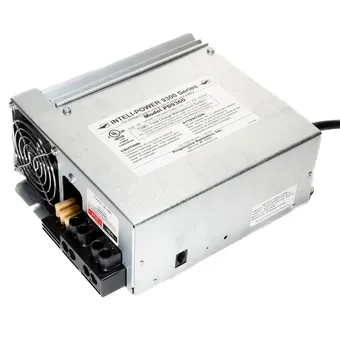
Progressive Dynamics Inteli-Power PD9360 60 Amp Converter Charger
Why it's here
The specification is unremarkable and the documentation is why it wins. Output is 13.2V to 14.7V DC at 60 amps, from a 1,000W input on a standard 15 amp plug. The unit is 3.6 by 8 by 9 inches and 5.8 lb, with reverse battery protection fuses, over-temperature logic, output short protection and GFCI compatibility. The fan is automatic and comes on around 140°F internal, so it is not running constantly.
What you are really buying is the profile system. Press the selector button for three seconds and the LED cycles green for flooded lead acid, white for AGM, blue for lithium, magenta for a constant 13.6V output. The manual then documents what each profile does. No other unit here tells you that.
By the cross-reference guide it replaces the Iota DLS-55, Parallax 7455 and 7465, and the PowerMax PM3-55 and PM4-55 — which is to say, most 55 to 60 amp deck-mount converters fitted in the last fifteen years.
Full specifications
| Output | 60A |
|---|---|
| Output voltage | 13.2V to 14.7V DC |
| Input voltage | 105V to 130V AC, 60 Hz |
| Input draw | 1,000W |
| AC plug | 15 amp |
| Charge profiles | Flooded lead acid, AGM, lithium, constant 13.6V |
| Dedicated lithium profile | Yes |
| Factory default profile | Flooded lead acid — must be changed by hand |
| How the profile is set | Button behind an access hole, held 3 seconds; LED colour indicates the profile |
| Mounting | Deck mount |
| Dimensions | 3.6 x 8 x 9 in |
| Weight (lb) | 5.8 |
| Fan | Automatic, switches on at roughly 140°F internal |
| Protections | Reverse battery fuses, over-temperature, output short, GFCI safe |
| Remote display | PD92201 pendant included in the retail (V-suffix) package the PDI store sells; optional via RJ-22 port on the base unit |
| Replaces | Iota DLS-55, Parallax 7455/7465, PowerMax PM3-55 and PM4-55, WFCO deck mounts |
| Warranty | Not stated in the manual — confirm before buying |
Specifications verified August 11, 2026 from PD9300 Series owner's manual — specifications and charge profiles (PDF) , PD9300 battery selection procedure, including factory default (PDF) , Progressive Dynamics converter cross-reference guide .
Strengths
- A real lithium charge profile, not an adjustable dial — the converter runs the logic
- Four profiles including a constant 13.6V mode for unusual cases
- The only unit here with a published owner's manual documenting the charge behaviour
- 60 amps from a standard 15 amp AC plug
- Optional PD92201 remote pendant so you can see what it is doing without opening a bay
Weaknesses
- Ships set to flooded lead acid — get this wrong and the upgrade achieves nothing
- Changing the profile needs an insertion tool through an access hole, which is fiddly in situ
- No warranty term stated in the manual or on the product page
- Deck mount only — no use if your converter is a section inside a distribution panel
Fit: Deck-mount replacement — it swaps for a standalone converter box, not for a converter section inside a distribution panel. If your converter is a slide-out section in a WFCO or Parallax power centre, you need a PD4655V-type section instead. Check dimensions against the existing installation before ordering.
Buy it if
You want the profile decided by the manufacturer rather than by you, and documentation you can check before and after fitting.
Choose something else if
Your converter is a slide-out section in a power centre — you want a PD4655V-type section instead.
Best for a 30 amp rig
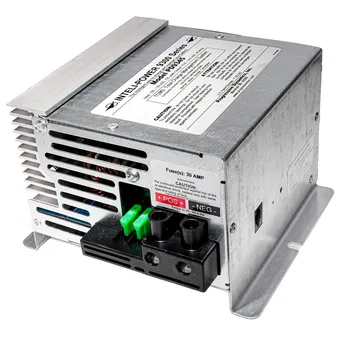
Progressive Dynamics Inteli-Power PD9345 45 Amp Converter Charger
Why it's here
The same converter as the PD9360 with less output and less appetite. 13.2V to 14.7V DC at 45 amps, 725W in, 15 amp plug, 4.5 by 8.25 by 7.25 inches and 4.5 lb.
The case for it is arithmetic rather than features. A 30 amp pedestal gives you 3,600W. This takes 725W of it while charging; the 60 amp unit takes 1,000W and the 80 amp unit 1,300W. If you have two 100Ah batteries, 45 amps refills them from half in a couple of hours, and the difference between that and 60 amps matters far less than the difference between charging and tripping the pedestal breaker.
There is a second arithmetic argument for buying small, and it is the one people miss: the battery may refuse the extra amps anyway. Battle Born publishes a 50 amp maximum charge current for its 100Ah battery, so a single one of those cannot use more than 50 amps however large the converter is — an 80 amp unit finishes about twelve minutes sooner than this one and no sooner than a 55 amp one. The charge time calculator shows which ceiling your own bank runs into.
Replaces the Iota DLS-45, Parallax 7440 and 7445, PowerMax PM3-45 and PM4-45, and the WFCO WF-9845.
Full specifications
| Output | 45A |
|---|---|
| Output voltage | 13.2V to 14.7V DC |
| Input voltage | 105V to 130V AC, 60 Hz |
| Input draw | 725W |
| AC plug | 15 amp |
| Charge profiles | Flooded lead acid, AGM, lithium, constant 13.6V |
| Dedicated lithium profile | Yes |
| Factory default profile | Flooded lead acid — must be changed by hand |
| How the profile is set | Button behind an access hole, held 3 seconds; LED colour indicates the profile |
| Mounting | Deck mount |
| Dimensions | 4.5 x 8.25 x 7.25 in |
| Weight (lb) | 4.5 |
| Fan | Automatic, switches on at roughly 140°F internal |
| Protections | Reverse battery fuses, over-temperature, output short, GFCI safe |
| Remote display | PD92201 pendant included in the retail (V-suffix) package the PDI store sells; optional via RJ-22 port on the base unit |
| Replaces | Iota DLS-45, Parallax 7440/7445, PowerMax PM3-45 and PM4-45, WFCO WF-9845 |
| Warranty | Not stated in the manual — confirm before buying |
Specifications verified August 11, 2026 from PD9300 Series owner's manual — specifications and charge profiles (PDF) , PD9300 battery selection procedure, including factory default (PDF) .
Strengths
- 725W input draw — the gentlest on a 3,600W shore supply of anything here
- Same four-profile system and same documentation as the PD9360
- Lightest unit on the page at 4.5 lb
- 45 amps is a sensible match for one or two lithium batteries
Weaknesses
- Same factory-default lead acid trap as the rest of the PD9300 range
- A larger bank charged from empty will take noticeably longer than it would on 60 or 80 amps
- Taller than the PD9360 at 4.5 inches, which can matter in a shallow bay
- No stated warranty term
Fit: The sensible size for a 30 amp rig with one or two lithium batteries. At 725W input it leaves more of a 3,600W shore supply for everything else than the 60 or 80 amp units do.
Buy it if
You have 30 amp service and one or two batteries. This is the size most travel trailers should be fitting.
Choose something else if
You have a large bank you regularly run down and refill from shore power.
Best value
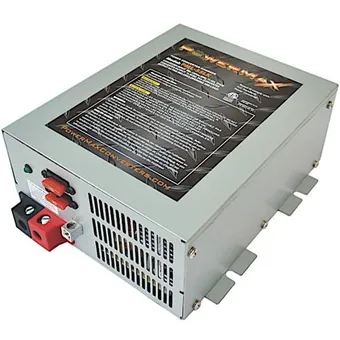
PowerMax PM3-55LK 55 Amp Deck Mount RV Converter Charger
Why it's here
The honest case for this unit is the price, and it is a real case. Fifty-five amps of deck-mount converter for about half what the equivalent Progressive Dynamics unit costs is a meaningful saving on a project that is already expensive.
The honest case against is that PowerMax publishes almost nothing. We could not find a manual, a specification sheet or a stated warranty term — the listing says “adjustable output supports properly configured lithium charging requirements”, which puts the words “properly configured” between you and a working charge, and then does not tell you what proper means.
If you already know that LiFePO4 wants roughly 14.4V of absorption, you can set this and be fine. If you were hoping the converter would know that, buy the Progressive Dynamics.
Full specifications
| Output | 55A |
|---|---|
| Output voltage | Adjustable — no fixed lithium profile published |
| Input voltage | 110V AC |
| Charge profiles | Three-stage smart charging, plus an adjustable output |
| Dedicated lithium profile | No |
| Mounting | Deck mount |
| Weight (lb) | 6.7 |
| Replaces | Deck-mount converters of similar output — check dimensions |
| Published documentation | No published manual or specification sheet found |
| Warranty | Policy page published, no term stated — confirm before buying |
Specifications verified August 10, 2026 from PowerMax PM3 Lithium Plus series page , Progressive Dynamics cross-reference — PowerMax PM3-55 fitment class .
Strengths
- Roughly half the price of the equivalent Progressive Dynamics unit
- 55 amps, three-stage charging, and an output you can set where you want it
- Widely stocked on Amazon, so replacement and returns are straightforward
- Deck mount, so it drops into the most common fitment class
Weaknesses
- No published manual or specification sheet — for a device charging a four-figure battery bank
- "Lithium compatible" here means an adjustable voltage, not a dedicated profile with its own logic
- Setting and verifying the output voltage is your job, with no documented procedure
- No warranty term stated anywhere we could find
Fit: Lithium capability here means an adjustable output voltage you set yourself, not a defined lithium charge profile the converter runs on its own. That is a meaningful difference: it works, but the setup is on you and there is no published procedure to follow.
Buy it if
You are comfortable with a multimeter, you know what voltage you want, and the price difference matters more than the documentation.
Choose something else if
You want to fit it, select lithium, and stop thinking about it.
Most output
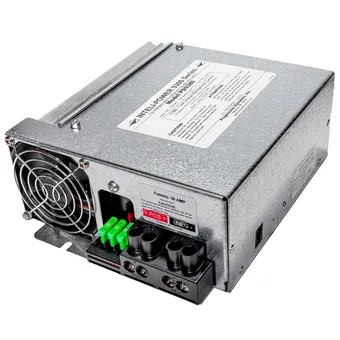
Progressive Dynamics Inteli-Power PD9380 80 Amp Converter Charger
Why it's here
The output figure is the least interesting thing about this converter. The important line in the specification is the input: 1,300W, on a 20 amp AC plug.
That plug requirement is easy to miss and awkward to discover after delivery. Progressive Dynamics flags it explicitly in the cross-reference guide, marking the PD9380 with a 20 amp plug note wherever it appears as a replacement for the Iota DLS-75 and PowerMax PM3-75 and PM4-75.
Everything else matches the PD9360 — 13.2V to 14.7V output, four selectable profiles, automatic fan, the same protections. Buy it if the bank justifies it and the service supports it.
Full specifications
| Output | 80A |
|---|---|
| Output voltage | 13.2V to 14.7V DC |
| Input voltage | 105V to 130V AC, 60 Hz |
| Input draw | 1,300W |
| AC plug | 20 amp — not the 15 amp plug the smaller units use |
| Charge profiles | Flooded lead acid, AGM, lithium, constant 13.6V |
| Dedicated lithium profile | Yes |
| Factory default profile | Flooded lead acid — must be changed by hand |
| How the profile is set | Button behind an access hole, held 3 seconds; LED colour indicates the profile |
| Mounting | Deck mount |
| Dimensions | 3.6 x 8 x 9 in |
| Weight (lb) | 6 |
| Fan | Automatic, switches on at roughly 140°F internal |
| Protections | Reverse battery fuses, over-temperature, output short, GFCI safe |
| Remote display | PD92201 pendant included in the retail (V-suffix) package the PDI store sells; optional via RJ-22 port on the base unit |
| Replaces | Iota DLS-75, PowerMax PM3-75 and PM4-75 |
| Warranty | Not stated in the manual — confirm before buying |
Specifications verified August 11, 2026 from PD9300 Series owner's manual — specifications and charge profiles (PDF) , Progressive Dynamics converter cross-reference guide .
Strengths
- 80 amps — the fastest shore charge here for a large bank
- Same documented four-profile system as the rest of the range
- Same compact 3.6 by 8 by 9 inch case as the 60 amp unit, only 6 lb
- A genuine match for a 270Ah battery or a multi-battery bank
Weaknesses
- Needs a 20 amp AC plug, not the 15 amp plug the rest of the range uses
- 1,300W of draw is over a third of a 30 amp pedestal's entire capacity
- Pointless above the battery bank's own maximum charge current
- The most expensive unit here, for capacity most rigs cannot use
Fit: The 20 amp AC input plug is the constraint, not the DC output. On a 30 amp rig a converter drawing 1,300W is over a third of everything the pedestal will give you, before the air conditioner. This is a large-bank, 50 amp service unit.
Buy it if
You have 50 amp service and a large bank, and refilling it quickly from shore power is worth paying for.
Choose something else if
You have 30 amp service. This is the wrong end of the range for you regardless of bank size.
Most output for the money
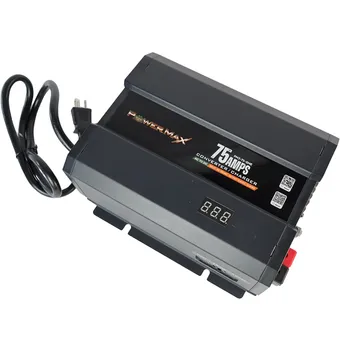
PowerMax PM3-75LK 75 Amp RV Power Converter
Why it's here
Included because high-output converters are otherwise expensive, and this is the cheap way into 75 amps. The reservations are the same as the PM3-55LK’s, and they scale with the price of the battery bank it is charging.
The practical warning is the listing itself: it carries size variants from 15A to 60A alongside the 75A version, on one page. Confirm the selected size before ordering, and confirm it again on the unit when it arrives.
Full specifications
| Output | 75A |
|---|---|
| Output voltage | Adjustable — no fixed lithium profile published |
| Input voltage | 110V AC |
| Charge profiles | Three-stage smart charging, plus an adjustable output |
| Dedicated lithium profile | No |
| Mounting | Deck mount |
| Replaces | Deck-mount converters of similar output — check dimensions |
| Published documentation | No published manual or specification sheet found |
| Warranty | Policy page published, no term stated — confirm before buying |
Specifications verified August 10, 2026 from PowerMax PM3 Lithium Plus series page .
Strengths
- 75 amps at a price well under the equivalent Progressive Dynamics unit
- Three-stage charging with an adjustable output for lithium
- Sold in a range from 15A to 60A alongside this one, so the family covers most rigs
- Amazon-stocked, unlike most converters at this output
Weaknesses
- Same documentation problem as the PM3-55LK, on a larger and more expensive unit
- Listed with multiple size variants — easy to order the wrong output at checkout
- A converter this size on 30 amp service is the wrong purchase regardless of price
- No stated warranty term
Fit: Sold as one size in a range that also covers 15A to 60A, so check the variant selected at checkout matches the output you want. A converter this size belongs on 50 amp service — see the note on the PD9380 about what a large converter costs you at a 30 amp pedestal.
Buy it if
You want high output on a budget and you are confident configuring it yourself.
Choose something else if
You are not certain which variant you are adding to the basket. Check the size selector twice.
How to choose
Check what you already have first. If it has a lithium setting, you are done and this page cost you nothing. Progressive Dynamics power centres frequently do.
Then identify the fitment class. Deck mount, converter section, or wall-mount power centre. This narrows the field before any specification matters.
Then decide profile or dial. A defined lithium profile costs more and thinks for you. An adjustable output costs less and expects you to know the number. Neither is wrong; pretending they are the same thing is.
Then size to the service, not the bank. Thirty amp service means 45 amps of converter unless you have a specific reason. Fifty amp service and a large bank can use 60 or 80.
Then check the battery’s maximum charge current. Buying more converter than the bank will accept is money spent on nothing. If you have not settled the bank yet, size that first in what size lithium battery do I need — the converter follows from it, not the other way round.
And if an inverter is on the same shopping list, stop before buying either. An inverter/charger replaces the converter and adds automatic switchover in one box, and it changes this page’s arithmetic — the fork is worked through in inverter vs inverter/charger.
Related guides
- Best RV lithium batteries — the batteries this converter exists to charge, compared on charge temperature and BMS current.
- Charging lithium in cold weather — a correctly configured converter still charges nothing if the battery is below its threshold.
- Battle Born vs Dakota Lithium — both accept 50 amps maximum, so neither justifies the biggest converter here.
- 30 amp vs 50 amp RV — what your service provides, and why converter input draw matters more than output.
- Why does my RV breaker keep tripping? — a new high-output converter is a new load, and it starts the moment you plug in.
- Best RV surge protectors — a converter and a lithium bank are the most expensive things downstream of the pedestal.
- EMS vs surge protector — sustained low voltage makes a converter underperform as surely as the wrong profile does.
- The electrical section collects everything published so far.
For how products on this site are selected and what we do not claim about them, see the editorial policy.
Questions worth answering
Will my existing RV converter charge a lithium battery?
It will charge it, but usually not fill it. Converters built for lead acid commonly hold around 13.6V, and LiFePO4 needs roughly 14.2V to 14.6V to finish. Dakota Lithium states the outcome plainly for its own batteries — a lead acid charger will work, but will only reach about 80% of capacity. Nothing is damaged. You simply paid for 100Ah and receive 80Ah, every cycle, and the battery usually gets the blame.
How do I tell what converter I already have?
Look for a label on the unit itself. It is either a standalone box on a shelf or in a bay, or a section inside the distribution panel where the 12V fuses and 120V breakers live. The model number matters more than the brand, because it determines which replacement physically fits.
Do I need a new converter if I already have solar?
Often not urgently. A solar charge controller set to a lithium profile can do the finishing charge the converter cannot, so a rig that spends its days in the sun may already reach full. The converter still matters for shore power and cloudy weeks, and it is the reason a bank looks fine in July and never fills in November.
Is a bigger converter always better?
No, and on a 30 amp rig it can be actively worse. An 80 amp converter draws around 1,300W from the pedestal while it works, out of the 3,600W a 30 amp hookup provides. That is a third of your supply gone before the air conditioner starts. Match the converter to the service and the bank, not to the biggest number available.
Can I just turn my converter's voltage up instead?
On units with an adjustable output, yes — that is how the PowerMax models here achieve lithium charging. It works, but you are setting and verifying the voltage yourself with no published procedure, and there is no profile logic underneath deciding when to stop. A converter with a defined lithium mode does that for you.