For most rigs the Battle Born BB10012 is the one to buy: 100Ah, 100 amps continuous, 100% usable capacity and a ten-year warranty, with a datasheet that answers questions the rest of the category avoids. If the price is the problem, the LiTime 12V 100Ah Group 24 does the same job for a fraction of it. If you camp in winter and charge while you are out there, the Dakota Lithium 100Ah has the heater built in.
The battery is the easy part. What decides whether this upgrade works is the charger you already own and the temperature you camp in, and both are covered below.
Quick picks
Best overall
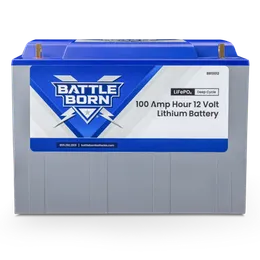
Battle Born BB10012
Documented to the last figure, assembled in Nevada, and it accepts charge seven degrees colder than most rivals.
Best value
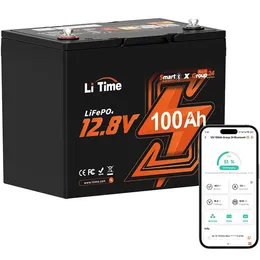
LiTime 100Ah Group 24 BT
Group 24 fit and a published 4,000 cycles at full depth of discharge, at a fraction of the US-assembled price.
Best for winter camping
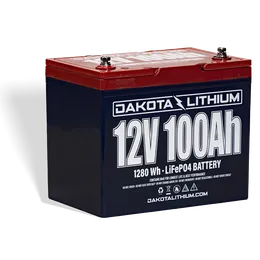
Dakota Lithium 100Ah Heated
Internal heating built into the standard model rather than sold as an upgrade, behind an eleven-year warranty.
Best single large battery
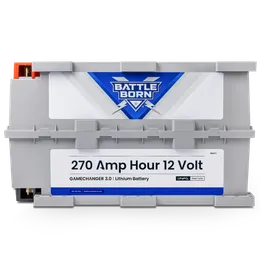
Battle Born BBGC3
270Ah and 300A continuous from one case — enough to run a 3,000W inverter without paralleling.
Best for a tight battery bay
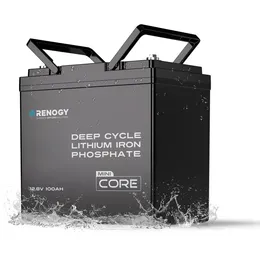
Renogy Core Mini 100Ah
A full 100Ah in a Group 22NF case, for the van and teardrop builds nothing else fits.
How the five compare
| Model | Capacity | Continuous discharge | Charge temp | Heated | Weight (lb) | Warranty | Price | Buy |
|---|---|---|---|---|---|---|---|---|
| Battle Born BB10012 | 100Ah | 100A | 25°F to 135°F | No | 31 | 10 years | $$$$$ | Check price(opens in a new tab) |
| LiTime 100Ah Group 24 BT | 100Ah | 100A | 32°F to 122°F | No | 21.9 | 5 years | $$$ | Check price(opens in a new tab) |
| Dakota Lithium 100Ah Heated | 100Ah | 100A | — | Yes | 27.55 | 11 years | $$$$ | Check price(opens in a new tab) |
| Renogy Core Mini 100Ah | 100Ah | 100A | — | No | 22.7 | 5 years, prorated | $$$ | Check price(opens in a new tab) |
| Battle Born BBGC3 | 270Ah | 300A | 25°F to 135°F | No | 80.8 | 10 years | $$$$$ | Check price(opens in a new tab) |
What you are actually buying
A lead-acid house battery should not be taken below roughly half charge. Do it regularly and it will not last. So the 100Ah pair in your battery bay has never been a 200Ah bank — it has been a 100Ah bank that weighs 130 pounds and takes all afternoon to refill.
LiFePO4 removes that rule. Battle Born publishes 100% usable depth of discharge on the BB10012, and LiTime rates its cells at 4,000 cycles taken to full depth of discharge rather than half. One 100Ah lithium battery at 31 lb does the work of two 100Ah lead-acid batteries at 130 lb, and it does it for several thousand cycles rather than several hundred.
That is the honest case for the upgrade, and it is a strong one — though not universal. If you mostly stay on shore power and rarely discharge the bank, the advantages never arrive and AGM remains the better buy; we set the two side by side in lithium vs AGM.
What follows is the part the category leaves out.
The number nobody publishes: when it will take a charge
Every manufacturer here publishes two temperature ranges. Almost every roundup reports one of them.
The discharge range is wide — most of these batteries will supply power down to -4°F. The charge range is much narrower, because pushing current into a cold LiFePO4 cell plates lithium onto the anode and permanently damages it. The BMS prevents that by refusing the charge, which means that on a cold morning your solar controller works, your alternator works, and the battery quietly accepts nothing.
Battle Born BB10012
The most generous cutoff here — charging is permitted seven degrees below freezing.
Dakota Lithium 100Ah heated
Below 32°F the internal element warms the cells to 41°F, then charging proceeds.
LiTime 100Ah Group 24
LiTime states this model should only be charged above 32°F and recommends bringing it indoors on cold days.
Victron LFP Smart 12.8/100
The strictest limit of the group — nine degrees above freezing before it will charge.
Will supply power Will accept charge Freezing, 32°F
Capacity falls in the cold as well, which is a separate problem from charging — Victron rates the same cell stack at 100Ah at 77°F but only 80Ah at freezing. (Victron itself is not recommended below; see what we left out.)
Heated models solve the charging half, and they are not free: Battle Born publishes 28W of continuous draw for the BB10012H’s element, which works out at roughly a third of a 100Ah battery’s own capacity over 24 hours at 15°F. That is an argument for sizing a winter bank generously rather than for avoiding heated batteries.
For the full picture — what the cold does to the cells, every manufacturer’s published threshold, what the heater costs by temperature, and how to store a pack through a freeze — see charging RV lithium batteries in cold weather.
Your converter is probably the reason it never reaches 100%
LiFePO4 wants roughly 14.2V to 14.6V of absorption voltage to finish a charge. Battle Born specifies 14.2V to 14.6V absorption and 13.4V to 13.8V float. LiTime specifies 14.4V ± 0.2V. Renogy specifies 14.4V.
A converter designed for lead-acid commonly sits around 13.6V. Dakota Lithium states it directly: a lead-acid charger will work, but will only charge the battery to about 80% of capacity. Nothing breaks. You simply bought 100Ah and receive 80Ah, forever, and the battery is blamed for it.
So budget for one of three things: a lithium-capable converter, a converter with a selectable lithium profile, or a solar controller doing the real charging with a lithium profile set. Which one you can fit is decided by whether your existing converter is a standalone box or a section inside the distribution panel — we go through the fitment classes, the profile-versus-adjustable-voltage distinction, and the units worth buying in the best RV converter for lithium batteries.
Charging from the tow vehicle needs its own answer. Lithium’s internal resistance is tiny — Battle Born publishes 7 milliohms for the BB10012, Victron 0.8 for the 12.8/100 — so a depleted bank will draw as much as the alternator can physically produce and hold it there. That is how alternators are cooked. A DC-DC charger caps the current at something the alternator is rated for — and on any recent vehicle it is also the only thing that will charge the bank at all, because modern alternators drop their voltage. Whether you actually need one is worked through in do I need a DC to DC charger?
Note also that the batteries disagree about how fast they want to be filled. The BB10012 accepts 50A maximum. The GC3 accepts 135A. LiTime’s Group 24 will take 100A but recommends 20A. Sizing a charger above the battery’s maximum buys nothing.
Read the BMS rating, not the amp hours
The BMS decides how much current the battery will pass before it disconnects, and that figure — not capacity — is what determines whether an inverter will run.
A 100A continuous BMS at 12.8V is about 1,280W. Run a 2,000W inverter near its rating and the battery will shut down protecting itself, no matter how many amp hours are left in it. Two batteries in parallel share that load; one Battle Born GC3 at 300A continuous carries it alone. The other side of that arithmetic — which inverter sizes match which banks, and the units worth buying — is worked through in the best RV inverters. To get the count for your own rig — how many of which battery, checked against both your amp-hours and your inverter’s current — the RV battery calculator does the arithmetic from your appliance list.
Surge ratings are separate and short. Battle Born allows 200A for 30 seconds on the BB10012 and 500A for 30 seconds on the GC3. LiTime publishes 400A for one second. Dakota publishes 200A for a ten-second pulse. Those windows exist for motor startup, not for running loads.
The batteries in detail
Best overall
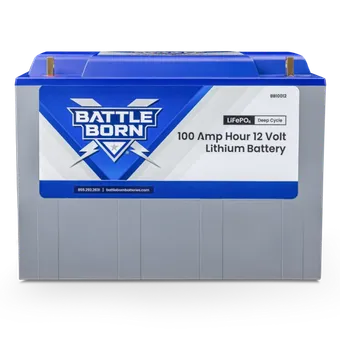
Battle Born 100Ah 12V LiFePO4 Deep Cycle Battery
Why it's here
The specification that justifies the price is not the capacity, which is ordinary, but the charge temperature range: 25°F to 135°F, against the 32°F floor almost everyone else publishes. Seven degrees sounds trivial until it is the difference between a solar controller that works in October and one that does not.
Everything else is unglamorous and correct. 100A continuous, 200A surge for 30 seconds, absorption 14.2V to 14.6V, float 13.4V to 13.8V, rebulk at 13.3V, 3,000 to 5,000 cycles, 31 lb in a Group 27 or Group 31 footprint. Cells are UL 1642 listed, the pack is ETL listed to UL 62133-2 and UL 2054, and the whole thing carries an IP65 rating and a Class 1 Division 2 listing.
A heated version, the BB10012H, is available where sub-freezing charging matters — with the caveats about draw and hazardous-location listing noted above.
Full specifications
| Capacity | 100Ah |
|---|---|
| Nominal voltage | 12V |
| Cell chemistry | LiFePO4, cylindrical cells |
| Continuous discharge | 100A |
| Peak discharge | 200A for 30 seconds |
| Max charge current | 50A |
| Recommended charge current | 0.5C |
| Internal resistance | 7 mΩ — published by Battle Born for the BB10012i Smart variant. The standard BB10012 datasheet does not state one, so treat it as the family figure rather than this model's. Cited because it is nearly nine times Victron's 0.8 mΩ prismatic figure, and that spread decides how far a voltage reading moves under load |
| Absorption voltage | 14.2V to 14.6V |
| Float Voltage | 13.4V to 13.8V |
| Usable depth of discharge | 100% |
| Cycle life | 3,000–5,000 cycles |
| Discharge temperature | -4°F to 135°F |
| Charge temperature | 25°F to 135°F |
| Internal heating | No |
| Bluetooth | No |
| Series and parallel | Series to 48V, unlimited in parallel |
| Group size | Replaces Group 27 and Group 31 |
| Dimensions | 12.76 x 6.86 x 8.95 in |
| Weight (lb) | 31 |
| Terminals | 0.25 in brass flag, 3/8 in hole, 9–11 ft-lb |
| Certifications | Cells UL 1642 and UN38.3; pack ETL listed to UL 62133-2 and UL 2054; IP65; Class 1 Division 2; CE |
| Assembly | Assembled in the USA |
| Warranty | 10 years |
Specifications verified August 10, 2026 from Battle Born BB10012 data sheet (PDF) , Battle Born BB10012 product page .
Strengths
- Charges down to 25°F — the most generous cold cutoff of any non-heated battery here
- 100% usable depth of discharge, published rather than implied
- Ten-year warranty, assembled in Reno from UL-listed cells
- Series connection to 48V with no limit in parallel, so the bank can grow
- The most complete published datasheet in the category, down to terminal torque
Weaknesses
- The most expensive way to buy 100Ah, by a wide margin
- No Bluetooth or monitoring on the standard model — that is the Smart variant
- 50A maximum charge current is modest for a bank being refilled from solar and shore together
- Sold direct rather than through Amazon, so no marketplace returns process
Fit: Physically replaces a Group 27 or Group 31 lead-acid battery. The BMS refuses charge below 25°F; the BB10012H adds integrated heating for sub-freezing charging. Series connection is permitted up to 48V.
Buy it if
You want the battery you stop thinking about, with documentation you can check, and the ten-year term matters more than the purchase price.
Choose something else if
You are building the largest bank your budget allows. Two cheaper batteries hold more energy than one Battle Born.
Best value
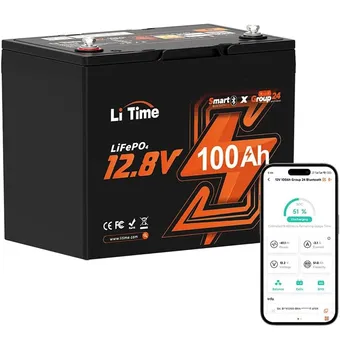
LiTime 12V 100Ah Group 24 Bluetooth LiFePO4 Battery
Why it's here
The obvious budget choice, and a defensible one. 1,280Wh, a 100A BMS, 400A for one second, IP65, M8 terminals, five-year warranty, and a Group 24 case that solves the fitment problem more often than the specification sheet suggests.
Two things deserve credit. LiTime publishes the full temperature table rather than a single number, and on its own product page it states that this model should only be charged above 32°F and that the best practice on cold days is to bring the battery indoors. That is a manufacturer talking a customer out of a sale, and it is more candour than several of the pages currently outranking this one manage.
The cycle-life gap is worth understanding rather than treating as dishonesty. The 15,000-cycle figure that appears in listings and the 4,000-cycle figure on LiTime’s specification page are both real; they describe the same cells taken to very different depths of discharge. Plan on the 4,000, since taking the full capacity is why you bought lithium.
For sub-freezing charging LiTime sells a self-heating version of this same battery, which is the cheaper answer to winter than any heated battery from the US brands.
Full specifications
| Capacity | 100Ah |
|---|---|
| Nominal voltage | 12.8V |
| Stored energy | 1280Wh |
| Cell chemistry | LiFePO4, prismatic cells |
| Continuous discharge | 100A |
| Peak discharge | 400A for 1 second |
| Max charge current | 100A |
| Recommended charge current | 20A |
| Charge voltage | 14.4V ± 0.2V |
| Usable depth of discharge | 100% |
| Cycle life | 4,000+ cycles at 100% DoD |
| Discharge temperature | -4°F to 140°F |
| Charge temperature | 32°F to 122°F |
| Low-temperature protection | Charging blocked below freezing |
| Internal heating | No |
| Bluetooth | Yes |
| Series and parallel | Up to 4S4P, 20.48kWh maximum |
| Group size | Group 24 |
| Dimensions | 10.24 x 6.61 x 8.27 in |
| Weight (lb) | 21.9 |
| Terminals | M8 bolts |
| Housing | ABS, IP65 |
| Warranty | 5 years |
Specifications verified August 10, 2026 from LiTime 12V 100Ah Group 24 specifications and cold-weather guidance .
Strengths
- Group 24 footprint at 21.9 lb — fits trays that will not take a Group 31 battery
- 4,000+ cycles at 100% depth of discharge, published as a specification rather than a headline
- Bluetooth monitoring included at this price
- LiTime publishes its full charge, discharge and storage temperature ranges
- Expandable to 4S4P for a 20.48kWh bank
Weaknesses
- Charging blocked below 32°F, and the BMS warms nothing — LiTime tells you to bring it indoors
- Five-year warranty against Battle Born's ten and Dakota's eleven
- Marketing quotes up to 15,000 cycles, which is a different test from the 4,000 figure on the specification page
- Warranty terms are published as a headline period rather than a document you can read
Fit: Group 24 is the smaller of the two common RV trays, so this fits where a Group 31 battery will not. LiTime states this model must only be charged above 32°F — the BMS blocks charging below that, it does not warm the cells. For sub-freezing charging LiTime sells a self-heating version of the same battery.
Buy it if
You want the most usable capacity per dollar and you camp in weather where charging above freezing is a given.
Choose something else if
You charge in sub-freezing conditions, or you want a warranty you can read the exclusions of before buying.
Best for winter camping
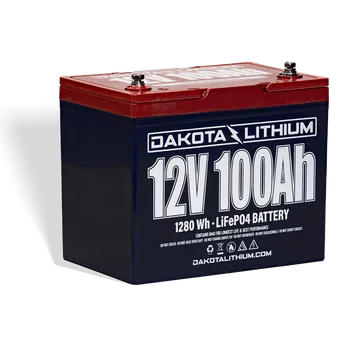
Dakota Lithium 12V 100Ah Deep Cycle Heated LiFePO4 Battery
Why it's here
Heating is the differentiator, and the behaviour is specific: when charging is attempted below 32°F, the internal element warms the cells to 41°F first, then allows the charge. That is the mechanism that makes winter solar useful rather than decorative.
The eleven-year warranty is the longest here, though read what it is: Dakota describes it as a manufacturer defect warranty, not a guarantee of capacity retention. Those are different promises, and every battery on this page makes the first kind rather than the second.
The rest is solid and conventional. 100A continuous, 200A for a ten-second pulse, 50A maximum charge, 14.4V recommended, M8 terminals to 15 ft-lb, Group 24 at 10.23 by 6.60 by 8.66 inches. Dakota’s own note that a lead-acid charger will only reach about 80% is the single most useful sentence any manufacturer in this group publishes.
Full specifications
| Capacity | 100Ah |
|---|---|
| Nominal voltage | 12V |
| Cell chemistry | LiFePO4 |
| Continuous discharge | 100A |
| Peak discharge | 200A for 10 seconds |
| Max charge current | 50A |
| Charge voltage | 14.4V recommended, 15V maximum |
| Cycle life | Up to 5,000 cycles to 80% capacity |
| Operating temperature | -4°F to 140°F |
| Internal heating | Yes |
| How the heater behaves | Below 32°F the internal element warms the cells to 41°F before charging |
| Bluetooth | No |
| Group size | Group 24 |
| Dimensions | 10.23 x 6.60 x 8.66 in |
| Weight (lb) | 27.55 |
| Terminals | M8 bolts, 15 ft-lb maximum |
| BMS protections | Cell balancing, low and high voltage cutoff, short circuit and high temperature protection |
| Warranty | 11 years |
Specifications verified August 10, 2026 from Dakota Lithium 12V 100Ah specifications, heating behaviour and warranty .
Strengths
- Eleven-year warranty — the longest published term of any battery here
- Internal heating included in the standard model rather than sold as a separate SKU
- Group 24 case at 27.55 lb, so it fits where the larger packs do not
- Dakota states the lead-acid charger problem openly rather than leaving buyers to find it
- Up to 5,000 cycles to 80% remaining capacity
Weaknesses
- Dakota does not publish the heater's power draw, so you cannot budget for it as you can with Battle Born
- No Bluetooth or app monitoring
- 15V maximum charge voltage is higher than the rest of this group — match the charger carefully
- Deep cycle only, and Dakota is explicit that it is not for engine starting
Fit: Group 24 footprint with internal heating included rather than sold as a separate model. Deep cycle only — Dakota states it is not designed for engine starting. Dakota also notes a lead-acid charger will work but will only fill the battery to about 80%.
Buy it if
You camp through the winter and need charging to work below freezing without moving the battery indoors.
Choose something else if
You need to know exactly what the heater costs you overnight — Battle Born publishes that figure and Dakota does not.
Best single large battery
Battle Born 270Ah 12V GC3 LiFePO4 Deep Cycle Battery
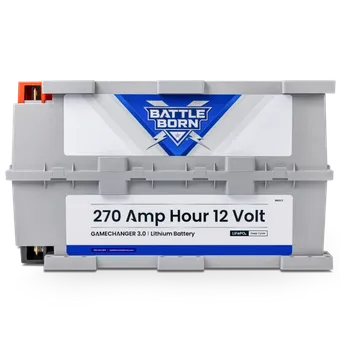
Why it's here
This is the battery for people whose problem is current, not capacity. Most 12V lithium batteries stop at 100A continuous, which caps you at roughly 1,280W regardless of how many amp hours sit behind it. The GC3 passes 300A, so a single battery runs an inverter that would otherwise need three in parallel.
Charge acceptance scales with it: 135A maximum, and an absorption time Battle Born puts at 100 minutes per 270Ah bank. The trade is physical. At 80.8 lb in a 22.83 by 7.09 by 13.15 inch case, this is a two-person lift into a bay that has to be measured first — the height is what catches people, not the footprint.
Electrically it is the BB10012 scaled up, including the 25°F charge floor and the ten-year warranty.
Full specifications
| Capacity | 270Ah |
|---|---|
| Nominal voltage | 12V |
| Cell chemistry | LiFePO4, cylindrical cells |
| Continuous discharge | 300A |
| Peak discharge | 500A for 30 seconds |
| Max charge current | 135A |
| Recommended charge current | 0.5C |
| Absorption voltage | 14.2V to 14.6V |
| Float Voltage | 13.4V to 13.8V |
| Usable depth of discharge | 100% |
| Cycle life | 3,000–5,000 cycles |
| Discharge temperature | -4°F to 135°F |
| Charge temperature | 25°F to 135°F |
| Internal heating | No |
| Bluetooth | No |
| Series and parallel | Series to 48V, unlimited in parallel |
| Group size | GC3 |
| Dimensions | 22.83 x 7.09 x 13.15 in |
| Weight (lb) | 80.8 |
| Terminals | 0.25 in brass flag, 3/8 in hole, 9–11 ft-lb |
| Certifications | Cells UL 1642 and UN38.3; pack certified to UL 62133-2; IP65; Class 1 Division 2; CE |
| Assembly | Assembled in the USA |
| Warranty | 10 years |
Specifications verified August 10, 2026 from Battle Born BBGC3 product cutsheet (PDF) , Battle Born BBGC3 product page .
Strengths
- 300A continuous — enough for a 3,000W inverter from one battery
- 270Ah in a single case, with one set of cables and one set of connections to fail
- 135A maximum charge current, so it refills as fast as you can feed it
- Same ten-year warranty and same 25°F charge floor as the BB10012
- 500A surge for 30 seconds covers air conditioning startup
Weaknesses
- 80.8 lb, and the GC3 case is tall — 13.15 inches of headroom, not just floor space
- Expensive enough that two mid-market 100Ah batteries hold comparable energy for less
- No internal heating unless you buy the BBGC3H
- Sold direct, so no marketplace price comparison
Fit: Tall and narrow GC3 case — measure headroom as well as floor area, and check the tray will take 81 lb. The 300A continuous rating is what makes a single battery viable behind a 3,000W inverter. A heated version, the BBGC3H, is available for sub-freezing charging.
Buy it if
You are running a serious inverter and would rather have one battery, one shunt and one set of lugs than four of everything.
Choose something else if
Your battery bay is a standard tray. Measure the height before anything else.
Best for a bay nothing else fits
Renogy Core Mini 12V 100Ah LiFePO4 Battery
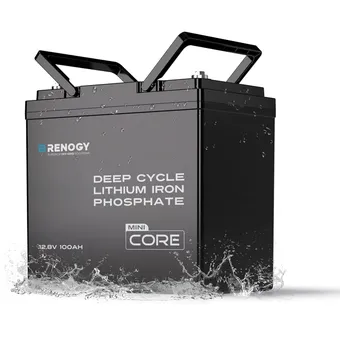
Why it's here
Included for a specific problem: teardrops, van conversions and truck campers where the battery box was sized for something small and there is no room to enlarge it. Group 22NF is meaningfully smaller than Group 24, and getting a full 100Ah into that footprint is the achievement.
The missing cycle-life specification is the reason this sits last rather than higher. Renogy published a cycle-life figure for its now-delisted 100Ah Smart and does not for this one, and cycle life is the number that decides whether a lithium battery was worth its price. Treat the compactness as the reason to buy and the longevity as unquantified.
Full specifications
| Capacity | 100Ah |
|---|---|
| Nominal voltage | 12.8V |
| Cell chemistry | LiFePO4 |
| Continuous discharge | 100A |
| Peak discharge | 300A surge |
| Low-temperature protection | BMS blocks charging at low temperature |
| Internal heating | No |
| Bluetooth | No |
| Communication | Compatible with Renogy remote monitoring |
| Group size | Group 22NF |
| Dimensions | 9.02 x 5.43 x 8.39 in |
| Weight (lb) | 22.7 |
| Housing | IP65 |
| BMS protections | 100A, with low temperature charging, high temperature, overvoltage, undervoltage, overcurrent and short circuit protection |
| Warranty | 5 years, prorated |
| Cycle life | Not published by Renogy for this model |
Specifications verified August 10, 2026 from Renogy Core Mini series product page , Renogy limited warranty document, prorated battery terms (PDF) .
Strengths
- Group 22NF case at 9.02 by 5.43 by 8.39 inches — around half the volume of a Group 31 battery
- 100Ah in 22.7 lb, so a teardrop or van build can carry real capacity
- 300A peak surge from a 100A BMS
- Low-temperature charging protection built in
- IP65, and compatible with Renogy remote monitoring
Weaknesses
- Renogy does not publish a cycle life figure for this model, which is a strange omission
- Renogy's battery warranty is prorated — free replacement in the first 12 months, then you pay a share of the original price scaled by the time remaining
- No internal heating
- The small case is the entire reason to buy it — in a standard tray you are paying for compactness you do not need
Fit: Group 22NF is smaller than Group 24, which is the point — this is the one that fits a battery box in a teardrop or a van build where nothing else will. Renogy states it is around half the volume of a Group 31 battery.
Buy it if
Your battery space is the constraint. Measure the bay, and if a Group 24 will not go in, this probably will.
Choose something else if
You have a normal battery tray. Buy on specification instead, because this one's advantage is dimensional.
How to choose
Start with the tray. Measure length, width and height, including terminal clearance and the lid. Group 24 is the common RV size, Group 31 is larger, Group 22NF is smaller, and GC3 is taller than most bays allow. Everything else is negotiable; this is not. Every case on this page is drawn to scale, with the capacity arithmetic alongside it, in what size lithium battery do I need.
Then decide about winter. If you will ever charge below freezing, you need either a heated battery or a battery you can carry somewhere warm. This is the question most likely to make an otherwise correct purchase wrong.
Then look at the BMS current, not the capacity. Add up what runs through the inverter at once — what size inverter do I need is the worksheet for that. If the answer is over about 1,200W, one 100A battery will not carry it regardless of amp hours.
Then budget for the charger. A lithium-capable converter or solar profile, and a DC-DC charger if you charge while driving. Skipping this is how people end up with an expensive battery that never passes 80%.
Then read the warranty term as a document, not a number. Ten years flat and five years prorated are not comparable, and neither is a defect warranty the same as a capacity guarantee.
Amp hours come last, because by this point the choice has usually made itself.
What we left out, and why
The pages currently ranking for this query recommend a rotating cast of names — VATRER, NewtiPower, Dumfume, TEMGOT, WattCycle, GREENOE — mostly 300Ah units at prices the established brands cannot approach, usually with a claim of 15,000 cycles.
We did not include them, for reasons that are checkable rather than snobbish. There is no published warranty document to read, only a headline year count. The model numbers change between listings, so a review written six months ago may describe a different product with the same name. The cycle-life claims are quoted without the depth of discharge that would make them meaningful. And there is frequently no US entity to make a warranty claim against three years from now, which is when a battery warranty starts to matter.
The specifications may well be accurate. The point is that nothing published allows anyone to check, and this site’s recommendations rest on documents we have read. Where a low price is the priority, LiTime is the brand on this page that publishes enough to be held to it.
Victron was cut for a different reason, and it is worth stating because the battery is genuinely good. Victron does not sell direct — its own product page offers “find a dealer near you” rather than a price — and there is no Amazon listing. We could not send you anywhere to buy it, and a recommendation you cannot act on is not a recommendation. Its datasheet is still the best cold weather evidence on this page, which is why it is quoted above. If you already run Victron equipment, the LFP Smart 12.8/100 is the right battery for that system — buy it through your dealer, and note that it needs an external Victron BMS because it has no internal disconnect.
We also excluded Epoch, whose 12V batteries are well regarded in the RV and marine world, because we could not retrieve their published specification sheets at the time of writing. That is an absence of evidence rather than evidence of a problem, and we will revisit it.
Renogy’s 100Ah Smart (RBT100LFP12S) was reviewed here at launch and has been removed. A day after our specs were verified, a link check found the model delisted from Renogy’s US store — no product page, no search result, just a catalog page where its listing used to be. Renogy’s current 100Ah range is the Core Mini reviewed above plus the self-heating Pro and DuoHeat models. Its unusually complete specification table was the reason it was on this page, and those documents remain accurate for anyone who already owns one — but a battery you cannot buy is not a recommendation, so it no longer holds a slot.
Related guides
- Best RV converter for lithium batteries — the other half of this upgrade, and the reason most lithium banks never reach 100%.
- Charging lithium in cold weather — every manufacturer’s published charge threshold, what a heater costs per night, and how to store a pack through a freeze.
- Battle Born vs Dakota Lithium — the two premium picks head to head, decided on fitment and heating rather than on brand.
- Best RV surge protectors — a lithium bank is the most expensive thing in your rig’s electrical system, and park power is what threatens it.
- EMS vs surge protector — sustained low voltage is what damages RV equipment, and it is also what makes a converter underperform.
- 30 amp vs 50 amp RV — what your shore service can actually deliver while a large charger is working.
- Why does my RV breaker keep tripping? — a new high-output converter is a new load, and this is what it looks like when the pedestal disagrees.
- Do I need an RV surge protector? — check your transfer switch before buying protection you may already have.
- The electrical section collects everything published so far.
For how products on this site are selected and what we do not claim about them, see the editorial policy.
Questions worth answering
Is a 100Ah lithium battery really worth two 100Ah lead-acid batteries?
Close to it, for a reason that has nothing to do with the lithium being better at storing energy. A lead-acid battery should not be taken below about 50% state of charge without shortening its life badly, so a 100Ah lead-acid battery is a 50Ah battery in practice. Battle Born publishes 100% usable depth of discharge on the BB10012. You are buying the half you were never allowed to use. One consequence worth planning for: a LiFePO4 bank holds nearly the same voltage from full to almost empty, so a voltmeter cannot tell you where in that 100% you are. Counting amps in and out is the only method that resolves it, which needs a shunt — [sized on two ratings, not one](/electrical/what-size-shunt-for-battery-monitor/), and usually one of [Victron's two monitors](/electrical/victron-smartshunt-vs-bmv-712/). A battery's own Bluetooth is not automatically a substitute — Victron's Lithium Smart reports cell voltages and temperature and no state of charge at all, which is [the distinction to check before buying](/electrical/do-i-need-a-shunt-if-my-battery-has-bluetooth/). Nor is a multimeter: none of these makers publishes a resting-voltage to state-of-charge table, and [the reason is worth understanding](/electrical/rv-battery-state-of-charge-calculator/).
Can I charge a lithium battery below freezing?
Not unless it has an internal heater, and the exact cutoff varies more than the category admits. Battle Born permits charging down to 25°F. LiTime blocks it below 32°F. Victron's Smart LiFePO4 will not accept charge below 41°F. Discharging is a different question — every battery here will happily supply power well below freezing.
Will my RV's existing converter charge lithium properly?
Probably not to full. Lead-acid converters commonly hold around 13.6V, and LiFePO4 wants roughly 14.2V to 14.6V of absorption to finish the job. Dakota Lithium states plainly that a lead-acid charger will work but will only fill the battery to about 80% of capacity. You are not damaging anything, you are just paying for capacity you never see.
How big an inverter can one battery run?
Work from the BMS, not the battery capacity. A 100A continuous BMS at 12.8V is about 1,280W before the battery disconnects, so a 2,000W inverter run anywhere near its rating needs two batteries in parallel or one with a bigger BMS — the Battle Born GC3 is rated at 300A continuous for exactly this reason.
Do I need a DC-DC charger to charge from the tow vehicle?
For anything more than trickle top-ups, yes. Lithium has very low internal resistance — Battle Born publishes 7 milliohms, Victron 0.8 — so a nearly empty bank will take everything the alternator can give and keep asking. A DC-DC charger limits that current to something the alternator is rated to survive.
Can I wire these in series for a 24V system?
Depends on the battery, and it is worth checking before you buy rather than after. Battle Born permits series connection up to 48V with no limit in parallel. LiTime allows up to 4S4P. Others are parallel only — check the connection-method line on the datasheet, not the brand, because a parallel-only battery can never become a 24V bank later.