For most RV owners, the Dakota Lithium. Not because it out-performs the Battle Born — on the figures that describe charging and discharging, the two are almost identical — but because it includes heating in the standard model, comes in a Group 24 case that fits more battery trays, and carries an eleven-year warranty against Battle Born’s ten.
Buy the Battle Born if you are replacing a Group 27 or 31 battery and want the hole filled properly, if you run an inverter with a real surge load, or if you would rather have a manufacturer that publishes every number than one that publishes most of them.
Both are good batteries. The decision is usually settled by the tray, not by the specification.
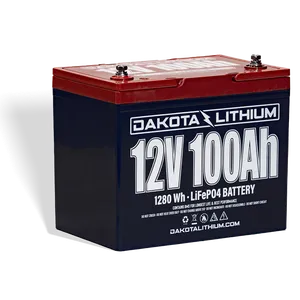
Dakota Lithium 100Ah Heated
12V 100Ah Deep Cycle Heated
Group 24, heating built in, eleven-year warranty. Smaller and cheaper.
$$$$
Check price at Dakota Lithium(opens in a new tab)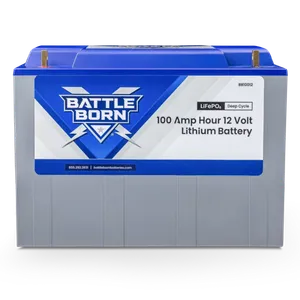
Battle Born BB10012
BB10012
Group 27/31, full published datasheet, longer surge, heating costs extra.
$$$$$
Check price at Battle Born Batteries(opens in a new tab)Specification by specification
| Specification | Dakota Lithium 100Ah Heated | Battle Born BB10012 |
|---|---|---|
| Capacity | 100Ah | 100Ah |
| Continuous discharge Both 100A — the same inverter ceiling | 100A | 100A |
| Peak discharge Battle Born holds 200A for 30 seconds; Dakota for 10 | 200A for 10 seconds | 200A for 30 seconds Better |
| Max charge current Both 50A. Neither charges faster than the other | 50A | 50A |
| Internal heating Included as standard on Dakota; a separate model on Battle Born | Yes Better | No |
| Group size Group 24 fits trays a Group 27/31 battery will not | Group 24 Better | Replaces Group 27 and Group 31 |
| Dimensions | 10.23 x 6.60 x 8.66 in | 12.76 x 6.86 x 8.95 in |
| Weight (lb) 27.55 lb against 31 lb | 27.55 Better | 31 |
| Cycle life Dakota quotes 5,000 to 80% capacity; Battle Born 3,000–5,000. Different tests | Up to 5,000 cycles to 80% capacity | 3,000–5,000 cycles |
| Warranty Eleven years to ten — both defect warranties, not capacity guarantees | 11 years Better | 10 years |
| Certifications Battle Born publishes a full certification list; Dakota does not | — | Cells UL 1642 and UN38.3; pack ETL listed to UL 62133-2 and UL 2054; IP65; Class 1 Division 2; CE Better |
| Price | $$$$ Better | $$$$$ |
The heating argument, which is the real difference
Dakota builds heating into the standard 100Ah battery. Battle Born sells it as the BB10012H, a separate and more expensive product. That is the single biggest practical gap between the two.
They also work differently, and the difference matters more than the marketing suggests.
Dakota’s Even-Heat activates when charging is attempted below 32°F. It warms the cells to 41°F, then allows the charge. It is reactive — it heats because you asked it to charge.
Battle Born’s element switches on at an internal temperature of about 35°F whenever the heat function is enabled, whether or not anything is charging.
The consequence is a cost, and Battle Born is the only one of the two that publishes it: 28W continuous while enabled, working out at roughly 20.8Ah over 24 hours at 25°F and 31.9Ah at 15°F. On a 100Ah battery that is up to a third of its own capacity spent staying warm.
Dakota does not publish an equivalent figure. That is not evidence its heater is worse — it is evidence you cannot plan around it the way you can with Battle Born’s. If you winter camp seriously, that is a real difference; the full treatment is in charging RV lithium batteries in cold weather.
| Model | Group size | Weight (lb) | Heating | Peak discharge | Warranty | Price | Buy |
|---|---|---|---|---|---|---|---|
| Dakota Lithium 100Ah Heated | Group 24 | 27.55 | Yes | 200A for 10 seconds | 11 years | $$$$ | Check price(opens in a new tab) |
| Battle Born BB10012 | Replaces Group 27 and Group 31 | 31 | No | 200A for 30 seconds | 10 years | $$$$$ | Check price(opens in a new tab) |
| Battle Born BB10012H | Replaces Group 27 and Group 31 | 31 | Yes | 200A for 30 seconds | 10 years | $$$$$ | Check price(opens in a new tab) |
The fitment argument, which usually decides it
This is the part that settles most real purchases, and it is barely mentioned on the pages currently ranking for this comparison.
- Dakota Lithium: 10.23 × 6.60 × 8.66 inches, 27.55 lb — a Group 24 case.
- Battle Born: 12.76 × 6.86 × 8.95 inches, 31 lb — replaces Group 27 and 31.
Two and a half inches of length is the difference between fitting a Group 24 battery box and not. Group 24 is the more common tray in travel trailers and smaller rigs; Group 27 and 31 turn up in larger trailers and motorhomes.
The asymmetry is worth stating plainly: a Dakota will go into a Battle Born’s space, but a Battle Born will not go into a Dakota’s. If you are unsure, that makes Dakota the safer order — though you should pack or bracket it so a smaller battery cannot move in a larger tray.
If you do not know which group your tray is, both of these cases are drawn to scale against four others in what size lithium battery do I need, along with how to measure the space properly.
Measure the tray, then stop at the first line that applies.
-
Your tray or box is Group 24, or the space is under about 11 inches long
Dakota Lithium
The Battle Born will not fit. This is not a preference, it is a measurement.
-
You are replacing a Group 27 or Group 31 battery and want the space filled
Battle Born
Sized for that opening. A Dakota also fits but leaves room it will move around in unless you bracket it.
-
You charge below freezing and the budget is the constraint
Dakota Lithium
Heating is included rather than a more expensive separate model.
-
You run an inverter with a heavy startup surge, or you need the Class 1 Division 2 listing
Battle Born
200A for 30 seconds against 200A for 10. Note the hazardous-location listing applies to the standard model only, not the heated one.
Documentation, and why it is a specification
Battle Born publishes a complete datasheet: charge and discharge temperature ranges as separate figures, absorption and float voltages, BMS cutoffs, internal resistance, terminal torque, a certification list running to UL 1642 on the cells and ETL to UL 62133-2 and UL 2054 on the pack, and the heater’s draw tabulated by outside temperature.
Dakota publishes the important operating figures — 100A continuous, 200A for a 10-second pulse, 50A maximum charge, 14.4V recommended and 15V maximum, the Even-Heat behaviour, dimensions, weight and terminal torque — and stops there. No certification list, no heater draw, no separate charge-temperature figure.
Dakota is also the more candid of the two in one specific way: it states plainly that a lead-acid charger will work but will only fill the battery to about 80% of capacity. That is a manufacturer warning you about a problem most owners discover months later, and it is the reason your converter matters as much as your battery.
One figure worth noticing in that list: Dakota’s 15V maximum charge voltage is higher than Battle Born’s 14.7V BMS high-voltage protection. If you are running a charger you configured yourself, set it for the battery you actually own.
Where they are genuinely the same
Most of the specification, which is why this decision is not as fraught as the brand loyalty around it suggests:
- 100Ah at 12V, LiFePO4
- 100A continuous discharge — the same roughly 1,280W inverter ceiling
- 50A maximum charge current — neither refills faster
- Deep cycle only; both makers state they are not engine-starting batteries
- Both need a charging profile suited to lithium, not the converter your RV probably came with
If you are choosing on charging and discharging performance, you are choosing between two batteries that behave the same way.
The verdict
Dakota Lithium, for most RV owners. Heating included rather than charged for, a Group 24 case that fits more rigs, eleven years of defect cover and a lower price. It is the battery that asks fewer questions of your rig.
Battle Born, when the specifics matter: a Group 27 or 31 opening to fill, an inverter that pulls a real surge for longer than ten seconds, a hazardous location listing to satisfy, or a preference for a manufacturer that publishes everything including what its heater costs you overnight.
What should not decide it: the extra year of warranty, or the cycle-life figures, which are quoted against different tests and are not comparable as printed.
Related guides
- Best RV lithium batteries — both of these alongside four others, compared on charge temperature and BMS current.
- Charging lithium in cold weather — every published charge threshold, and what a heater costs per night.
- Best RV converter for lithium batteries — whichever you buy, the converter decides whether it ever reaches 100%.
- Best RV surge protectors — protecting the most expensive thing in your electrical system from the pedestal.
- The electrical section collects everything published so far.
For how products on this site are selected and what we do not claim about them, see the editorial policy.
Questions worth answering
Which is better, Battle Born or Dakota Lithium?
For most RV owners, Dakota Lithium — because heating is included in the standard 100Ah model rather than sold as a separate part, the Group 24 case fits more battery trays, and the warranty runs eleven years to Battle Born's ten. Battle Born earns its price when you need the published figures, a 30-second surge rating rather than 10, or the hazardous location listing.
Is Dakota Lithium's 11-year warranty really better than Battle Born's 10?
Marginally, and read what both actually are. Dakota describes an eleven-year manufacturer defect warranty; Battle Born states ten years. Neither is a capacity-retention guarantee — that is a different promise that neither brand makes. A year of difference on a defect warranty is worth less than the physical fit or the heating.
Does Battle Born make a heated version?
Yes, the BB10012H, sold as a separate kit rather than built into the standard model. It is the more expensive route to the same capability, but it is the only heated battery in this category whose maker publishes the heater's power draw — 28W continuous, and about 20.8Ah to 31.9Ah over 24 hours depending on temperature.
Will a Dakota Lithium fit where my Battle Born went, or the reverse?
Dakota into a Battle Born space, yes — Dakota's Group 24 case is smaller in every dimension, though you will want packing or a bracket so it cannot move. The reverse often does not work: Battle Born's 12.76 inch length needs a Group 27 or 31 tray, and it will not go into a Group 24 box.
Which charges faster?
Neither. Both accept 50 amps maximum and both are rated at 100 amps continuous discharge. On charging and discharging they are, on published figures, the same battery.