A 20 lb propane cylinder lasts 20 lb divided by what you burn in a day — about 6.7 days at 3 lb a day, under five with a furnace running a few hours. But an Blue Rhino exchange cylinder of the same size contains 15 lb. Weighing the same cylinder twice measures your use over that interval.
Step 1 — the cylinder
What is on the tongue, and how was it filled?
Step 2 — your rate
Weigh it, or estimate it
The answer
Propane
—
A cylinder that lasts
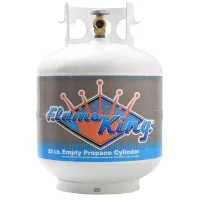
Flame King 20 lb Steel Propane Cylinder with OPD
20 lb (Flame King also lists it as "5 gal") · 17 lb empty · 17.8 in tall · Steel
Check price at Flame King(opens in a new tab)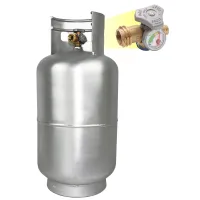
Flame King Lightweight 30 lb Aluminum Propane Cylinder with Gauge and OPD Valve
30 lb / 7 gallons "at 80% capacity" (also listed as "8 gal") · 17 lb empty · 26.5 in tall · High-grade aluminum
Check price at Flame King(opens in a new tab)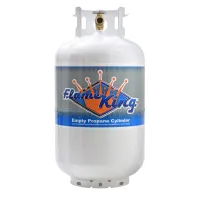
Flame King 30 lb Steel Propane Cylinder with Type 1 OPD Valve
30 lb / 7 gallons · 25 lb empty · 23.7 in tall · High-grade welded steel, powder coat finish
Check price at Flame King(opens in a new tab)How long does a 20 lb propane tank last?
Every calculator that ranks for this does the same sum: add up each appliance’s Btu rating, multiply by the hours it runs, and divide by the energy in propane. The sum is right. The inputs are the problem.
A furnace’s rating is what the burner draws while it fires, and nobody knows how many hours it fired last night. It cycles, so eight hours on the thermostat is some smaller number of hours of burner — how much smaller depends on the cold and the rig, and nothing on the furnace tells you. Guess the hours and the answer is a guess, however precise it looks.
Weigh it instead
Use the cylinder’s own stamped TW (tare weight), not a generic model weight. Subtract it from the total scale reading to find the propane remaining, as Ferrellgas explains. The example below uses TW 17 lb; your cylinder may differ. Do not empty a cylinder to find its tare weight.
Worked example: the same removable cylinder weighs 35 lb, then 32 lb, 24 hours later. Its own collar is stamped TW 17 lb. These are example readings, not your calculator results.
Use TW, not the “20 lb” size
TW is the empty weight of this cylinder. The cylinder’s nominal propane capacity is a different number. Do not assume every 20 lb cylinder weighs 17 lb empty, or empty a cylinder to obtain its tare.
Use the same scale and weighing setup, with the cylinder upright and disconnected. Follow the RV/cylinder instructions for removal, refitting and leak checks.
First weighing: 35 lb total
17 lb cylinder + 18 lb propane
24 hours later: 32 lb total
17 lb cylinder + 15 lb propane
Both weight bars use the same scale. Hatched = cylinder; solid = propane. They show mass, not liquid height.
- Use per day: (35 − 32) ÷ 24 hours × 24 = 3 lb/day.
- Propane remaining: 32 − 17 = 15 lb.
- Estimated time left: 15 ÷ 3 = 5 days, if use stays the same.
No refill or cylinder swap between readings. Water, dirt, ice or extra fittings can change scale weight. Repeat under representative conditions; cold weather, changing appliance use and scale resolution affect the estimate. This is not a fill instruction or a leak test.
Weigh removable cylinders outdoors, away from ignition sources, with the valve closed and the cylinder stable. Never disconnect or lift a permanently mounted RV tank for this method.
Method: Ferrellgas weighing guidance. Handling: PERC portable-cylinder guidance.
- Record the first total weight and time. Use a suitable scale on a stable, level surface, with the cylinder upright.
- Weigh the same cylinder again on the same scale. Do not refill or swap it between readings; keep fittings and weighing conditions consistent.
- Divide the weight lost by elapsed hours, then multiply by 24. A fall from 35 lb to 32 lb over 24 hours is 3 lb/day.
- Subtract TW from the second reading. With TW 17 lb, that leaves 15 lb; at the measured 3 lb/day rate, the estimate is five more days.
This is for removable cylinders, not permanently mounted RV tanks. Follow your RV’s instructions for shutting off, disconnecting, securing and reconnecting the cylinder, including the required leak check. Work outdoors, keep the valve closed while disconnected, and keep the cylinder upright and away from ignition sources; see PERC’s portable-cylinder guidance. Weighing is not a leak test or a way to determine a safe fill level.
The calculator starts with this example. Repeat the measurement in conditions similar to the trip you are planning: colder weather or different appliance use can change the remaining days substantially.
Exchange or refill: compare the supplied amount
Blue Rhino specifies a 15 lb net fill. The calculator compares that with a nominal 20 lb refill. Other providers and actual refill quantities can differ, so check the label or receipt.
And one thing not to do with a cylinder’s rating: take another 80% off it. Flame King describes its 30 lb aluminum cylinder as “30 lb / 7 gallons (at 80% capacity)” — the pound rating already is the filled amount.
Why a cylinder can run short before it is empty
The Propane Technical Pocket Guide explains that colder conditions and a lower liquid level reduce a cylinder’s vaporization rate. A cold, nearly empty cylinder may struggle to supply a furnace even though it still contains propane. Follow the RV’s changeover instructions and plan a reserve for cold conditions; a weight-based days estimate does not guarantee enough vapor flow for every load.
Which cylinder lasts the days you want
Enter how many days you want between fills and the calculator shows the smallest cylinder that gets there — not the biggest. The three in our records:
- 20 lb steel — 17 lb empty, 17.8 in tall.
- 30 lb steel — 25 lb empty, 23.7 in tall.
- 30 lb aluminum — 17 lb empty, 26.5 in tall.
These are published nominal empty weights; use your own cylinder’s TW for weighing. With a nominal full fill, the aluminum 30 lb example weighs 47 lb, versus 37 lb for the steel 20 lb example. The extra propane adds 10 lb to the loaded cylinder even though their empty weights match. Account for loaded cylinders in your vehicle’s measured weight and ratings; our cargo capacity calculator explains the budget. Check bracket dimensions, restraint and hose reach before changing cylinder size.
The cylinders compared
| Model | Propane | Empty weight | Size | Material | Buy |
|---|---|---|---|---|---|
| Flame King 20 lb steel | 20 lb (Flame King also lists it as "5 gal") | 17 lb | 12 x 12 x 17.8 in | Steel | Check price(opens in a new tab) |
| Flame King 30 lb steel | 30 lb / 7 gallons | 25 lb | 12.3 x 12.3 x 23.7 in | High-grade welded steel, powder coat finish | Check price(opens in a new tab) |
| Flame King 30 lb aluminum | 30 lb / 7 gallons "at 80% capacity" (also listed as "8 gal") | 17 lb | 12 x 12 x 26.5 in | High-grade aluminum | Check price(opens in a new tab) |
Where this goes wrong
- Guessing burner hours. The commonest error, and the reason to weigh.
- Assuming the nominal capacity is the supplied amount. Blue Rhino specifies 15 lb; check your own provider.
- Taking 80% off a cylinder’s rating. The rating already is the fill.
- Treating days remaining as guaranteed vapor flow. Cold and low fill levels can limit supply before the cylinder is empty.
- Forgetting the water heater. Use your exact model’s burner input and firing time. Our hot water calculator estimates shower duration, not actual burner runtime.
- Blaming the propane when the fridge stops cooling. An absorption fridge needs to operate within its model-specific leveling limits — and our leveling block calculator works out how far off the rig is and what raises it.
More capacity in a lighter cylinder
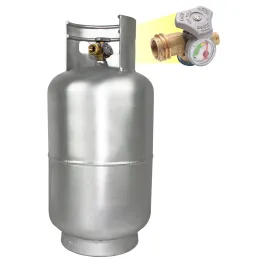
Flame King 30 lb aluminum
30 lb of propane at a 17 lb empty weight — the same empty weight as Flame King's 20 lb steel cylinder — with a built-in gauge. The tallest of the three at 26.5 in.
The 30 lb size in steel
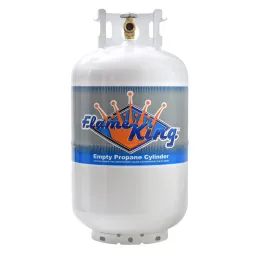
Flame King 30 lb steel
The same 30 lb of propane at 25 lb empty and 23.7 in tall, for when the aluminum cylinder does not fit the bracket.
If 20 lb already lasts long enough
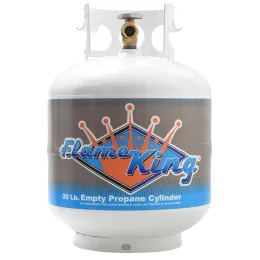
Flame King 20 lb steel
20 lb of propane, 17 lb empty, 17.8 in tall. A nominal 20 lb fill is a third more than a 15 lb Blue Rhino exchange fill.
Questions worth answering
How long will a 20 lb propane tank last in an RV?
As long as 20 lb divided by what you use in a day. At 3 lb a day it is about 6.7 days; running a 20,000 Btu/h furnace four burner-hours a day and a water heater for one comes to about 4.3 lb a day, or 4.7 days. The furnace decides it in cold weather. The reliable way to get your own figure is to weigh the cylinder twice, a day apart.
How much propane is in an exchange tank?
Blue Rhino specifies 15 lb of propane in its exchange cylinders. Compared with a nominal 20 lb fill, that gives a quarter fewer days at the same usage rate. Check the provider's label and the actual amount supplied.
How do I tell how much propane is left in my tank?
For a removable cylinder, subtract its own stamped empty weight (TW, or tare weight) from the total scale weight. With TW 17 lb, a 32 lb cylinder contains 15 lb of propane. Two consistent weighings, without a refill or cylinder swap between them, also let you estimate your daily use.
Is a 30 lb propane tank worth it over a 20 lb?
It holds half as much again, so it lasts half as long again at the same rate. Check the bracket, hose reach, restraint, full cylinder weight and applicable vehicle ratings first. Flame King's 30 lb aluminum cylinder weighs 17 lb empty, the same as its 20 lb steel one; its 30 lb steel cylinder weighs 25 lb.
How many Btu are in a pound of propane?
21,548, according to Table 1A of the Propane Education & Research Council's Propane Technical Pocket Guide, which also gives 91,502 Btu per gallon and 4.2 lb per gallon at 60°F.