For most RV roofs, buy Victron’s SmartSolar MPPT 100/50. Victron rates it for 700 W of panel on a 12 V battery and 60 A of short-circuit current, so four 150 W panels fit in any wiring a 100 V ceiling allows. If your roof has room for two or three panels, the 100/30 is enough. If the price band matters more than Bluetooth and standby draw, Renogy’s Rover Li 30A has the same 100 V and 30 A ratings.
Before you buy any of them, check one number the ranking lists mostly leave out. Maximum PV voltage is the limit that can damage a controller, and on a cold morning a set of panels reads higher than its label. Watts, which the lists rank on, are the one figure a controller simply throttles.
Best for most RV roofs
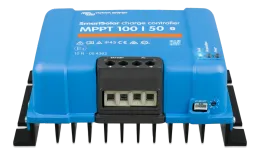
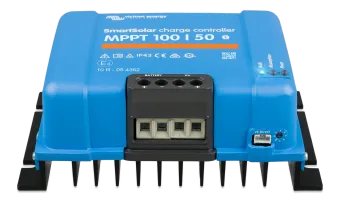
SmartSolar 100/50
Victron rates it for 700 W of panel on a 12 V battery and 60 A of short-circuit current, so four 150 W panels fit in any wiring that a 100 V ceiling allows.
Best for two or three panels
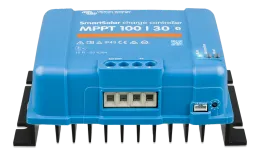
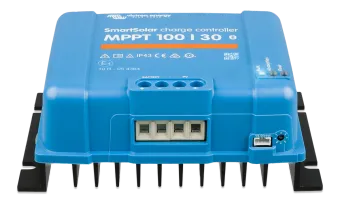
SmartSolar 100/30
440 W at 12 V in the same small case, with Bluetooth built in and a published limit on every figure that can damage it.
Best for long series strings
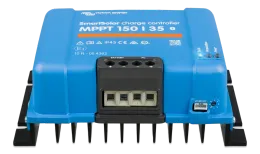
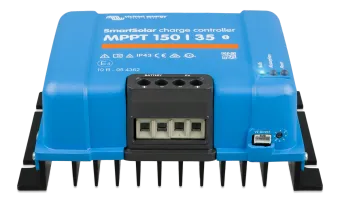
SmartSolar 150/35
The only one here that takes four 12 V panels in series on a frozen morning. It has less current than the 100/50, which is the price of the voltage.
Best for less money
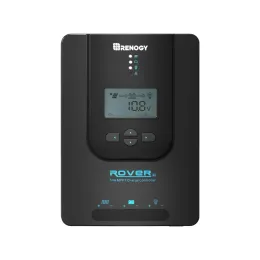
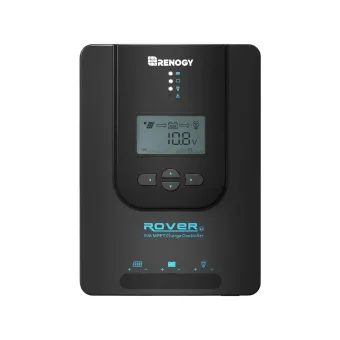
Rover Li 30A
The same 100 V and 30 A ratings as the 100/30 in a lower price band, with a load output and a battery temperature sensor in the box.
Best for one small panel
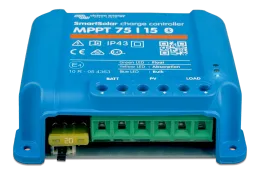
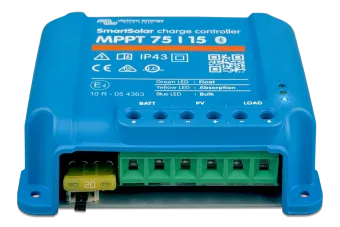
SmartSolar 75/15
Victron rates it for 220 W at 12 V, with a load output and the lowest standby draw here. A third panel in series is where its 75 V ceiling ends.
How the seven compare
| Model | Max PV voltage | Panel power (maker's figure) | PV current limit | Battery fuse | Bluetooth | Price | Buy |
|---|---|---|---|---|---|---|---|
| SmartSolar 100/50 | 100 V | 700 W at 12 V, 1400 W at 24 V | 60 A | 55-70 A, the minimum and maximum Victron specifies | Built in | $$$ | Check price(opens in a new tab) |
| SmartSolar 100/30 | 100 V | 440 W at 12 V, 880 W at 24 V | 35 A | 35-40 A, the minimum and maximum Victron specifies | Built in | $$$ | Check price(opens in a new tab) |
| SmartSolar 150/35 | 150 V absolute maximum coldest conditions, 145 V start-up and operating maximum | 500 W at 12 V, 1000 W at 24 V | 40 A | 40-45 A, the minimum and maximum Victron specifies | Built in | $$$$ | Check price(opens in a new tab) |
| Rover Li 30A | 100 V | 400 W at 12 V, 800 W at 24 V | Not published | Not specified - the manual recommends a battery-side fuse but gives no rating | Optional BT-2 module, sold separately | $$ | Check price(opens in a new tab) |
| SmartSolar 75/15 | 75 V | 220 W at 12 V, 440 W at 24 V | 15 A | 20-25 A, the minimum and maximum Victron specifies | Built in | $$ | Check price(opens in a new tab) |
| SmartSolar 100/20 | 100 V | 290 W at 12 V, 580 W at 24 V | 20 A | 25-30 A, the minimum and maximum Victron specifies | Built in | $$ | Check price(opens in a new tab) |
| Rover Li 40A | 100 V | 520 W at 12 V, 1040 W at 24 V | Not published | Not specified - the manual recommends a battery-side fuse but gives no rating | Optional BT-2 module, sold separately | $$$ | Check price(opens in a new tab) |
Two columns in that table matter more than the rest. The first is maximum PV voltage: every controller here is either 75 V, 100 V or 150 V, and that decides how many panels you can wire in series. The second is the PV current limit. Renogy does not publish one for the Rover Li, so our controller calculator cannot check either Renogy against an array, and it leaves them out rather than guess.
How many watts a controller takes
Most of the lists ranking for this search size a controller by dividing watts by 12. Both makers publish their own figure for the watts each controller passes, and it is higher every time:
| Controller | Charge current | Maker’s figure at 12 V | Charge current × 12 V |
|---|---|---|---|
| SmartSolar 75/15 | 15 A | 220 W | 180 W |
| SmartSolar 100/20 | 20 A | 290 W | 240 W |
| SmartSolar 100/30 | 30 A | 440 W | 360 W |
| Rover Li 30A | 30 A | 400 W | 360 W |
| SmartSolar 150/35 | 35 A | 500 W | 420 W |
| Rover Li 40A | 40 A | 520 W | 480 W |
| SmartSolar 100/50 | 50 A | 700 W | 600 W |
The reason is that the charge current is counted at the battery, and a 12 V battery takes its charge at well over 12 V. Neither maker shows its working, but Victron’s figures come to 14.0 to 14.7 watts per amp, and Renogy’s to 13.0 to 13.3.
One list near the top of this search gets it wrong in both directions on one page. It says a 40 A controller handles “roughly 480W on a 12V bank”, which is 40 × 12. It then recommends Renogy’s Rover 40A for “mid-sized RV arrays up to 800W on a 12V bank”. And it says a 600 W array on 12 V “needs at least a 60A controller”. Renogy’s manual rates its 40 A Rover Li at 520 W on a 12 V battery, and Victron rates its 50 A SmartSolar at 700 W.
None of those figures is a hard ceiling. Victron’s datasheet says what happens above it: “If more PV power is connected, the controller will limit input power.” The extra watts are wasted, not harmful, and a flat roof panel spends most of the day below its rating anyway. So a modest excess is a choice, not a fault. If you want to know how much panel your rig actually needs, the solar sizing calculator works it from your location and month.
The voltage most lists leave out
Cold open-circuit voltage (Voc)
100 V maximum
Array short-circuit current (Isc)
35 A maximum
100/30
Converts array voltage and current into battery charging voltage and current.
The “30” belongs here.
It is a different limit from the array’s 35 A Isc ceiling.
Example limits are for this exact model. Extra panel watts can be clipped within Victron’s allowed limits; that does not permit excess Voc or Isc. PV input amps and battery charge amps are different quantities.
Conceptual energy path, with wiring and protection omitted. Victron 100/30 and 100/50 datasheet.
Three of the lists we read give no maximum PV voltage for several of their picks, and the one quoted above prints it in its comparison table for one controller out of seven. That is the number that matters most. Victron’s datasheet footnotes cover the other two: too many watts is limited, and too much short-circuit current “may damage the controller”. Over its PV voltage limit a SmartSolar stops charging and shows error #33, and Victron’s manual says the charger “can sustain damage based on the extent of the PV voltage height”. Victron puts that limit in the product name: a 100/30 is 100 V maximum PV and 30 A charge current.
Open-circuit voltage also rises as panels get colder. Victron publishes −0.35% per °C for its panels, so a 150 W BlueSolar rated at 22.3 V reads about 25.0 V at 14°F. That turns the controller choice into a wiring question:
- Three in series: 66.9 V on the label and 75.1 V at 14°F. That is past the 75/15’s ceiling.
- Four in series: 89.2 V on the label and 100.1 V at 14°F. That is past every 100 V controller here, Renogy’s included. Only the 150/35 takes it.
- Two in series, two strings: 50.1 V at 14°F and 17.4 A. A 100/50 takes it, and so does a 100/30 if the array’s watts suit it.
The controller calculator runs that check for your own panels and your coldest morning, and it says when rewiring the array solves a problem before it recommends a bigger controller.
The controllers in detail
Best for most RV roofs
Victron SmartSolar MPPT 100/50 Charge Controller
Why it's here
Full specifications
| Max PV voltage | 100 V |
|---|---|
| Max PV short-circuit current | 60 A |
| Charge current | 50 A |
| Panel power (maker’s nominal) | 700 W at 12 V, 1400 W at 24 V |
| Battery fuse | 55-70 A, the minimum and maximum Victron specifies |
| Self-consumption | 30 mA at 12 V, 20 mA at 24 V |
| Load output | None; virtual load output via a VE.Direct TX cable |
| Bluetooth | Built in |
| Temperature sensing | Internal sensor; battery temperature over Bluetooth from a Smart Battery Sense or BMV-712 |
| Enclosure | IP43 electronics, IP22 connection area |
| Warranty | 5 years standard, upgradable to 10 |
Specifications verified October 22, 2026 from Victron SmartSolar MPPT 100/50 datasheet - maximum PV open circuit voltage 100 V; rated charge current 50 A; maximum PV short circuit current 60 A; nominal PV power 700 W at 12 V and 1400 W at 24 V , Same datasheet, re-read 22 Oct 2026 - self-consumption 30 mA at 12 V; Bluetooth Smart built in; no cooling fan; internal temperature sensor; IP43 electronics, IP22 connection area; -30 to +60 C, full rated output to 40 C; 1.3 kg; 130 x 186 x 70 mm , Victron SmartSolar MPPT 100/30 & 100/50 manual, Rev 13 (10/2026) - section 3.8, no physical load output; a virtual load output needs a VE.Direct TX digital output cable , Victron warranty and repairs - "5 years standard warranty on power products", upgradable to 10 years , Victron SmartSolar 100/30 & 100/50 manual, Rev 13 (10/2026), battery fuse table - "MPPT 100/50 55A 70A" .
Strengths
- Rated for 700 W at 12 V and 1,400 W at 24 V, so 600 W of panel on a 12 V battery runs without being limited
- A 60 A PV short-circuit limit, which is what parallel wiring needs: four 150 W panels in parallel put 34.76 A into it
- Bluetooth built in, and it can take battery temperature over Bluetooth from a Smart Battery Sense or BMV-712
- No fan, and the same 130 × 186 × 70 mm case as the 100/30
- Victron publishes a battery fuse range for it: 55 to 70 A
- Five-year warranty, upgradable to ten
Weaknesses
- A 100 V ceiling, so four 12 V panels in series are over it on a frozen morning
- No load output; the manual offers a virtual one through a VE.Direct TX cable
- Battery temperature needs a second Victron device, where the Renogy has a wired sensor in the box
- More controller than one or two panels need
Fit: The same 100 V ceiling as the 100/30 with a far higher current limit, which is what parallel wiring needs - parallel keeps the voltage at one panel's and multiplies the short-circuit current instead.
Buy it if
Your roof takes three to four panels, or you expect to add one, and they will be wired in parallel or two-by-two.
Choose something else if
You want four or more panels in series, which needs a 150 V controller, or you have only one or two panels.
Best for two or three panels
Victron SmartSolar MPPT 100/30 Charge Controller
Why it's here
Full specifications
| Max PV voltage | 100 V |
|---|---|
| Max PV short-circuit current | 35 A |
| Charge current | 30 A |
| Panel power (maker’s nominal) | 440 W at 12 V, 880 W at 24 V |
| Battery fuse | 35-40 A, the minimum and maximum Victron specifies |
| Self-consumption | 30 mA at 12 V, 20 mA at 24 V |
| Load output | None; virtual load output via a VE.Direct TX cable |
| Bluetooth | Built in |
| Temperature sensing | Internal sensor; battery temperature over Bluetooth from a Smart Battery Sense or BMV-712 |
| Enclosure | IP43 electronics, IP22 connection area |
| Warranty | 5 years standard, upgradable to 10 |
Specifications verified October 22, 2026 from Victron SmartSolar MPPT 100/30 datasheet - maximum PV open circuit voltage 100 V; rated charge current 30 A; maximum PV short circuit current 35 A; nominal PV power 440 W at 12 V and 880 W at 24 V , Same datasheet, re-read 22 Oct 2026 - self-consumption 30 mA at 12 V; Bluetooth Smart built in; no cooling fan; internal temperature sensor; IP43 electronics, IP22 connection area; -30 to +60 C, full rated output to 40 C; 1.3 kg; 130 x 186 x 70 mm , Victron SmartSolar MPPT 100/30 & 100/50 manual, Rev 13 (10/2026) - section 3.8, no physical load output; a virtual load output needs a VE.Direct TX digital output cable , Victron warranty and repairs - "5 years standard warranty on power products", upgradable to 10 years , Victron SmartSolar 100/30 & 100/50 manual, Rev 13 (10/2026), battery fuse table - "MPPT 100/30 35A 40A" .
Strengths
- Rated for 440 W at 12 V, which is about three 150 W panels or four 100 W panels
- Standby draw of 30 mA at 12 V, under a third of the Rover Li
- Bluetooth built in, with no module to buy
- A published 35 A short-circuit limit, so its current side can be checked against an array
- Battery fuse range of 35 to 40 A, from the manual
Weaknesses
- Four 150 W panels in parallel make 34.76 A of short-circuit current against its 35 A limit, which our calculator treats as no margin at all
- Above 440 W on a 12 V battery it limits input power, so a fourth large panel mostly adds nothing on a sunny day
- No load output
- In the same price band as the 100/50 on our records, which does more
Fit: The common RV choice, and the one the cold-voltage case is built on: four 150 W panels in series reach 100.1 V at -10 C, which is past this controller's ceiling by a tenth of a volt.
Buy it if
You have two or three panels, under about 440 W, on a 12 V battery, and you want Bluetooth without extras.
Choose something else if
You are likely to add a fourth panel. The 100/50 is in the same price band on our records.
Best for long series strings
Victron SmartSolar MPPT 150/35 Charge Controller
Why it's here
Full specifications
| Max PV voltage | 150 V absolute maximum coldest conditions, 145 V start-up and operating maximum |
|---|---|
| Max PV short-circuit current | 40 A |
| Charge current | 35 A |
| Panel power (maker’s nominal) | 500 W at 12 V, 1000 W at 24 V |
| Battery fuse | 40-45 A, the minimum and maximum Victron specifies |
| Self-consumption | 20 mA at 12 V, 15 mA at 24 V |
| Load output | None; virtual load output via a VE.Direct TX cable |
| Bluetooth | Built in |
| Enclosure | IP43 electronics, IP22 connection area |
| Warranty | 5 years standard, upgradable to 10 |
Specifications verified October 22, 2026 from Victron SmartSolar MPPT 150/35 datasheet - maximum PV open circuit voltage 150 V absolute maximum coldest conditions, 145 V start-up and operating maximum; rated charge current 35 A; maximum PV short circuit current 40 A; nominal PV power 500 W at 12 V and 1000 W at 24 V , Victron SmartSolar 150/35 & 150/45 manual, Rev 13 (10/2026), battery fuse table - "MPPT 150/35 40A 45A" , Victron SmartSolar datasheet re-read 22 Oct 2026 - MPPT 150/35: self-consumption 20 mA at 12 V, 15 mA at 24 V; no cooling fan; Bluetooth Smart built in; IP43 electronics, IP22 connection area; no load-output row (the manual, section 3.8, describes a virtual load output only) , Victron warranty and repairs - "5 years standard warranty on power products", upgradable to 10 years .
Strengths
- States its limit as a cold-weather figure: 150 V absolute maximum in the coldest conditions, 145 V for start-up and operation
- Four 150 W panels in series reach 100.1 V at 14°F, well inside it
- Series strings keep current low, which keeps cable thin on a long run from the roof
- Works on 12, 24 and 48 V batteries
- Battery fuse range of 40 to 45 A
Weaknesses
- Rated for 500 W at 12 V, less than the 100/50, so it is not an upgrade for a parallel array
- The highest price band of the seven
- No load output
- None of the seven ranking lists we counted included it
Fit: The only controller here whose datasheet states its limit as a cold-weather figure in as many words - 150 V absolute maximum coldest conditions against 145 V start-up and operating maximum.
Buy it if
You want to wire four or more panels in series, or the cable run from the roof to the controller is long.
Choose something else if
Your array is wired in parallel or two-by-two on a 12 V battery. The 100/50 passes more power for less.
Best for less money
Renogy Rover Li 30A MPPT Solar Charge Controller
Why it's here
Full specifications
| Max PV voltage | 100 V |
|---|---|
| Solar input range | 15 V to 100 V open circuit; MPPT operating from 17 V |
| Max PV short-circuit current | Not published |
| Charge current | 30 A |
| Panel power (maker’s nominal) | 400 W at 12 V, 800 W at 24 V |
| Battery fuse | Not specified - the manual recommends a battery-side fuse but gives no rating |
| Self-consumption | 100 mA at 12 V, 58 mA at 24 V |
| Load output | 20 A load output |
| Bluetooth | Optional BT-2 module, sold separately |
| Temperature sensing | Remote battery temperature sensor included |
| Enclosure | IP32 |
| Warranty | 3 years materials and workmanship, per Renogy's Limited Warranty document (RNG-4-243). Neither the US product page nor the manual states it |
Specifications verified October 22, 2026 from Renogy Rover Li Series user manual, Version B3 (30 Jan 2026) - technical specifications: 30 A; 400 W at 12 V, 800 W at 24 V; maximum solar input 800 W; maximum solar input voltage 100 V; solar input range 15-100 V (Voc); MPPT operating range 17-100 V; 100 mA at 12 V; 98% conversion; 20 A load; RS485 Modbus; heat sink; IP32; -35 to 45 C; 4.4 lb , Renogy Rover Li 30A product page - sold as controller only (RNG-CTRL-RVR30-US) or with the BT-2 Bluetooth module (RNG-CTRL-RVR30-BT-US); remote temperature sensor in the box , Renogy Limited Warranty for All (RNG-4-243, file A9, May 2026), Part 3 Charge Controller - RNG-CTRL-RVR20, RVR30, RVR40 and the -BT bundles under "3-year material and workmanship warranty" .
Strengths
- The same 100 V ceiling and 30 A charge current as the SmartSolar 100/30, in a lower price band
- A 20 A load output, which none of the larger Victrons has
- A remote battery temperature sensor comes in the box
- Renogy publishes 98% conversion efficiency, the same figure as Victron
- Renogy publishes a solar input range of 15 to 100 V, with tracking from 17 V
Weaknesses
- Standby draw of 100 mA at 12 V. Over a month parked under a cover that is 72 Ah, against 22 Ah for the 100/30
- No published PV short-circuit limit, so its current side cannot be checked against an array
- Bluetooth needs the BT-2 module, sold separately; compare the bundle, not the bare controller
- IP32, against IP43 for the Victron’s electronics and IP22 at its terminals, in a larger case: 4.4 lb against 2.9 lb
- The manual recommends a battery fuse but gives no rating, and the warranty is three years against Victron's five — stated only in Renogy's separate warranty document
Fit: The Rover Li 30A sits against Victron's SmartSolar 100/30: the same 100 V ceiling and 30 A rating, with a 20 A load output the Victron lacks and more than three times its standby draw. Bluetooth needs the BT-2 module, sold separately. Renogy says to connect the battery before the panels, because its reverse-polarity protection does not apply otherwise.
Buy it if
You want a load output or a wired temperature sensor, and the price band matters more than standby draw.
Choose something else if
The rig sits in storage with the solar covered, or you want every limit published so the array can be checked.
Best for one small panel
Victron SmartSolar MPPT 75/15 Charge Controller
Why it's here
Full specifications
| Max PV voltage | 75 V |
|---|---|
| Max PV short-circuit current | 15 A |
| Charge current | 15 A |
| Panel power (maker’s nominal) | 220 W at 12 V, 440 W at 24 V |
| Battery fuse | 20-25 A, the minimum and maximum Victron specifies |
| Self-consumption | 10 mA at 12 V with the load output off, 19 mA with it on |
| Load output | 15 A load output, with automatic load disconnect |
| Bluetooth | Built in |
| Enclosure | IP43 electronics, IP22 connection area |
| Warranty | 5 years standard, upgradable to 10 |
Specifications verified October 22, 2026 from Victron SmartSolar MPPT 75/15 datasheet - maximum PV open circuit voltage 75 V; rated charge current 15 A; maximum PV short circuit current 15 A; nominal PV power 220 W at 12 V and 440 W at 24 V , Victron SmartSolar 75/10-100/20 manual (multilingual), Rev 13 (10/2026), section 4.2 - "MPPT 75/15 and 100/15 20A 25A" , Victron SmartSolar datasheet re-read 22 Oct 2026 - MPPT 75/15 column: self-consumption 12 V 19 mA load on, 10 mA load off; maximum continuous load current 15 A; Bluetooth Smart built in; IP43 electronics, IP22 connection area; -30 to +60 C, full rated output to 40 C , Victron warranty and repairs - "5 years standard warranty on power products", upgradable to 10 years .
Strengths
- Rated for 220 W at 12 V, which suits one panel of up to about 200 W
- Standby draw of 10 mA at 12 V with the load output off, the lowest here
- A 15 A load output with automatic load disconnect
- Bluetooth built in
- Battery fuse range of 20 to 25 A
Weaknesses
- A 75 V ceiling: three 150 W panels in series reach 75.1 V at 14°F, past it
- A 15 A short-circuit limit, so two 150 W panels in parallel (17.38 A) are over it
- Two 150 W panels fit only in series, where the 220 W rating limits a 300 W pair
Fit: The smallest controller here, and the one whose ceiling a cold morning breaks first: three 12 V panels in series sit near 75 V at 25 C and go past it below freezing.
Buy it if
You have one panel, or a small van roof, and want Bluetooth and a load output.
Choose something else if
You might ever add a second panel. The 100/20 or 100/30 leaves room for it.
A 100 V ceiling in the small size
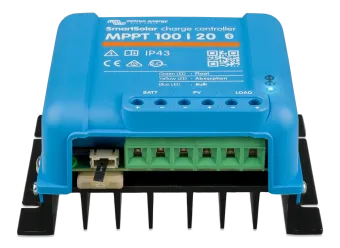
Victron SmartSolar MPPT 100/20 Charge Controller
Why it's here
Full specifications
| Max PV voltage | 100 V |
|---|---|
| Max PV short-circuit current | 20 A |
| Charge current | 20 A |
| Panel power (maker’s nominal) | 290 W at 12 V, 580 W at 24 V |
| Battery fuse | 25-30 A, the minimum and maximum Victron specifies |
| Self-consumption | 10 mA at 12 V with the load output off, 26 mA with it on |
| Load output | 20 A load output at 12 and 24 V, with automatic load disconnect |
| Bluetooth | Built in |
| Enclosure | IP43 electronics, IP22 connection area |
| Warranty | 5 years standard, upgradable to 10 |
Specifications verified October 22, 2026 from Victron SmartSolar MPPT 100/20 datasheet - maximum PV open circuit voltage 100 V; rated charge current 20 A; maximum PV short circuit current 20 A; nominal PV power 290 W at 12 V and 580 W at 24 V , Victron SmartSolar 75/10-100/20 manual (multilingual), Rev 13 (10/2026), section 4.2 - "MPPT 100/20 25A 30A" , Victron SmartSolar datasheet re-read 22 Oct 2026 - MPPT 100/20-48V column: self-consumption 26/20/19 mA load on, 10/8/7 mA load off; maximum continuous load current 20 A at 12 and 24 V; Bluetooth Smart built in; IP43 electronics, IP22 connection area , Victron warranty and repairs - "5 years standard warranty on power products", upgradable to 10 years .
Strengths
- A 100 V ceiling, so three 150 W panels in series (75.1 V at 14°F) are safe where the 75/15 is not
- A 20 A load output at 12 and 24 V, with automatic load disconnect
- Works on 12, 24 and 48 V batteries
- Bluetooth built in, with 10 mA standby at 12 V and the load off
Weaknesses
- Rated for 290 W at 12 V, so it limits anything over two 150 W panels on a sunny day
- A 20 A short-circuit limit: two 150 W panels in parallel fit, three do not
Fit: A 100 V ceiling with a 20 A charge current, which on 12 V is Victron's 290 W nominal PV power - two 150 W panels and no more before it starts limiting.
Buy it if
You have two panels and want a load output, or you are on a 24 V battery, where it is rated for 580 W.
Choose something else if
You have three or more panels on a 12 V battery. The 100/30 is rated for half as much again.
The one every list includes
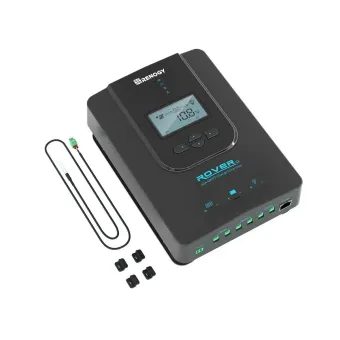
Renogy Rover Li 40A MPPT Solar Charge Controller
Why it's here
Full specifications
| Max PV voltage | 100 V |
|---|---|
| Solar input range | 15 V to 100 V open circuit; MPPT operating from 17 V |
| Max PV short-circuit current | Not published |
| Charge current | 40 A |
| Panel power (maker’s nominal) | 520 W at 12 V, 1040 W at 24 V |
| Battery fuse | Not specified - the manual recommends a battery-side fuse but gives no rating |
| Self-consumption | 100 mA at 12 V, 58 mA at 24 V |
| Load output | 20 A load output |
| Bluetooth | Optional BT-2 module, sold separately |
| Temperature sensing | Remote battery temperature sensor included |
| Enclosure | IP32 |
| Warranty | 3 years materials and workmanship, per Renogy's Limited Warranty document (RNG-4-243). Neither the US product page nor the manual states it |
Specifications verified October 22, 2026 from Renogy Rover Li Series user manual, Version B3 (30 Jan 2026) - technical specifications: 40 A; 520 W at 12 V, 1040 W at 24 V; maximum solar input 1040 W; maximum solar input voltage 100 V; solar input range 15-100 V (Voc); MPPT operating range 17-100 V; 100 mA at 12 V; 98% conversion; 20 A load; RS485 Modbus; heat sink; IP32; -35 to 45 C; 4.4 lb , Renogy Rover Li 20/30/40A product page - 40A sold as controller only (RNG-CTRL-RVR40-US) or with the BT-2 Bluetooth module (RNG-CTRL-RVR40-BT-US) , Renogy Limited Warranty for All (RNG-4-243, file A9, May 2026), Part 3 Charge Controller - RNG-CTRL-RVR20, RVR30, RVR40 and the -BT bundles under "3-year material and workmanship warranty" .
Strengths
- Rated for 520 W at 12 V and 1,040 W at 24 V
- The same 20 A load output and boxed temperature sensor as the 30A
- Renogy’s Rover 40A was on all seven ranking lists we counted
Weaknesses
- Sits between Victron’s sizes: 520 W at 12 V against the 100/30’s 440 W and the 100/50’s 700 W
- No published PV short-circuit limit, which matters most on the parallel arrays a 40 A controller is bought for
- The same 100 mA standby draw, separately sold BT-2 module and three-year warranty as the 30A
Fit: The Rover Li 40A is the nearest Renogy match for Victron's SmartSolar 100/50, though not an exact one: 520 W at 12 V against the Victron's 700 W, from the same 100 V ceiling. Same 20 A load output, standby draw and BT-2 caveat as the 30A, in the same larger case.
Buy it if
You want the Renogy features on an array between about 440 and 520 W at 12 V.
Choose something else if
Your array is past 520 W on a 12 V battery, or wired in parallel, where a published short-circuit limit matters.
What the spec sheets say that the lists do not
Efficiency is not a difference. The comparisons that put Victron ahead on efficiency are quoting a gap neither maker publishes. Victron’s datasheets say 98% maximum, and Renogy’s manual says 98% conversion. The differences between the two brands are elsewhere, and the Victron vs Renogy comparison goes through them size for size.
Standby draw matters when the rig is parked. A controller draws from the battery whenever the panels are dark. At 12 V the SmartSolar 100/30 and 100/50 draw 30 mA, and the Rover Li draws 100 mA. Over a 12-hour night that is 0.36 Ah against 1.2 Ah, which is nothing. Over a month in storage under a cover it is 22 Ah against 72 Ah, and the difference is half a 100 Ah battery.
The battery fuse is not the controller’s rating. Victron’s manuals give every SmartSolar a minimum and a maximum fuse between the controller and the battery: 35 to 40 A for the 100/30, 55 to 70 A for the 100/50. Renogy’s Rover Li manual recommends a fuse there and gives no rating. The solar fuse calculator works out that fuse and the ones on the panel side.
Only the small Victrons and the Renogys have a load output. The 75/15 and 100/20 have one (15 A and 20 A), and both Rover Li models have 20 A. The 100/30, 100/50 and 150/35 have none, only a virtual output through a VE.Direct TX cable. Most RVs run their 12 V loads from the fuse panel anyway, so this matters mainly for a simple van or trailer build.
What we checked, and what we did not
Every figure on this page came from the manufacturer’s own datasheet or manual. Victron’s datasheets and the battery fuse tables in its October 2026 manuals supply the Victron figures. Renogy’s figures come from the Rover Li Series user manual, Version B3, dated 30 January 2026. Where Renogy publishes nothing, the table says so rather than filling the gap from a retailer listing.
We have not tested any of these controllers. Several of the pages ranking for this search say they have. One, on a site about drones, says its author spent three months testing eight controllers. Six of the ten results we checked sit on sites about something else: drones, wearables, laptops, gardening and games. The months in their titles changed from one search to the next, which suggests the title is regenerated and the page is not.
We counted the brands on seven of those lists. Renogy appears on all seven, and its Rover 40A is on every one. Victron’s SmartSolar appears on five, mostly as the 75/15 or the 100/50. The 150/35, the controller that solves the cold-voltage problem, was on none.
Also considered
A kit with the controller already in it. Renogy’s 400 W kit ships with the Rover Li 40A and its Bluetooth module. Its 100 W kit ships with a 25 V PWM controller that its own panel comes within 0.14 V of on a 14°F morning. The panels-and-kits roundup checks every kit’s panels against the controller in its box.
BougeRV and LiTime each appear on three of the seven lists. We have not built records for them from their manuals yet, so we cannot say how they compare on the figures above, and we have not ranked them.
EPEVER’s Tracer 2215BN, 3215BN and 4215BN are one of the few alternatives to the 150/35 for long series strings. EPEVER’s datasheet rates them at 150 V “at minimum operating environment temperature” and 138 V at 25°C, and lists no lithium preset, only a programmable User setting. We have not built records for them, and at least one retailer lists the 4215BN as discontinued, so we have not ranked them.
Victron’s BlueSolar MPPT controllers leave out the built-in Bluetooth. We have not compared their datasheets with the SmartSolar models here.
PWM controllers sit on several of the lists as budget picks. They hold the panels at battery voltage and throw the rest away, which costs most when panels are wired in series. Our controller page works the numbers for a four-panel roof.
The controller already in your RV. If your RV is solar prepped, check what the port is wired to before buying. Some are wired straight to the battery for a portable panel with its own controller, and some run through a factory controller first. The solar prep guide explains how to tell.
Related guides
- What size solar charge controller? — the cold-morning voltage check, run against your own panels.
- Victron vs Renogy charge controller — the 100/30 and 100/50 against the Rover Li 30A and 40A.
- What size fuse for solar? — string, array and battery fuses for the controller you choose.
- How much solar do I need? — the panel count, from your location and month.
- RV solar panel not charging the battery — what to check when a new controller shows no charge.
- The electrical section collects everything published so far.
For how products on this site are selected and what we do not claim about them, see the editorial policy.
Questions worth answering
What is the best solar charge controller for an RV?
For most RV roofs, Victron's SmartSolar MPPT 100/50. Victron rates it for 700 W of panel on a 12 V battery and 60 A of PV short-circuit current, so four 150 W panels fit whether they are wired in parallel or two-by-two. For two or three panels the 100/30 is enough, and for a lower price band Renogy's Rover Li 30A matches its 100 V and 30 A ratings with a load output and a higher standby draw.
How many watts can a 30 amp charge controller handle?
On a 12 V battery, the makers say more than 360 W, which is the figure you get by multiplying 30 by 12. Victron rates its 30 A SmartSolar 100/30 at 440 W and Renogy rates its 30 A Rover Li at 400 W. The amps are counted on the battery side, and a 12 V battery takes its charge at well over 12 V. On a 24 V battery both figures double.
What size charge controller do I need for 400 watts of solar?
On a 12 V battery, a 30 A controller: the Victron 100/30 is rated for 440 W at 12 V and the Renogy Rover Li 30A for 400 W. Then check the voltage, which watts do not tell you. Four 12 V panels in series can pass 100 V on a cold morning (four of Victron's 150 W panels reach 100.1 V at 14°F), so wire them two-by-two or in parallel, or buy a 150 V controller.
Can I connect more solar than the controller is rated for?
In watts, yes. Victron's datasheet says "If more PV power is connected, the controller will limit input power", so the excess is wasted rather than harmful. Short-circuit current and open-circuit voltage are different. Victron says too much short-circuit current "may damage the controller". Over its PV voltage limit a SmartSolar stops charging, and Victron's manual says it "can sustain damage based on the extent of the PV voltage height".
Is Victron better than Renogy for RV solar?
Not on efficiency, which is the usual claim: both makers publish 98%. The differences are elsewhere. Victron builds in Bluetooth, draws less at standby (30 mA against 100 mA at 12 V) and publishes a short-circuit limit and a five-year warranty against Renogy's three. Renogy adds a 20 A load output and a wired battery temperature sensor in a lower price band.
MPPT or PWM for an RV?
MPPT for anything past a single small panel. A PWM controller holds the panels at battery voltage and throws away the rest, which matters most when panels are wired in series. On four 150 W panels on 12 V, our controller page works it out by Victron's own method at about 469 W of 600 W in parallel and about 117 W in series.
Do I need a fuse between the charge controller and the battery?
Yes. Victron's manuals give each SmartSolar a minimum and a maximum battery fuse, from 20 to 25 A for the 75/15 up to 55 to 70 A for the 100/50. Renogy's Rover Li manual recommends a battery-side fuse but gives no rating. The fuse protects the cable, so it also has to suit the wire size.
Does my solar-prepped RV need its own charge controller?
It depends on what the port is wired to. Some RV makers run the port straight to the battery for a portable panel with its own controller, and some run it through a factory controller or to a space where one can be installed. Find out which before buying, or you may end up with two controllers in series.