Start by setting aside the number most comparisons lead with: the efficiency gap. It is not in either manufacturer’s documents. Victron’s datasheet gives the SmartSolar 100/30 a maximum efficiency of 98%. Renogy’s manual gives the Rover Li a conversion efficiency of 98%. Pages claiming one harvests 5 to 15% more than the other cite nothing for it.
What does separate them is smaller, more specific and checkable: Bluetooth built in or bought separately, how much the controller draws when the sun is down, whether there is a load output, how well the case is sealed, what each maker states about warranty — and one limit Renogy does not publish at all. Matched size for size, the SmartSolar 100/30 sits against the Rover Li 30A.
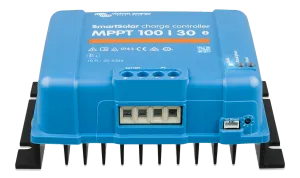
SmartSolar 100/30
SCC110030210R
30 A MPPT, 100 V limit, 440 W of panel at 12 V. Bluetooth built in, no fan, no load output, 30 mA standby draw. Five-year warranty.
$$$
Check price at Victron Energy(opens in a new tab)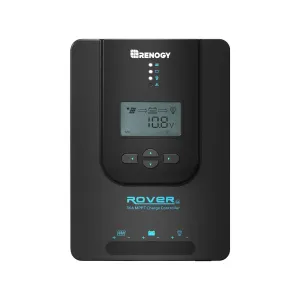
Rover Li 30A
RNG-CTRL-RVR30
30 A MPPT, 100 V limit, 400 W of panel at 12 V. 20 A load output, wired temperature sensor in the box, Bluetooth by BT-2 module. 100 mA standby draw.
$$
Check price at Renogy(opens in a new tab)Specification by specification
| Specification | SmartSolar 100/30 | Rover Li 30A |
|---|---|---|
| Max PV voltage The same ceiling. The step up is Victron’s 150 V models | 100 V | 100 V |
| Charge current | 30 A | 30 A |
| Panel power 40 W more panel at 12 V for the same 30 A rating | 440 W at 12 V, 880 W at 24 V Better | 400 W at 12 V, 800 W at 24 V |
| PV short-circuit limit Victron publishes the limit and warns that exceeding it may damage the controller. Renogy publishes only a maximum input power, 800 W | 35 A Better | Not published |
| Efficiency 98% from both. The gap competitors quote is in neither document | 98% maximum | 98% conversion; MPPT tracking over 99% |
| Standby draw A third of the draw, which counts on a rig in storage | 30 mA at 12 V, 20 mA at 24 V Better | 100 mA at 12 V, 58 mA at 24 V |
| Load output Physical terminals against a cable-and-relay workaround | None; virtual load output via a VE.Direct TX cable | 20 A load output Better |
| Bluetooth The Renogy needs the BT-2 module for any app | Built in Better | Optional BT-2 module, sold separately |
| Temperature sensing Renogy includes a wired battery sensor; Victron’s needs an extra Bluetooth device | Internal sensor; battery temperature over Bluetooth from a Smart Battery Sense or BMV-712 | Remote battery temperature sensor included Better |
| Enclosure | IP43 electronics, IP22 connection area Better | IP32 |
| Operating temperature Victron is rated to keep working 27°F hotter, at reduced output above 104°F | -22°F to 140°F, full output to 104°F Better | -31°F to 113°F |
| Communication Each speaks its own maker’s ecosystem | VE.Direct | RS485 Modbus |
| Weight And a smaller case: 130 × 186 × 70 mm against 238 × 172 × 77 mm | 2.9 lb (1.3 kg) Better | 4.4 lb (2.0 kg) |
| Warranty Five years against three, and Renogy’s is only in its separate warranty document | 5 years standard, upgradable to 10 Better | 3 years materials and workmanship, per Renogy's Limited Warranty document (RNG-4-243). Neither the US product page nor the manual states it |
| Price Renogy sells the BT-2 bundle separately; price it in if you want the app | $$$ | $$ Better |
The efficiency gap is not in either manual
Every ranking comparison of this pairing says, in one form or another, that the Victron “harvests more”. Some put a number on it: 5 to 15% more energy, or Renogy at 96 to 97% against Victron’s 98%. None cites a document.
The documents say:
- Victron: “Maximum efficiency exceeds 98 %.” The datasheet’s specification table gives 98% for both the 100/30 and the 100/50.
- Renogy: conversion efficiency 98%, MPPT tracking efficiency above 99%, from the Rover Li manual’s technical specifications.
That is the same figure. Neither maker publishes a field comparison against the other, and a few tenths of a percent between two published maxima would not show on a battery monitor. If a controller harvests noticeably less than its neighbor on the same roof, look at the wiring, the array and the settings before the badge.
One more myth worth retiring: a ranking page describes the Rover as “fan-cooled”. Renogy’s manual lists its cooling as a heat sink. Victron’s datasheet says “No cooling fan”. Neither has one.
Matched size for size
The other thing almost no comparison does is put like against like. One sets a 30 A Victron against a 40 A Renogy; another sets a 40 A Renogy against a 50 A Victron. Here are the four that actually pair up.
| Model | Panel power | PV current limit | Standby draw | Buy |
|---|---|---|---|---|
| SmartSolar 100/30 | 440 W at 12 V, 880 W at 24 V | 35 A | 30 mA at 12 V, 20 mA at 24 V | Check price(opens in a new tab) |
| Rover Li 30A | 400 W at 12 V, 800 W at 24 V | Not published | 100 mA at 12 V, 58 mA at 24 V | Check price(opens in a new tab) |
| SmartSolar 100/50 | 700 W at 12 V, 1400 W at 24 V | 60 A | 30 mA at 12 V, 20 mA at 24 V | Check price(opens in a new tab) |
| Rover Li 40A | 520 W at 12 V, 1040 W at 24 V | Not published | 100 mA at 12 V, 58 mA at 24 V | Check price(opens in a new tab) |
The limit Renogy does not publish
Victron’s datasheet gives every SmartSolar a maximum PV short-circuit current — 35 A on the 100/30, 60 A on the 100/50 — and a footnote that matters: “A PV array with a higher short circuit current may damage the controller.” It also says the opposite about watts: “If more PV power is connected, the controller will limit input power.” Too much panel power is throttled. Too much current can damage it.
Renogy’s Rover Li manual publishes the 100 V open-circuit ceiling and a maximum solar input power — 800 W on the 30A, 1,040 W on the 40A — but no short-circuit current limit at all. That does not mean the Rover is fragile. It means there is no published figure to check a parallel array against, which is the configuration where current, not voltage, is the binding limit.
It is also why our charge controller calculator checks your array against the Victron units and leaves the Rover Li out: with no current limit published, there is nothing honest to check that side against. The voltage side applies to both, and on a cold morning it is the one that catches people — four 150 W panels in series reach about 100 V at 14°F.
Standby draw, and the rig in storage
Both controllers take a small current from the battery whenever the panels are not supplying them — every night, and for the whole of a winter in storage with the panels covered.
- Victron SmartSolar: 30 mA at 12 V.
- Renogy Rover Li: 100 mA at 12 V.
Worked out over a day, that is about 0.7 Ah against 2.4 Ah; over a month, about 22 Ah against 72 Ah. On a 100 Ah battery left on a covered rig for a month, the Renogy alone takes roughly three-quarters of it. Neither figure matters on a rig that sees sun every day. The difference shows on the one that does not, usually as a battery that is flat after storage — and a shunt battery monitor is what shows how much of that the controller took.
The load output
The Rover Li has load terminals rated at 20 A: a switched DC output the controller can turn on and off, for example to cut lights when the battery runs low. The SmartSolar 100/30 and 100/50 have no physical load output. Victron’s manual describes a “virtual load output” made with a VE.Direct TX digital output cable, which drives a BatteryProtect module, a relay, or a load’s own remote on/off input.
On most RVs this matters less than it sounds, because the coach’s DC loads already run through its own fuse panel and battery disconnect. It matters on a simpler system — a van or a trailer with a few lights and a fan — where the controller’s load output is the low-voltage cut-off.
Bluetooth, sensing and the rest of the system
This is the trade that most often decides it, and it cuts both ways.
- The SmartSolar has Bluetooth built in. Settings, live readings and 46 days of stored history are in the VictronConnect app with nothing else to buy. Over the same Bluetooth it can take battery voltage and temperature from a Smart Battery Sense or a BMV-712 monitor.
- The Rover Li needs the BT-2 module for any app. Renogy sells the controller alone or bundled with it. It talks RS485 Modbus, and it ships with a wired remote battery temperature sensor in the box.
So the Victron includes the app and charges extra for battery temperature sensing; the Renogy includes the sensor and charges extra for the app. If you already own a Victron battery monitor, the SmartSolar joins it with no wiring. If you are building on Renogy’s own batteries and monitor, the Rover fits that system instead.
Lithium needs one setting either way. Renogy’s manual says the Rover Li recognizes 12 or 24 V automatically for lead-acid but must be set manually for lithium. Victron’s charge voltages are adjustable from the app.
Enclosure and heat
- Ingress: Victron rates the SmartSolar IP43 for the electronics and IP22 at the connection area. Renogy rates the Rover Li IP32. Neither belongs outdoors; the Victron is better sealed against splashing water.
- Operating temperature: Victron gives −22°F to 140°F, with full rated output up to 104°F. Renogy gives −31°F to 113°F. In a hot, closed battery bay in summer, the Victron is rated to keep working well past where the Renogy’s range ends.
- Size: the Victron is 5.1 × 7.3 × 2.8 in and 2.9 lb. The Rover Li 30A shares the 40A’s larger case, 9.38 × 6.78 × 3.05 in and 4.4 lb.
Warranty: what each maker states
Victron states “5 years standard warranty on power products”, extendable to ten years for 10% of the purchase price.
Renogy gives the Rover Li three years, in its Limited Warranty document (RNG-4-243, May 2026), which lists the 20A, 30A and 40A and their Bluetooth bundles under a “3-year material and workmanship warranty”. You would not know it from the US product page or the Rover Li manual, neither of which states a term. An older 2023 Renogy warranty PDF gave the Rover two years, which is the likely source of the “one to two years” other comparisons print.
Who wrote the comparison you were about to read
Of the pages that rank for this pairing, one is published by a Victron distributor that sells only Victron, and one by a retailer that sells both brands. Two claim testing — “bench tests”, “real testing” — with no data behind it.
We earn commission on links here too, as disclosed above, and we have not tested either controller. That is why everything above is built from what each manufacturer prints in its own datasheet, manual and warranty document. This page first went up saying Renogy published no warranty term for the Rover Li, because neither its product page nor its manual gives one. Renogy’s separate warranty document does, and the section above now says so.
Which one, for which rig
Buy the SmartSolar 100/30 if you want the app without buying anything else, you already run a Victron battery monitor, the rig sits in storage for weeks at a time, the controller lives in a hot bay, or you want the longer warranty: five years against three. Size it on your actual panels first: what size solar charge controller checks cold-morning voltage and current.
Buy the Rover Li 30A if you want a load output for a simple system, you want a wired battery temperature sensor without buying a separate device, you are building on Renogy’s own system, or the lower price band decides it. Add the BT-2 module if you want to see it on your phone.
Something else, if your array is past about 440 W on a 12 V battery, or you want four panels in series, which needs a 150 V controller on a cold morning. The charge controller roundup covers the 100/50, the 150/35 and the two smaller SmartSolars as well as these two.
Neither yet, if your current controller is “not charging” — that is far more often a full battery, a cold lithium BMS or a blown fuse than a controller fault, and four readings at the controller find it before you spend anything.
Bluetooth and the battery monitor, no extras
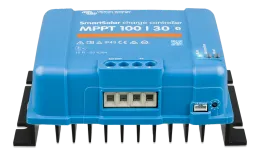
SmartSolar 100/30
Bluetooth built in, a third of the Renogy's standby draw, a published short-circuit limit and a five-year warranty.
A load output and a wired temperature sensor
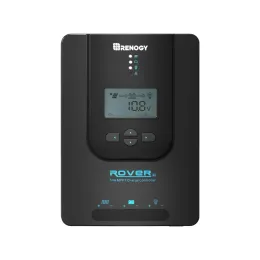
Rover Li 30A
20 A load terminals the Victron lacks and a remote battery sensor in the box, for the lower price band. Add the BT-2 module for an app.
Questions worth answering
Is Victron better than Renogy for a solar charge controller?
On the figures both makers publish, the SmartSolar 100/30 wins more rows than it loses: Bluetooth built in, a third of the standby draw, a better enclosure rating, a published short-circuit limit and a five-year warranty against Renogy's three. The Rover Li 30A wins on a 20 A load output, a wired battery temperature sensor in the box, and the lower price band. Efficiency is not a difference: both makers publish 98%.
Is Victron more efficient than Renogy?
Not on either maker's own figures. Victron's datasheet gives a maximum efficiency of 98% for the SmartSolar 100/30 and 100/50. Renogy's Rover Li manual gives a conversion efficiency of 98% and MPPT tracking efficiency above 99%. Comparisons claiming a 5 to 15% harvest advantage for either brand cite no source for it.
Which Renogy controller matches the Victron SmartSolar 100/30?
The Rover Li 30A. Both are rated at 30 A with a 100 V open-circuit limit; Victron rates the 100/30 for 440 W of panel at 12 V and Renogy rates the Rover Li 30A for 400 W. The SmartSolar 100/50 has no exact Renogy match: the Rover Li 40A is the nearest, at 520 W against the Victron's 700 W.
Does the Renogy Rover Li have Bluetooth?
Not built in. Renogy sells it as controller-only or bundled with the BT-2 Bluetooth module, which plugs into its RS485 port. The Victron SmartSolar has Bluetooth built in and talks to Victron's own battery monitors and sensors over it.
Does the Victron SmartSolar 100/30 have a load output?
No. Victron's manual describes a "virtual load output" made with a VE.Direct TX digital output cable, which drives a BatteryProtect module or a relay. The Renogy Rover Li has physical load terminals rated at 20 A. Most RV DC loads run through the coach's fuse panel rather than a controller's load output, so this matters most on simpler systems.
What warranty does Renogy give on the Rover Li?
Three years on materials and workmanship, per Renogy's Limited Warranty document (RNG-4-243, May 2026), which lists the Rover Li 20A, 30A and 40A and their Bluetooth bundles. Neither the US product page nor the Rover Li manual says so, and an older 2023 Renogy warranty PDF gave the Rover two years, which is where the "one to two years" in other comparisons comes from. Victron states five years on its power products, extendable to ten.
Can I use a Victron controller with Renogy panels?
Yes. Neither controller cares who made the panels; what matters is that the array's cold-weather open-circuit voltage stays under 100 V and, on the Victron, that its short-circuit current stays under the published limit. Our charge controller calculator checks both against your panels.