An RV solar system has up to three places that need a fuse, and each is sized differently. Individual string fuses depend on the possible back-feed and panel and cable ratings; three or more parallel strings commonly need them. A combined-array fuse, where required, uses the sum of string short-circuit currents times approximately 1.56. Between the controller and the battery, the range the controller’s own manual gives — which is not the controller’s rating.
Most guides give one fixed rule and disagree about which: fuse every panel, fuse two strings or more, fuse three or more. The published sizing method used here checks the maximum series fuse rating printed on your panel, and the calculator runs it against your own panels and wiring.
Step 1 of 2 — the array
Which panels, and how are they wired?
Step 2 of 2 — the controller
What does it charge?
The answer
—
—
| Where | Fuse | Rated for at least | Cable rated for at least |
|---|---|---|---|
| Each string | |||
| Array to controller | |||
| Controller to battery |
The parts
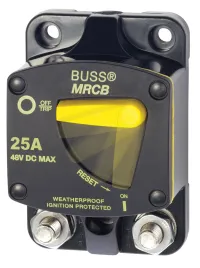
Blue Sea Systems 187-Series Surface Mount Circuit Breaker (25-200 A)
Sold in 25, 30, 40, 50, 60, 70, 80, 90, 100, 120, 135, 150, 200 A · rated to 48 V DC
Check price at Blue Sea Systems(opens in a new tab)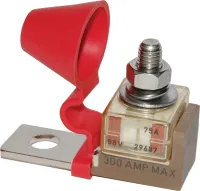
Blue Sea Systems 5191 MRBF Terminal Fuse Block (30-300 A)
Takes 30–300 A fuses · rated to 58 V DC
Check price at Blue Sea Systems(opens in a new tab)
Blue Sea Systems MRBF Terminal Fuses (30-300 A)
Sold in 30, 40, 50, 60, 75, 80, 90, 100, 125, 150, 175, 200, 250, 300 A · rated to 58 V DC
Check price at Blue Sea Systems(opens in a new tab)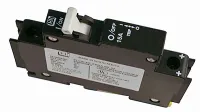
MidNite Solar MNEPV 150 V DC DIN-Rail Breakers (1-63 A)
Sold in 1, 2, 3, 4, 5, 6, 7, 8, 9, 12, 15, 20, 30, 40, 50, 60, 63 A · rated to 150 V DC
Check price at MidNite Solar(opens in a new tab)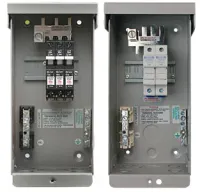
MidNite Solar MNPV3 PV Combiner (3-string)
Sold in 1, 2, 3, 4, 5, 6, 7, 8, 9, 12, 15, 20, 30, 40, 50, 60, 63 A · rated to 150 V DC
Check price at MidNite Solar(opens in a new tab)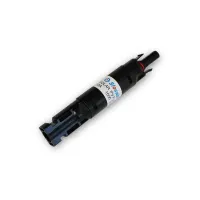
Renogy Solar Connector Waterproof In-Line Fuse Holder w/ Fuse
Sold in 10, 15, 20, 30 A · rated to 1000 V DC
Check price at Renogy(opens in a new tab)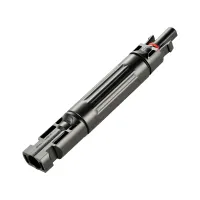
Rich Solar Inline Fuse Holder with Fuse (10-30 A)
Sold in 10, 15, 20, 30 A · rated to 1000 V DC
Check price at Rich Solar(opens in a new tab)When the strings need fuses
A fuse on the panel side protects the panels and their cable from current flowing into a faulted string from somewhere else. The code’s method, as Mersen, a fuse maker, sets it out for the 2017 National Electrical Code:
- One string. A string fuse may be omitted when there is no external back-feed source and the cable has adequate corrected ampacity (at least 1.56 times Isc in this method). A battery or inverter able to feed the PV circuit changes this conclusion.
- Two strings in parallel. If one faults, the other pushes up to 1.25 times its short-circuit current back into it. That is usually inside the panel’s maximum series fuse rating; verify the cable limit and absence of external back-feed too before omitting string fuses. The calculator checks it for your panel rather than assuming.
- Three or more. The fault current from the others adds up, and each string needs its own fuse, usually in a combiner box.
The size is the same calculation every time: short-circuit current × 1.25 × 1.25 ≈ Isc × 1.56, rounded up to the next standard fuse size. The first 1.25 covers sunlight brighter than the test standard; the second keeps the fuse from running near its limit for hours.
Renogy’s Rover Li manual gives a version of the same formula — “Total Amps of Solar Panel (Array) * 1.56” — but describes the amps as the panel’s “maximum output current” without saying whether that means the maximum-power current or the short-circuit current. The code’s method uses short-circuit current, the larger of the two.
The number on the panel that decides it
Every panel datasheet carries a maximum series fuse rating: the largest fuse its maker allows in series with it. A string fuse has to be at least Isc × 1.56 and no larger than that.
Usually there is room between the two. Victron’s 150 W panel has an Isc of 8.69 A and a 15 A rating: 8.69 × 1.56 = 13.6 A, so a 15 A fuse fits exactly.
Sometimes there is not. Victron’s 130 W panel has an Isc of 6.53 A and a 10 A rating. 6.53 × 1.56 = 10.2 A, the next standard size is 12 A, and 12 A is over the panel’s limit. Run three strings of that panel in parallel and no standard fuse satisfies both — which the calculator reports as a conflict rather than rounding to whichever is nearer. That is a question for the panel maker, or a reason to wire fewer, longer strings.
Between the controller and the battery
Letters identify the circuit being protected, not a universal fuse layout. Only fit the protection required by the actual array, controller, battery and wiring design.
A combined-array fuse at B is beyond this junction. It does not replace required string fuses at A. One string without external backfeed may need no string fuse; two strings need a panel-and-cable check. Three are drawn only to explain the fault path.
All devices need suitable DC voltage and interrupt ratings. PV voltage must allow for cold-weather Voc; battery protection must handle the bank’s available fault current. Disconnects, grounding and individual conductors are omitted. A fuse is not automatically a load-break disconnect; never unplug sunlit PV connectors under load.
References: Mersen’s PV protection guide (2017 NEC method) and Victron’s battery-side installation requirements.
A fuse after the combiner protects the combined run where the design requires one. It cannot replace individual string fuses: current can circulate between strings without passing through that combined-array fuse.
The battery-side fuse at C protects the battery cable. It is the one most guides get wrong. The common advice is to match the fuse to the controller’s rating: a 30 A fuse for a 30 A controller. Victron’s manuals say otherwise. Each gives a minimum and a maximum:
| Victron SmartSolar | Battery fuse, minimum | Maximum |
|---|---|---|
| 75/15 | 20 A | 25 A |
| 100/20 | 25 A | 30 A |
| 100/30 | 35 A | 40 A |
| 100/50 | 55 A | 70 A |
| 150/35 | 40 A | 45 A |
So “match the controller” puts a 30 A fuse on a 100/30 whose maker asks for at least 35. Victron’s smaller-controller manual adds that the battery fuse is needed “even if the solar charger has already been equipped with an external fuse.”
Not every maker gives a figure. Renogy’s Rover Li manual recommends fuses at both the input and output of the controller but prints no rating for the battery side, and the calculator says so rather than borrow Victron’s. If you have not chosen a controller yet, the charge controller roundup gives the battery fuse range for each of seven, next to the voltage and current limits that decide which one suits your array.
The voltage rating is the one people miss
A fuse or breaker has a DC voltage rating as well as an amp rating, and on the panel side the voltage is higher than people expect. Two 22 V panels in series read about 50 V on a cold morning, because open-circuit voltage rises as panels get colder; four reach 100 V. The fuse must be rated for that.
Victron’s wiring guide puts it plainly: “Most DC fuses are suitable for 12 and 24 V, but they are not necessarily suitable for 48 V and higher.” Blue Sea’s 187-series breaker is a good battery-side breaker and is rated to 48 V DC — below a two-panel string on a cold morning. The in-line PV fuses in the calculator are rated to 1,000 V DC; MidNite’s combiner breakers to 150 V DC.
The cold-morning arithmetic is the same one that sizes the controller itself: what size solar charge controller checks the string against the controller’s limit.
The cable has to be rated for the fuse
A fuse protects the cable it sits on, so every cable must be rated for at least the fuse on it — not the other way round. Southwire’s specification for its 10 AWG PV wire gives 35 A at 75°C (40 A at 90°C), from the 2023 NEC ampacity table. Apply the installation’s ambient-temperature and bundling corrections and terminal temperature limits before deciding whether that cable can carry the fuse rating. The table value alone does not settle it.
The battery run is also sized for voltage drop, which is a separate question the 12V wire size calculator answers for your run length.
What the code says, and what it does not
Two things the arithmetic does not cover. Heat: a fuse in a hot roof box or battery bay opens early, and Mersen’s chart derates a fuse to about 0.90 at 122°F. Do not simply increase the fuse: it must still stay within the panel’s maximum series fuse rating and the cable’s corrected ampacity. If no size fits, change the design with the manufacturer’s guidance. And the controller itself: Victron’s chargers carry “PV reverse polarity protection and PV reverse current protection”, which is why the battery cannot back-feed the panels through them. A controller without that protection changes the picture.
If the panels are not charging at all, the fuses are one of four readings at the controller that find the fault.
Questions worth answering
What size fuse do I need between my solar panel and charge controller?
The panel's short-circuit current times 1.56, rounded up to the next standard fuse size, for each string; for the whole array, the sum of the strings' short-circuit currents times 1.56. A Victron 150 W panel has an Isc of 8.69 A, so one string takes a 15 A fuse and two strings in parallel a 30 A combined-array fuse if that protection is required. This does not replace any required string fuses. The fuse must also be rated for the string's cold-morning voltage.
Do I need to fuse solar panels in parallel?
With three or more strings in parallel, yes — one fuse per string. With two, usually not: a fault in one string can only receive the other's current, 1.25 times its Isc, and that is normally within the maximum series fuse rating printed on the panel. With one string, usually not. These exemptions assume adequate cable ampacity and no other source of back-feed, such as a battery through an unprotected controller. The calculator checks the two-string case against your panel's own rating.
What size fuse between charge controller and battery?
The one the controller's manual specifies, which is not the controller's own current rating. Victron gives a minimum and maximum for each model: 20 to 25 A for the SmartSolar 75/15, 25 to 30 A for the 100/20, 35 to 40 A for the 100/30, 55 to 70 A for the 100/50, and 40 to 45 A for the 150/35. Fit it close to the battery.
What is the maximum series fuse rating on a solar panel?
The largest fuse the panel's maker allows in series with it, printed on the label and datasheet. A string fuse must be at least Isc times 1.56 and no larger than this figure. Victron rates its 95 W and 130 W panels at 10 A and its 150, 190 and 285 W panels at 15 A.
Can I use a 12 V automotive fuse or breaker on the panel side?
Only if it is rated for the panel side's voltage, which is often higher than people expect: two 22 V panels in series reach about 50 V on a cold morning. Blue Sea's 187-series breaker, for example, is rated to 48 V DC — fine at the battery, not on that string. Victron's wiring guide makes the same point: most DC fuses suit 12 and 24 V but not necessarily higher.
What size wire from solar panel to charge controller?
Wire rated for at least the fuse protecting it, then sized for voltage drop. Southwire lists 35 A at 75°C for its 10 AWG PV wire, before any applicable ambient-temperature, bundling and terminal limits. Our 12V wire size calculator works out the gauge for voltage drop over your run length.