For most RV roofs, buy Renogy’s 400 W kit, and wire it the way Renogy’s first diagram shows: all four panels in parallel. That takes three more 10 A in-line fuses than the box contains. Renogy’s other diagram, all four in series, is the only one the parts in the box complete, and it puts the panels at 99.5 V on a 14°F morning against the controller’s 100 V limit. Below about 10°F they are over it.
That is the pattern across this category. The lists rank kits on panel watts. What decides a kit is the controller in the box: whether it is PWM or MPPT, and whether the panels it ships with stay under its voltage limit when the morning is cold. Two of the four kits here are PWM, and the most-listed kit of all has 0.14 V to spare at 14°F.
Best kit for most RVs
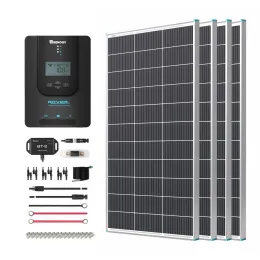
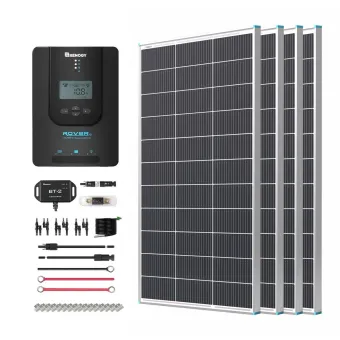
Renogy 400W Premium Kit
Four 100 W panels on an MPPT controller with Bluetooth in the box, 10 years on the panels and 3 on the controller. Use Renogy's parallel diagram, which needs three more 10 A fuses than it ships with.
400 W in a lower price band
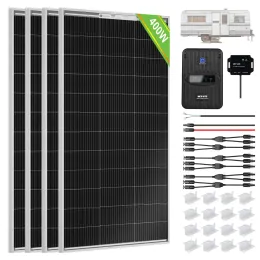
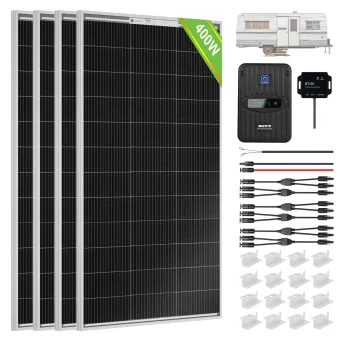
ECO-WORTHY 400W Kit
The same 400 W on a 40 A MPPT controller, wired by its own diagram so the cold voltage stays near 56 V. Every part is warranted for one year.
Best for a Go Power-prepped RV
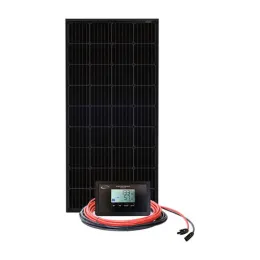
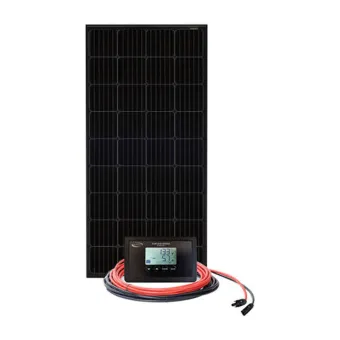
Overlander 200W Kit
Built for Go Power's factory roof prep. On a "Wired for Solar" RV only the panel and controller need fitting. Its PWM controller gives up over a third of the panel.
Best panel to build your own
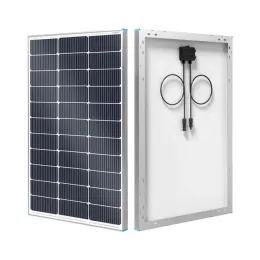
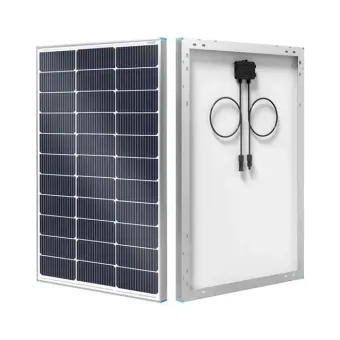
Renogy 100W N-Type
The panel inside both Renogy kits, sold alone, with every figure published down to the NOCT, 10 years on materials and 80% output at 25 years.
Best portable
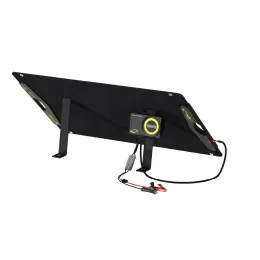
DuraLite 100
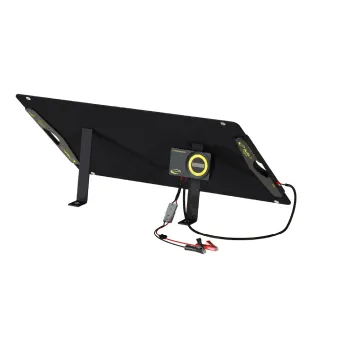
Plugs into Go Power and Zamp side ports with its own 30 A PWM controller. Not weatherproof, so it comes in at night.
How the kits compare
| Model | Panels | Controller | Cold-morning voltage | Warranty | Price | Buy |
|---|---|---|---|---|---|---|
| Renogy 400W Premium Kit | 400 W (4 x 100 W) | Rover Li 40A MPPT, 100 V limit, BT-2 included | Series, as Renogy's second diagram shows: 99.5 V at 14°F against 100 V, and over it below about 10°F. Parallel, as its first: 24.9 V, but three more 10 A fuses are needed | Panels 10 years, 80% output at 25 years; controller 3 years | $$$$ | Check price(opens in a new tab) |
| ECO-WORTHY 400W Kit | 400 W (4 x 100 W rigid panels) | 40 A MPPT (model not named), 100 V limit | Two in series, two strings, as ECO-WORTHY's diagram shows: 55.5 V at 14°F against 100 V | 1 year on panels and controller per ECO-WORTHY's warranty page, which lists no power-output term; the kit page claims a 25-year power guarantee | $$$ | Check price(opens in a new tab) |
| Overlander 200W Kit | 200W (one panel) | GP-SB-PWM-30-BT, 30 A PWM, 12 V only, Bluetooth | Not checkable: Go Power publishes no temperature coefficient for this panel. Go Power's own rule, Voc x 1.25 under 35 V, passes at 33.1 V | Panel output 25 years, no percentage stated; controller 5 years | $$$$ | Check price(opens in a new tab) |
| Renogy 100W Starter Kit | 100 W (one panel) | Wanderer Li 30A PWM, 25 V limit, 12 V only | 24.9 V at 14°F against 25 V, and over it below about 10°F | Panel 10 years, 80% output at 25 years; controller 1 year | $$ | Check price(opens in a new tab) |
Read the table from the right. The warranty column is where the documents part company with the product pages, and the cold-morning column is the one no ranking list prints. Panel watts, which the lists sort by, are the least interesting thing in it.
What a 100 W panel makes in a day
The lists we read gave a 100 W panel’s day as 30 amp-hours, as 500 watt-hours, and in one case as about 60 W, which is a rate rather than an amount. None of them said where, or when.
Both matter more than the panel. Using NASA’s 20-year averages for a flat surface, the same figures our solar sizing calculator uses, one 100 W panel lying flat on a roof puts this much into the battery each day:
| Where | June | December |
|---|---|---|
| Quartzsite, AZ | 624 Wh | 229 Wh |
| Denver, CO | 531 Wh | 168 Wh |
| Orlando, FL | 425 Wh | 229 Wh |
| Minneapolis, MN | 444 Wh | 96 Wh |
| Seattle, WA | 421 Wh | 62 Wh |
That is a tenfold range for the same panel. The arithmetic is NASA’s peak sun hours × 100 W × 0.75 × 98%. The 0.75 covers dirt, heat, wiring and mismatch together, and it is the one number here nobody publishes. The 98% is Victron’s published MPPT efficiency. A PWM controller makes every figure in the table smaller, which is the next section.
To size an array, start from your daily use and the month you actually camp, not from a panel count. The sizing calculator does it from both, and says when a roof cannot hold enough panel to do it.
The controller in the box
A kit is panels plus a controller, and the controller sets the ceiling.
A PWM controller is a switch. It connects the panels to the battery, so they run at battery voltage instead of at their maximum power point. Victron’s white paper on the question works out what that costs: at about 13.5 V a panel delivers close to its short-circuit current, so the harvest is roughly 13.5 V × Isc. Applied to each kit’s own panel figures:
| Kit | Controller | Panel rating | PWM harvest at 25°C |
|---|---|---|---|
| Renogy 100 W starter | Wanderer Li 30A PWM | 100 W | about 72 W |
| Go Power DuraLite 100 | 30 A PWM, built in | 100 W | about 74 W |
| Go Power Overlander 200 W | GP-SB-PWM-30-BT | 200 W | about 126 W |
The Overlander loses the most because its panel is the higher-voltage one: 26.5 V open circuit, 23.5 V at maximum power, all of which PWM throws away above 13.5 V. In hot sun the gap narrows, because a hot panel’s maximum-power voltage falls toward the battery’s. Victron’s example panel gives 77 W on PWM against 77.5 W on MPPT at a 75°C cell. In the cold it widens.
An MPPT controller converts the panel’s voltage down to the battery’s and keeps the power. Renogy publishes 98% for the Rover Li, and ECO-WORTHY’s manual 97% peak. Both MPPT kits here are 400 W kits, and on four panels the PWM loss above would be four times as many watts.
The full working, and what PWM does to panels wired in series, is on our charge controller sizing page.
The cold morning, kit by kit
S means panels in series. P means strings in parallel. Each rectangle below is one identical panel.
4S · All in series
Four times the voltage; one panel’s current.
2S2P · Two strings
Twice the voltage and twice the current.
4P · All in parallel
One panel’s voltage; four times the current.
Conceptual connections only. Cable, connectors, fuses, disconnects and any required diodes must follow the exact panel, kit and controller instructions. Also check the controller’s minimum start-up voltage and battery voltage.
Check cold voltage and controller limits · Check solar fuse requirements
Panel voltage rises as the panel gets colder. Each maker publishes how much, as a Voc temperature coefficient, and the first sunny morning after a frost is when a controller sees the most. Here is each kit against its own controller, on its maker’s own figures, at 14°F:
- Renogy 100 W starter kit. One panel at 22.79 V rises to 24.86 V, against the Wanderer’s 25 V limit. It is over below about 10°F. Renogy’s installation manual says it is “recommended to add a 10–20% safety margin” after the cold correction. This pairing cannot meet that even at 77°F, where 22.79 V plus 10% is already past 25 V.
- Renogy 400 W kit, wired in series. Four panels read 91.16 V at 77°F and 99.46 V at 14°F, against the Rover Li’s 100 V. At 0°F they reach 101.3 V. Renogy’s own kit FAQ says it is “safer to build a system operating at around 90% of the rated voltage and current”, and in series this array is at 91% on a mild day.
- Renogy 400 W kit, wired in parallel. 24.86 V at 14°F, nowhere near the limit, at 21.24 A of short-circuit current. This is Renogy’s first diagram, and the one to use. It needs a 10 A fuse on every panel, and the box has one.
- ECO-WORTHY 400 W kit. Its diagram wires two in series and two strings in parallel: 55.5 V at 14°F on the kit page’s figures, against 100 V. All four in series would reach 111 V, and the controller manual’s own string table allows at most three of this panel in series.
- Go Power Overlander. Not checkable. Go Power publishes no temperature coefficient for the ShadeTech panel. By Go Power’s own rule, nameplate Voc × 1.25 under 35 V, it passes at 33.1 V.
Our charge controller calculator runs the same check for any array and your own coldest morning. It uses Victron’s panels and coefficient, so treat it as the method and these figures as the answer for these kits.
The kits and panels in detail
Best kit for most RVs
Renogy 400W 12V Premium Solar Panel Kit with Rover Li 40A MPPT Controller
Why it's here
Full specifications
| Panel power | 400 W (4 x 100 W) |
|---|---|
| Panels | 4 x Renogy RSP100DC 100 W rigid monocrystalline panels, which Renogy markets as 16BB N-type; 33 cells each, anodized aluminum frame, 3.2 mm tempered glass |
| Controller | Renogy Rover Li 40A MPPT (RNG-CTRL-RVR40), with the BT-2 Bluetooth module included in this kit |
| Controller PV voltage limit | 100 V DC open-circuit; MPPT operating range 17-100 V |
| Controller panel rating | 520 W at 12 V, 1040 W at 24 V |
| Wiring | Renogy's kit page shows two official diagrams. The first tab, "Parallel Connection with 40A Fuse", joins all four panels through the three Y-branch pairs with a 10 A in-line fuse on each panel; three of those fuses are not included. The second, "Series Connection with 10A Fuse", puts all four panels in one string through the single included fuse |
| Wired in series | 91.16 V open-circuit at 77°F (STC), about 99.46 V at 14°F on Renogy's -0.26 %/C coefficient, against the controller's 100 V limit; 5.31 A |
| Wired in parallel | 22.79 V open-circuit (24.86 V at 14°F); 21.24 A short-circuit |
| Fuses in the box | One 10 A in-line PV fuse (solar-connector fuse holder) and one 40 A ANL fuse set. Parallel wiring needs three more 10 A in-line fuses, which Renogy says to buy separately |
| Cables | 20 ft 10 AWG solar adaptor kit; 8 ft 8 AWG battery-to-controller tray cables with 3/8 in ring lugs; 2 ft 8 AWG ANL fuse cable with 3/8 in ring terminals |
| Expansion | Renogy gives no panel count. Its FAQ says added panels are limited by the controller's 100 V input and its 520 W rating at 12 V (1040 W at 24 V), and advises running at about 90% of rated voltage and current |
| Materials and workmanship | Panels 10 years materials and workmanship; Rover Li 40A controller 3 years; BT-2 module 1 year; Y-branch connectors 3 years; cables, fuses and Z brackets 1 year (Renogy Limited Warranty, RNG-4-243) |
| Power output warranty | Panel output 95% at 5 years, 90% at 10 years and 80% at 25 years under the same warranty document. The kit page says "10-year output warranty" |
Specifications verified October 22, 2026 from Renogy product page "400W 12V Solar Panel Kit with Optional Smart Monitoring" (and its Shopify .json / .js data) - SKU RNG-KIT-PREMIUM400D-RVR40-US; package: 16BB N-Type 100 Watt panel x4, Rover Li 40 Amp MPPT controller x1, BT-2 x1, 8 ft 8 AWG tray cables, 2 ft 8 AWG ANL fuse cable, Z bracket set of 4 x4, 10 A in-line fuse x1, 40 A ANL fuse set x1, Y-branch pairs x3, 20 ft 10 AWG adaptor kit; panel table 22.79 V / 5.31 A / 19.97 V / 5.01 A; "temperature coefficient of -0.29%/C"; parallel and series wiring diagrams; FAQ on three extra 10 A fuses, 100 VDC, 520 W at 12 V, 90% guidance , Renogy RSP100DC datasheet (100W Monocrystalline Solar Panel; no version printed) - Vmp 19.97 V, Imp 5.01 A, Voc 22.79 V, Isc 5.31 A, 600 VDC UL, 15 A series fuse, Pmax -0.32 %/C, Voc -0.26 %/C, 865 x 578 x 30 mm, 5.9 kg (13.0 lb); 10 years materials and workmanship, 25 years output , Renogy Rover Li Series user manual, Version B3 (30 Jan 2026) - 40 A; 12 V @ 520 W, 24 V @ 1040 W; maximum solar input voltage 100 V DC (Voc); MPPT operating range 17-100 V; 100 mA at 12 V, 58 mA at 24 V; 20 A load; RS485 Modbus; IP32; presets AGM, Gel, Flooded, Li, User-defined; "Ensure that the working voltage of the solar panel or the solar panel array does not exceed 100V" , Renogy Limited Warranty for All (RNG-4-243, file A9, May 2026; text identical to the A7 file) - RSP100DC 10-year materials and workmanship and 5-year 95% / 10-year 90% / 25-year 80% output; RNG-CTRL-RVR40 and RNG-CTRL-RVR40-BT "3-year material and workmanship warranty"; RCM-BT2 1 year; Y-branch connector pairs 3 years; adaptor kits, tray cables, ANL fuse cables, in-line and ANL fuses, Z brackets 1 year , Renogy Solar Kit Installation & Maintenance Guide (CFR/EN, PDF dated July 2026) - "strictly follow" the kit page's wiring diagram; expansion rules; installation by "licensed electricians or trained professionals" , Renogy Solar Installation & Maintenance Manual (A1) - low-temperature Voc correction with a recommended 10-20% safety margin; each parallel branch needs its own fuse and a blocking diode .
Strengths
- MPPT controller rated for 520 W at 12 V, so the 400 W array runs without being limited
- BT-2 Bluetooth module in the box; on the Rover Li it is otherwise sold separately
- 10 years on the panels and 80% output at 25 years, from Renogy’s warranty document; 3 years on the controller
- Every panel figure published, including the Voc coefficient this page’s cold check needs
- Four sets of Z brackets, Y-branch connectors, a 40 A ANL battery fuse and 8 AWG battery cables included
Weaknesses
- Wired in series, the only layout its own parts complete, it passes the controller’s 100 V limit below about 10°F
- The parallel layout needs three more 10 A in-line fuses than the box holds
- Renogy’s installation manual calls for blocking diodes in parallel, which the kit diagram omits
- The Rover Li draws 100 mA at standby and publishes no PV short-circuit limit
- No roof entry gland, and Renogy says installation is for licensed electricians or trained professionals
Fit: Wired in series as Renogy's second diagram shows, the four panels reach about 99.5 V open-circuit at 14°F on Renogy's own coefficient, half a volt under the Rover Li's 100 V limit, and pass it below about 10°F. Renogy's panel manual advises a further 10-20% margin, which the series layout cannot meet, and at 91.16 V it sits outside the kit page's own advice to run at about 90% of rated voltage even at 77°F. The parallel layout keeps the array near 23 V but needs three extra 10 A fuses, and Renogy's installation manual also calls for a blocking diode per branch, which the kit diagram omits.
Buy it if
You want 400 W on an MPPT controller with Bluetooth, and you will wire it in parallel with the extra fuses.
Choose something else if
You want to wire it in series in a cold climate, or you want everything in the box to finish the job.
400 W in a lower price band
ECO-WORTHY 400W 12V (4x100W) Off Grid Solar Kit
Why it's here
Full specifications
| Panel power | 400 W (4 x 100 W rigid panels) |
|---|---|
| In the box | 4 x 100 W monocrystalline panels, 1 x 40 A MPPT charge controller, 1 x 5 m (16.4 ft) extension cable with MC4 connectors, 3 x Y MC4 branch connectors, 4 x Z mounting brackets, 1 x 1.5 m tray cable. No battery, inverter or fuses |
| Open-circuit voltage (Voc) | 24.5 V per the kit page; 22.7 V per the linked manual |
| Controller | 40 A MPPT, 12/24 V auto-detect. The kit page does not name a model; its figures match the NS24L40 column of ECO-WORTHY's 12V/24V 40A MPPT manual |
| Controller PV voltage limit | 100 V open circuit ("Array voltage should never exceed this limit") |
| Controller panel rating | 560 W at 12 V, 1,120 W at 24 V |
| Wiring | Two series pairs joined in parallel (2S2P), per the wiring diagram on the kit page. ECO-WORTHY publishes no written wiring steps for this kit. The box's three Y-connector pairs would also allow all four in parallel |
| Cold-morning voltage | About 55.5 V for the 2S2P array at 14°F (-10°C) using the kit page's 24.5 V Voc and -0.38 %/C, against the controller's 100 V limit. All four in series would reach about 111 V by the same figures |
| Fuses | None in the kit. The controller manual says solar and battery fuses or DC breakers are required and are external to the controller |
| Warranty | 1 year materials and workmanship on panels, controller, cables and brackets under ECO-WORTHY's Limited Warranty page, which lists no power-output term. The kit page claims a "25-year linear power guarantee"; the panel manual's chart shows 90% to year 12 and 80% to year 25 |
Specifications verified October 22, 2026 from ECO-WORTHY kit page and its Shopify .js product JSON - SKU US-L02M100N-MCWMZ-4; box list (4 x 100 W panels, 40 A MPPT, 5 m extension cable, 3 x Y MC4, 4 x Z brackets, 1.5 m tray cable); panel 20.2 V Vmp, 24.5 V Voc, 5.20 A Isc, 4.95 A Imp, -(0.38+/-0.01)%/C Voc coefficient, 895 x 585 x 35 mm, 14.55 lb (15.06 lb in the spec tab); controller 560/1120 W, 20 A load, 97%, 1-2 W, under 100 V PV; BT-02 feature text; "25-year linear power guarantee"; 2S2P wiring diagram and box photo , ECO-WORTHY Monocrystalline Solar Panel Manual, Version 2.0 (100W page, module type ECOM100W), linked from the kit page - Mono PERC, 33 cells, 22.7 V / 19.5 V / 5.13 A / 5.55 A (labels out of line), -0.35 %/C Pmax, -0.23 %/C Voc, +0.05 %/C Isc, 1000 V DC, 10 A series fuse, IP67 box, 895 x 585 x 35 mm, 6.6 kg, guaranteed-power chart , ECO-WORTHY 12V/24V 40A MPPT Solar Charge Controller manual (models NS24L30/L40/H50/H60), from ECO-WORTHY's product manual download page - 40 A, 100 V PV limit, 560/1120 W, 20 A load, 1-2 W, 97%, LiFePO4-4s 14.4/10.8/12.4 V, BT-02 optional, mount indoors, IP42, series-string table, external fuses required , ECO-WORTHY product manual download page - lists the file above as "12V/24V 40A MPPT Solar Charge Controller" , ECO-WORTHY Limited Warranty page - PV modules, charge controllers, cables and mounts 1 year; no power-output term; continental US only; original purchaser only; labor not covered .
Strengths
- MPPT, rated for 560 W at 12 V, so 400 W runs without being limited
- Its diagram wires two by two, keeping the cold voltage near 56 V against a 100 V limit
- A lower price band than Renogy’s 400 W kit
- LiFePO4 preset, a 20 A load output and a temperature-sensing cable with the controller
Weaknesses
- One year on everything per ECO-WORTHY’s warranty page, which lists no power-output term, although the kit page claims a 25-year power guarantee
- The kit page and the panel manual it links give two different sets of panel figures
- The controller is not named on the kit page; its figures match ECO-WORTHY’s NS24L40
- No fuses in the box, though the controller manual says they are required; the controller must be mounted indoors
- Whether the Bluetooth module is in the box is unclear from ECO-WORTHY’s own pages
Fit: The only 12 V kit on ECO-WORTHY's US store, and the one its RV page recommends as a first system. Four framed panels go on the roof on Z brackets; the 40 A MPPT controller must be mounted indoors near the battery. ECO-WORTHY's diagram wires the panels 2S2P, which keeps the cold array voltage near 56 V against the controller's 100 V limit. Wiring all four in series would exceed it in cold weather. Fuses, roof fasteners and sealant are not in the box.
Buy it if
You want 400 W on an MPPT controller for less, and a one-year warranty is acceptable.
Choose something else if
The warranty matters to you, or you want one consistent set of panel figures before you wire anything.
Best for a Go Power-prepped RV
Go Power! Overlander 200W Solar Charging Kit
Why it's here
Full specifications
| Panel power | 200W (one panel) |
|---|---|
| In the box | One 200W panel, a GP-SB-PWM-30-BT controller, 25 ft red and 25 ft black #10 solar output cables, an L-bracket mounting kit, a solar controller fuse kit and a controller hardware kit, per the 2026 RV kits manual's parts checklist. No cable entry plate |
| Panel | 200W ShadeTech monocrystalline (GP-PV-200-M12-RN) per the January 2026 spec sheet and the March 2026 manual. Go Power says ShadeTech replaces the GP-PV-200M "across every kit and system that panel shipped in", but the Overlander product page still lists the GP-PV-200M |
| Open-circuit voltage (Voc) | 26.5V (ShadeTech); the product page gives 24.3V, the GP-PV-200M figure |
| Controller | GP-SB-PWM-30-BT - 30A PWM, single bank, 12V only, parallel arrays only, backlit LCD and Bluetooth (Go Power! Connect app), flush mount, indoors only |
| Controller PV voltage limit | 35V maximum PV DC input per the controller manual, which caps nameplate Voc x 1.25 at 35V (28V nameplate). The same manual gives a 15-28V PV operating range and says the PV terminals tolerate 28V (30V in its protection table); the kit spec sheet says 28V |
| Roof entry | No entry plate included. Go Power's manual routes the 25 ft cables through the refrigerator vent (two methods, grommet not included) or plugs the panel leads into a factory-installed Go Power! Cable Entry Plate |
| Wiring | One panel, 25 ft #10 cables down through the fridge vent or entry plate to the controller, then a fused positive to the battery. Extra panels go in parallel only - Go Power says series wiring damages components and voids the warranty |
| Expansion | 600W on the included controller per the product page's bullets, the spec sheet and Go Power's store; the same product page's comparison table says "up to 510 W" with OVERLANDER-E kits |
| Warranty | 25 years limited power output on the panel - no percentage and no separate materials-and-workmanship term published; 5 years on the controller from factory shipment |
Specifications verified October 22, 2026 from Go Power Overlander / Retreat / Slim spec sheet (file dated 5 Jan 2026) - OVERLANDER-200W, 200W ShadeTech, Vmp 23.5, Imp 8.9A, Voc 26.5, Isc 9.32A, 1000VDC, 22 lb (10 kg), 1341 x 668 x 35 mm, clear or black frame, 25-year limited power output; GP-SB-PWM-30BT table with a 28V panel input limit; "approximately 600 watts (30 amps)"; 25 ft quick-connect cables , Go Power RV Solar Power Kits user manual, 56587 RevP (March 2026) - parts checklist, cable entry plate and fridge-vent routing, Wired for Solar notes, parallel-only warning, L-bracket mounting, 1/2 in roof, 3 ft from the front edge, 3.3 ft panel leads, Overlander system diagram , Go Power ShadeTech 200W module page (GP-PV-200-M12-RN) - 23.5V, 8.9A, 26.5V, 9.3A, 22 lb, 1341 x 668 x 35 mm, L-brackets and rivet nuts, direct replacement for the GP-PV-200M, mixing-generations note , Go Power GP-PV-200M / GP-BF-200M spec sheet (legacy panel, linked from the ShadeTech page) - 20.8V, 9.62A, 24.3V, 10.09A, -0.39 %/C power, -0.31 %/C voltage, 15A series fuse, 600VDC, 26.4 lb , Go Power GP-SB-PWM-10/30BT controller manual, RevD (31 Aug 2026) - 12V, 30A, 600W, 35V max PV input, 15-28V operating range, 37.5A Isc limit, battery types, LiFePO4 14.4/14.1V, parallel only, 30A fuse within 18 in, Bluetooth, 5-year warranty , Go Power GP-SB-PWM-30-BT spec sheet (dated 15 Sep 2026) - 35V max PV input, 15-28V operating range, 37.5A PV short-circuit current, 50A battery overcurrent protection, total Imp not to exceed 30A , Go Power Overlander Solar Charging Kit (200 watts) product page - kit contents, GP-PV-200M figures, 600W expansion bullet, "up to 510 W" comparison row, 25 years power output / 5 years controller , Go Power store listing, part 84383 - black panel, GP-SB-PWM-30-BT, 600W on the controller, 59.1 x 26.3 x 1.58 in, 35 lb kit, 25-year panel / 5-year controller warranty, "matches factory wiring" , Go Power Wired for Solar page - factory rooftop entry port (Cable Entry Plate) on pre-wired RVs; lists the Overlander kit , Go Power Standard Warranty page - materials and workmanship for the product's warranty period, non-transferable, Canada and continental US .
Strengths
- Made for Go Power’s factory roof prep: the panel plugs into a Go Power cable entry plate
- On a “Wired for Solar” RV, Go Power says only the panel and controller need installing
- Controller with Bluetooth and an LCD, a lithium profile and a 5-year warranty
- 25 ft of #10 cable, mounting feet and a fuse kit in the box
- Go Power says it expands to 600 W, in parallel, on the same controller
Weaknesses
- PWM: about 126 W of the panel’s 200 W by Victron’s method at 25°C
- No temperature coefficient published for the panel, so the cold check cannot be done
- Go Power’s own documents describe two different panels under the Overlander name
- The controller’s PV limit is printed as 35 V, 30 V and 28 V in different Go Power documents
- Panel output warranty of 25 years with no percentage, and no materials-and-workmanship term published
Fit: Go Power's manual plugs the panel straight into a factory Go Power! Cable Entry Plate where one is fitted; on a "Wired for Solar" RV it says only the panel and controller need installing, at the decal-marked controller spot, after checking the factory wiring and fuse. Solar On The Side sidewall ports are for portable kits, not this one. The controller is PWM, 12V only, and takes extra panels in parallel only. Go Power's ShadeTech page says mixing panel generations affects array performance and to contact support before expanding an array of older Go Power! panels.
Buy it if
Your RV has Go Power's roof prep, or a controller location already wired for it.
Choose something else if
You are starting from a bare roof. An MPPT kit puts more of the panel into the battery.
Best panel to build your own
Renogy 100W 12V N-Type Rigid Monocrystalline Solar Panel
Why it's here
Full specifications
| Rated power | 100 W at STC |
|---|---|
| Max-power voltage (Vmp) | 19.97 V |
| Max-power current (Imp) | 5.01 A |
| Open-circuit voltage (Voc) | 22.79 V |
| Short-circuit current (Isc) | 5.31 A |
| Voc temperature coefficient | -0.26 %/C |
| Power temperature coefficient | -0.32 %/C |
| NOCT | 47 C +/- 2 C |
| Max series fuse | 15 A |
| Module efficiency | 20.0% |
| Dimensions | 34.1 x 22.8 x 1.2 in (865 x 578 x 30 mm) |
| Weight | 13.0 lb (5.9 kg) |
| Materials and workmanship | 10 years materials and workmanship under Renogy's Limited Warranty document, the datasheet and the product page. An older description block left in the page's HTML says 5 years |
| Power output warranty | 95% output at 5 years, 90% at 10 years and 80% at 25 years under Renogy's Limited Warranty document. The datasheet and product page summarize it as 25 years, 80% |
Specifications verified October 22, 2026 from Renogy RSP100DC datasheet (100W Monocrystalline Solar Panel; no version printed) - 100 W, Vmp 19.97 V, Imp 5.01 A, Voc 22.79 V, Isc 5.31 A, 20.0% module efficiency, 600 VDC UL, 15 A series fuse, -40 C to 85 C, NOCT 47 +/- 2 C, Pmax -0.32 %/C, Voc -0.26 %/C, Isc 0.046 %/C, 33 cells (3 x 11), 865 x 578 x 30 mm (34.1 x 22.8 x 1.2 in), 5.9 kg (13.0 lb), 3.2 mm tempered glass, Type 1 fire performance, IP65 junction box with two 15SQ045 diodes, 14 AWG 600 mm leads, connectors 22 A / 1000 V DC / IP67; "10 Years Material and Workmanship Warranty", "25 Years Power Output Warranty" , Renogy RSP100DC/RSP195DC/RSP320DC-BK user manual, Version A3 (August 30, 2026) - same electrical, thermal and mechanical figures as the datasheet, except the RSP100DC's solar connector is rated IP 65 , Renogy product page "100/175/200W N-Type Solar Panel" (and its Shopify .json / .js data) - SKU RSP100DC-US (also RSP100DCx2-US and RSP100DCx4-US); spec table 100 W, 22.79 V, 5.31 A, 19.97 V, 5.01 A, 600 VDC, 15 A, 20.00%, -40°F to 194°F, 865 x 578 x 30 mm, 5.9 kg; "10-Year Warranty - 25-Year 80% Output"; "2,400Pa wind loads" and "5,400Pa snow loads"; "IP65-rated junction box and IP67 connectors" , Renogy Limited Warranty for All (RNG-4-243, file A9, May 2026; text identical to the A7 file linked from this product page) - RSP100DC under "10-year material and workmanship warranty" and under "5-year 95% output warranty, 10-year 90% output warranty, 25-year 80% output warranty" , Renogy Solar Installation & Maintenance Manual (A1, linked as "User Manual" on the product page) - low-temperature Voc correction and a recommended 10-20% safety margin; rigid mounting with M6/M8 bolts, 10 cm ventilation gap, locking fasteners; "Installation must be performed by a licensed professional. Non-professional installation voids the warranty" .
Strengths
- Every figure published, including a NOCT, which Victron does not give for its panels
- 10 years on materials and workmanship; 95% output at 5 years, 90% at 10, 80% at 25
- 20.0% module efficiency in a 34 x 23 in frame
- A Voc coefficient of −0.26%/°C, so a cold morning adds less voltage than on Victron’s panels at −0.35%/°C
Weaknesses
- Four in series reach 99.5 V at 14°F, too close to a 100 V controller to wire that way in the cold
- Renogy says installation by a non-professional voids the warranty
- Renogy’s own documents disagree on the connector rating (IP67 or IP65) and the operating temperature
Fit: The RSP100DC replaced Renogy's RNG-100D-SS: the old RNG-100D-SS-US page on renogy.com now redirects here, and it is the panel in Renogy's current 100 W starter and 400 W premium kits. Four in series reach about 99.5 V open-circuit at 14°F on Renogy's own coefficient, just under a 100 V controller's limit and over it once the 10-20% margin Renogy's installation manual recommends is added. On a 25 V PWM controller such as the Wanderer, one panel reaches 24.86 V at 14°F.
Buy it if
You are building your own system around an MPPT controller you have chosen, and want a panel with every figure published.
Choose something else if
You want one box with everything in it. Renogy's 400 W kit has four of these.
Best portable
Go Power! DuraLite 100W Portable Solar Kit
Why it's here
Full specifications
| Panel power | 100W |
|---|---|
| Controller | Built-in 30A PWM (GP-PWM-30-DL), 12V only |
| Controller PV voltage limit | 28V nameplate Voc (35V after the NEC 1.25 factor) per the controller manual; the spec sheet says 28V and the controller spec sheet 30V |
| Sidewall port | SAE solar plug adapter (Go Power's store sells it as the Zamp Solar Ready plug); Go Power says it fits Zamp Solar Ready and Go Power! Solar On The Side ports |
| Cable length | 12 ft |
| Weight | 10 lb (4.5 kg) including accessories; panel alone 8.4 lb (3.8 kg) |
| Weatherproof | No - Go Power says not to leave it out overnight or in bad weather |
| With a power station | Not with the controller connected - Go Power says to disconnect it first |
| Expansion | Up to two DuraLite 100W expansion panels on the built-in controller (300W total) |
| Warranty | 2 years panel, 5 years controller (Quick Start Guide); the 2022 manual (Rev A) says 1 year panel, 1 year cables and components, 5 years controller |
Specifications verified October 22, 2026 from Go Power GP-DURALITE-100 Quick Start Guide (part 82764) - 100W, 5.06A, 23.3V Voc, 5.45A Isc, 30A PWM controller, 536 x 605 x 45.7 mm closed, 536 x 1210 x 22.8 mm open, 8.4 lb, 2 years panel / 5 years controller, 12 ft quick-connect cable, SAE and XLR-style adapters, LiFePO4 with BMS only , Go Power DuraLite 100 user manual, MAN_DURALITE-100-100E-PSK Rev A (2022) - parts list (SAE solar plug, 2-pin XLR to Anderson), not weatherproof, not for power stations with the controller connected, controller specifications, LF1 profile, 300W expansion limit, warranty , Go Power GP-PWM-30-DL controller manual, MAN_DuraLite-100-Controller Rev A (2022) - 30A rated, 28V nameplate Voc limit, battery types, LF1 14.8V/14.0V, LiFePO4 with BMS only, 5-year warranty , Go Power DuraLite spec sheet (GP-DURALITE-100 and expansion) - 100W, 19.8V, 5.06A, 10 lb (4.5 kg) kit, 12 ft cable, 2-year panel warranty, built-in 30A PWM lithium-capable controller , Go Power store listing, part 82764 - "Plugs directly into Zamp Solar Ready side wall ports and Go Power! Solar On The Side ports"; not weatherproof , Go Power GP-DURALITE-100 product page .
Strengths
- Go Power says it plugs into Go Power and Zamp side ports
- A 30 A PWM controller built in, with a LiFePO4 profile
- Folds to 21 x 24 in and weighs 10 lb with accessories
- Expands to 300 W with two DuraLite expansion panels
Weaknesses
- PWM: about 74 W of the panel’s 100 W by Victron’s method at 25°C
- Not weatherproof: Go Power says not to leave it out overnight or in bad weather
- Not for a power station with its controller connected
- Go Power’s warranty documents disagree: 2 years on the panel in one, 1 year in another
Fit: Go Power says it plugs into Zamp Solar Ready and Go Power! Solar On The Side sidewall ports, but Zamp says its ports take only Zamp SAE plugs, so check the port's polarity before plugging in. The controller is PWM and sits in the kit, which suits a port wired straight to the battery; it is not weatherproof and must not feed a power station with the controller in circuit.
Buy it if
Your RV has a side solar port wired straight to the battery, and you park where a roof panel would be shaded.
Choose something else if
You want solar working while you are away from the rig, or in the rain.
The one on most lists
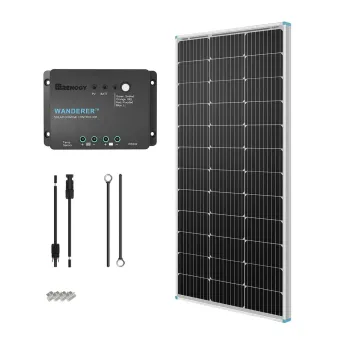
Renogy 100W 12V Solar Panel Kit with Wanderer Li 30A PWM Controller
Why it's here
Full specifications
| Panel power | 100 W (one panel) |
|---|---|
| Panel | 1 x Renogy RSP100DC 100 W rigid monocrystalline panel, which Renogy markets as 16BB N-type; 33 cells, anodized aluminum frame, 3.2 mm tempered glass |
| Controller | Renogy Wanderer Li 30A PWM (RNG-CTRL-WND30-LI), negative ground, 12 V batteries only |
| Controller PV voltage limit | 25 V DC open-circuit. The manual says to keep input under 25 V DC "to prevent permanent damage" and to check it against the panels' Voc |
| Controller panel rating | 400 W at 12 V per the kit page. The controller's manual and datasheet do not give a PV power limit |
| Lithium charging | Li mode defaults to a 12.8 V LiFePO4 battery only, with a 14.2 V boost voltage (adjustable 12.6-16 V through the Renogy BT app) and no float stage. It can wake an over-discharged lithium battery. Low-temperature charge protection for lithium is not specified by the manufacturer |
| Wiring | One panel straight to the controller through the adaptor kit. Renogy's kit diagram shows no fuse anywhere |
| Fuses in the box | None. Renogy's Wanderer manual sizes the controller-to-battery fuse at 30 A, and its RSP100DC manual says a PV fuse and a battery fuse are required |
| Cables | 20 ft 10 AWG solar adaptor kit (RNG-AK-20FT-10, a pair, solar connectors to bare ends) and 8 ft 10 AWG battery tray cables (RNG-TRAYCB-8FT-10, a pair, ring terminal to bare end) |
| Expansion | Up to 400 W of the same panel, per the kit page. Parallel only: two panels in series (45.58 V open-circuit) exceed the 25 V input limit |
| Materials and workmanship | Panel 10 years materials and workmanship; controller 1 year; adaptor kit, tray cables and Z brackets 1 year (Renogy Limited Warranty, RNG-4-243) |
| Power output warranty | Panel output 95% at 5 years, 90% at 10 years and 80% at 25 years under the same warranty document |
Specifications verified October 22, 2026 from Renogy product page "100W 12V Solar Panel Kit" (and its Shopify .json / .js product data) - SKU RNG-KIT-STARTER100D-WND30-US; package contents RSP100DC x1, RNG-CTRL-WND30-LI x1, RNG-AK-20FT-10 x1, RNG-TRAYCB-8FT-10 x1, RNG-MTS-ZB x1; panel table 100 W, Voc 22.79 V, Isc 5.31 A, Imp 5.01 A, Vmp 19.97 V, 865 x 578 x 30 mm, 13.0 lb; controller table 12 V, 30 A, "Max. PV Input Voltage 25 VDC", "Max. PV Input Power 400W at 12V", up to 8 AWG; cables 10 AWG 8 ft and 10 AWG 20 ft; "expand up to 400W"; wiring diagram with no fuse , Renogy RSP100DC datasheet (100W Monocrystalline Solar Panel; no version printed) - Vmp 19.97 V, Imp 5.01 A, Voc 22.79 V, Isc 5.31 A, 600 VDC UL, 15 A series fuse, Pmax -0.32 %/C, Voc -0.26 %/C, NOCT 47 C, 865 x 578 x 30 mm, 5.9 kg (13.0 lb), 33 cells; "10 Years Material and Workmanship Warranty", "25 Years Power Output Warranty" , Renogy Wanderer 30A PWM (Wanderer Li) user manual, Version 1.1 - 12 VDC, 30 A, max PV input 25 VDC, self-consumption 10 mA or less, IP20, RS232, 0.65 lb, 163.8 x 109.6 x 44.7 mm; Sealed, Gel, Flooded, Li; Li boost 14.2 V (user 12.6-16 V), Li defaults for 12.8 V LFP only; install indoors; 30 A controller-to-battery fuse; BT-1 and temperature sensor sold separately , Renogy Wanderer Li 30A product page - SKU RNG-CTRL-WND30-LI-US; self-consumption under 10 mA, IP20, BT-1 compatible; spec table "Warranty: 1-year material and workmanship warranty" (the same page's body text says 2 years) , Renogy Limited Warranty for All (RNG-4-243, file A9, May 2026; text identical to the A7 file) - RSP100DC "10-year material and workmanship warranty" and 5-year 95% / 10-year 90% / 25-year 80% output; RNG-CTRL-WND30-LI 1 year; RNG-AK-20FT-10, RNG-TRAYCB-8FT-10 and RNG-MTS-ZB 1 year , Renogy RSP100DC/RSP195DC/RSP320DC-BK user manual, Version A3 (August 30, 2026) - same electrical figures as the datasheet; "A battery fuse is required" and "A solar panel fuse is required on the positive end" , Renogy Solar Kit Installation & Maintenance Guide (CFR/EN, PDF dated July 2026) - follow the kit page's wiring diagram; expansion only with same-model panels, total Isc and array Voc within the controller's limits, thicker cables if needed; installation by "licensed electricians or trained professionals" , Renogy Solar Installation & Maintenance Manual (A1) - low-temperature Voc correction with a recommended 10-20% safety margin; a fuse and a blocking diode on each parallel branch; non-professional installation voids the warranty .
Strengths
- The lowest price band here for a roof panel and a controller
- The same panel as Renogy’s 400 W kit, with its 10-year warranty
- Can grow to 400 W, in parallel, on the same controller
- The Wanderer Li has a lithium mode and draws 10 mA or less at standby
Weaknesses
- The Wanderer’s 25 V limit: the panel reaches 24.86 V at 14°F and passes 25 V below about 10°F
- Cannot meet the 10–20% margin Renogy’s own installation manual recommends, even at 77°F
- PWM: about 72 W of the panel’s 100 W by Victron’s method at 25°C
- No fuse in the box, though Renogy’s panel manual says a PV fuse and a battery fuse are required
- One-year controller warranty, 12 V only, and no Bluetooth without a separate module
Fit: The PWM controller suits a single 12 V battery and must be mounted indoors. Its 25 V input limit leaves little room: the panel's 22.79 V open-circuit voltage rises to 24.86 V at 14°F on Renogy's own coefficient and passes 25 V below about 10°F. Renogy's panel manual advises a further 10-20% margin, which this pairing cannot meet even at 77°F. Adding panels to reach 400 W means wiring them in parallel, and Renogy's installation manual then calls for a fuse and a blocking diode on each branch, none of which are in the box.
Buy it if
You want to keep a battery topped up in mild weather, at the lowest cost.
Choose something else if
You camp where mornings go below about 10°F, or you plan to grow past one panel. Its controller is the limit.
Which kit fits your RV’s solar prep
Before choosing a kit, find out what your RV already has. A Go Power roof prep ends at a cable entry plate on the roof, and the Overlander’s panel plugs straight into it. On a rig Go Power calls “Wired for Solar”, it says only the panel and controller need installing, at a controller location marked with a decal, after checking the factory wiring and fusing.
A side-wall port is for a portable panel that carries its own controller, like the DuraLite. Some side ports run straight to the battery and some through a factory controller, and plugging a kit with its own controller into the second kind puts two controllers in a row.
The Renogy and ECO-WORTHY kits assume a bare roof. Neither includes a roof entry gland, and both controllers must be mounted indoors near the battery.
Which of these you have, and how to test the port before plugging anything in, is on our RV solar prep guide.
What we checked, and what we did not
Every figure on this page came from the manufacturer’s own documents: Renogy’s RSP100DC datasheet, the Wanderer Li and Rover Li manuals, its installation guides and its Limited Warranty document (RNG-4-243, May 2026); ECO-WORTHY’s kit page, panel and controller manuals and warranty page; and Go Power’s 2026 RV kits manual, spec sheets, controller manual and warranty page. Where those documents disagree, the records say so and give both figures. The cold voltages and PWM harvests are our arithmetic from those figures.
We have not tested any of these. Several pages ranking for this search say they have. On the kit side, a drone site, a laptop site, a video-game site, a food site and a dog site each describe months of testing on a travel trailer. One ranking page carries the current year in its title over an “Updated Oct 12, 2022” dateline, and another URL now opens a category page rather than an article. The most-listed ECO-WORTHY kit, a 200 W kit with a battery and inverter, is no longer on ECO-WORTHY’s own US store.
Two pages on this search are worth reading. Offgridauthority says plainly that it did no lab testing, and smartrvhub works from published specifications. That is the approach here too.
Also considered
Victron panels with a SmartSolar controller. The build-your-own route, with the most complete documentation of any maker here. Our sizing calculator picks the panels for your roof and month, and the controller roundup covers the SmartSolar range.
Flexible panels. Glued flush, they run hotter and most carry shorter warranties than rigid ones. The trade is on our flexible vs rigid page.
ECO-WORTHY’s 400 W kit with a battery and inverter. The same panels and controller plus a 1,100 W inverter and a 100 Ah LiFePO4 battery. ECO-WORTHY’s own battery documents disagree on whether it has Bluetooth and low-temperature charge protection, which matters on an RV that sees frost, so we have not listed it.
Go Power’s OBSIDIAN 190 W MPPT kit (KIT1056). Go Power’s only in-stock MPPT roof kit. Its store page does not name the controller model, and the display needed to change its settings from the factory AGM profile is sold separately.
EcoFlow and BougeRV panels. Each appears on three of the six panel lists we counted. We have not built records for either from their documents yet, so we have not ranked them.
Related guides
- How much solar do I need for my RV? — the panel count for your roof, your use and the month you camp.
- Best solar charge controller for an RV — seven MPPT controllers on their makers’ own figures.
- What size solar charge controller? — the cold-morning voltage check, for any array.
- What size fuse for solar? — string, array and battery fuses, including the ones these kits leave out.
- RV solar prep — what your factory port is wired to.
- Flexible vs rigid RV solar panels — warranties and mounting, maker by maker.
- The electrical section collects everything published so far.
For how products on this site are selected and what we do not claim about them, see the editorial policy.
Questions worth answering
What is the best solar kit for an RV?
For most RV roofs, Renogy's 400 W kit: four 100 W panels, a Rover Li 40A MPPT controller with its Bluetooth module in the box, 10 years on the panels and 3 on the controller. Wire it the way Renogy's first diagram shows, all four in parallel, which needs three more 10 A in-line fuses than the kit includes. Wired in series, as its second diagram shows, it goes past the controller's 100 V limit below about 10°F.
How much power does a 100 W solar panel make in a day on an RV?
It depends on where and when far more than on the panel. Lying flat on a roof, by NASA's long-term averages and a 0.75 allowance for dirt, heat and wiring, one 100 W panel puts about 624 Wh a day into the battery in Quartzsite in June and about 62 Wh in Seattle in December. Denver runs from about 531 Wh in June to 168 Wh in December. A single figure without a place and a month is not an answer.
Is the Renogy 100 W starter kit good for an RV?
For keeping a battery topped up in mild weather, it is a low-cost start. It has two limits. Its Wanderer controller is PWM, which by Victron's method harvests about 72 W of the panel's 100 W at 25°C. And its input limit is 25 V: the panel reads 24.86 V at 14°F by Renogy's own coefficient and passes 25 V below about 10°F. Renogy's installation manual recommends a 10–20% margin on top, which this pairing cannot meet even at 77°F.
PWM or MPPT for an RV solar kit?
MPPT, once there is more than a panel or two. A PWM controller holds the panels at battery voltage, so it collects close to their short-circuit current times about 13.5 V rather than their full rating. By Victron's method at 25°C that is about 72 W of 100 W for Renogy's starter panel and about 126 W of 200 W for Go Power's Overlander panel. The gap narrows in hot sun and widens in the cold.
Do RV solar kits come with fuses?
Some do. Renogy's 400 W kit has one 10 A in-line fuse and a 40 A ANL fuse; Go Power's Overlander has a fuse kit; Renogy's 100 W starter kit and ECO-WORTHY's 400 W kit have none, though both makers' manuals say fuses are required. Our fuse calculator works out the string, array and battery fuses for a given array and controller.
How long is the warranty on RV solar panels?
It varies more than the pages selling them suggest. Renogy's warranty document gives its RSP100DC panel 10 years on materials and 80% output at 25 years. ECO-WORTHY's warranty page gives its panels one year and no output term, though its kit page claims a 25-year power guarantee. Go Power states 25 years on output with no percentage. Read the warranty document, not the product page.
Can I add more panels to an RV solar kit later?
Within the controller's limits. Renogy's starter kit can grow to 400 W, in parallel only, because two of its panels in series would be 45.6 V on a 25 V controller. Go Power says the Overlander's controller takes up to 600 W, in parallel only, though one table on the same product page says 510 W. Check voltage and current against the controller, not just watts; our charge controller calculator does that for a given array.
Do I need a kit if my RV is solar prepped?
It depends on what the prep is wired to. A roof prep from Go Power ends at a cable entry plate the Overlander plugs into. A side-wall port is for a portable panel with its own controller. Some preps run straight to the battery and some through a factory controller. Find out which you have before buying anything.