Rigid panels on brackets are the default for a flat RV roof with room for them, and the makers’ own documents back that up. But the usual reasons given are wrong in detail. The warranty gap most comparisons quote — rigid panels warranted for a decade, flexible ones for one to three years — is not what the warranty documents say. And “flexible” covers two quite different products. If rigid is your answer, the panels-and-kits roundup compares the rigid kits on the same kind of evidence.
Read the documents and three things come out:
- The warranty gap is real within a brand and not across brands. Renogy and Go Power both give their flexible panels a much shorter warranty than their rigid ones. BougeRV’s CIGS flexible panel carries a longer product warranty than Victron’s rigid panels.
- Mounting instructions belong to the specific panel. A general airflow recommendation cannot replace the attachment method approved for your panel and roof. Different flexible products use different bonding systems.
- There are three kinds of panel, not two: rigid glass, semi-flexible crystalline, and CIGS thin film.
| What it handles | Rigid glass, framed | Flexible |
|---|---|---|
| Warranty, same brand | Longer: Renogy 10 years materials, 25 years at 80% output | Shorter: Renogy 5 years materials, 5 years at 90% output |
| Mounting | Brackets or feet, with air underneath | Use the exact model’s approved attachment system |
| Heat | Airflow behind the panel | Bonded contact restricts rear ventilation; loss varies |
| Weight per 100 W | About 12 lb (Victron 190 W: 23 lb) | 5.3 lb Renogy G3; 4.63 lb BougeRV ISE137 |
| Curved roofs | Possible with suitable mounts | Within the model’s bend and support limits |
| Walking access | Plan around panels | Do not infer walkability from flexibility |
Three kinds of panel, not two
- Rigid glass. Crystalline cells under glass in an aluminum frame, bolted to the roof on brackets or feet. Victron’s BlueSolar range is the example here: its datasheet describes “A sturdy, anodized aluminium frame” for “standard mounting systems”.
- Semi-flexible crystalline. The same kind of cells laminated between thin plastic sheets, frameless; the current Renogy G3 laminate is 3 mm thick. Renogy’s RNG-100DB-H, Go Power’s Solar Flex and SunPower’s discontinued E-Flex are all this. None of their makers states whether the front sheet is ETFE or PET, the distinction most guides make so much of — and Renogy’s newest flexible panel uses a third material, TPO.
- CIGS thin film. A different cell chemistry entirely. BougeRV’s Yuma 100 W is long and narrow — 82.2 × 13.7 in — and runs at a higher voltage than a crystalline 100 W panel: 24 V at maximum power and 30.5 V open circuit, against 20.7 V and 24.4 V on Renogy’s current G3 sheet. BougeRV’s 17% figure is cell efficiency; do not compare it directly with whole-module efficiency or assume it describes all thin-film panels.
That voltage difference matters if you mix them. Parallel panels share an operating voltage: mismatched maximum-power voltages can reduce the output you get from the combination. Check panel compatibility and the controller’s cold-weather open-circuit voltage and current limits, or use separate suitable controllers. What size solar charge controller explains those checks.
The current Renogy G3 datasheet also changes the dimensions to 43.0 × 22.9 inches and weight to 5.3 lb. Earlier G2 figures were different despite the same model name. BougeRV’s current page mixes long ISE137 specifications with Square-version copy; the 82.2-inch figure here is for ISE137. Confirm the supplied revision and SKU before laying out a roof.
What the warranties actually say
General warranty ranges hide differences between models. Here is what the documents reviewed in October say, panel by panel:
| Panel | Type | Materials / product | Output |
|---|---|---|---|
| Victron BlueSolar | Rigid | 5 years | 10 years at 90%, 25 years at 80% |
| Renogy RNG-100D-SS | Rigid | 10 years | 5 years at 95%, 10 at 90%, 25 at 80% |
| Renogy RNG-100DB-H | Flexible crystalline | 5 years | 5 years at 90% |
| Go Power Overlander 200 W | Rigid | Not stated for the panel | 25 years |
| Go Power Solar Flex 110 | Flexible crystalline | Not stated | 5 years |
| BougeRV Yuma 100 W | CIGS | 10 years | 25 years at over 80% |
| SunPower E-Flex 100 (discontinued) | Flexible crystalline | Not stated | 5 years at 80% |
Sources, read 22 October 2026: Victron’s current-models panel datasheet; Renogy’s Limited Warranty, RNG-4-243 A7; Go Power’s Overlander and Solar Flex 110 pages and spec sheets; BougeRV’s warranty policy and Yuma manual; SunPower’s E-Flex datasheet 523809 Rev D.
So: Victron’s own rigid panels carry 5 years, not 10 to 12, and none of the three current flexible makers here offers 1 to 3. Within Renogy and within Go Power, the flexible panel gets the shorter warranty — that much of the conventional wisdom holds. Across brands it does not: BougeRV’s CIGS panel has twice the product warranty of Victron’s rigid panels.
The earlier version of this article flagged conflicting output-warranty wording on Renogy’s flexible-panel page. On 6 November, the current page and its linked G3 sheet both give a five-year output term. The page states 90% at five years, consistent with the warranty row above. Confirm the terms for the actual product revision and purchase date.
The fine print that changes those numbers
- BougeRV repairs first and replaces second, and after the first year a replacement is charged by formula: “Replacement Cost = Original Price * (1 - Remaining Warranty Period / Total Warranty Period)”. The buyer pays labor and all shipping. Its 2022 CIGS manual gave the panel 18 months, a figure some reviews still repeat; the current manuals say 10 years.
- Go Power’s Solar Flex manual excludes damage from “winds exceeding 45 MPH”. It does not say whether driving at highway speed counts. Ask Go Power before you rely on either reading.
- SunPower made its warranty “contingent upon modules being mounted in accordance with the requirements” of its manual — which leads to the next problem.
How the makers say to mount them
First separate the physical arrangements. The sketch shows a section through an attachment point; it does not tell you where to apply adhesive.
Conceptual roof sections, not to scale. Panel thickness, clearance, support and attachment must come from the instructions for the exact panel, mounting system and roof.
Rigid panel on approved mounts
The stand-off allows ventilation behind the panel. The roof and mount system still need to carry the load and resist uplift while driving; a drawn air gap is not a clearance specification.
Flexible panel at a bonded contact
This section is through a bonded point, not a map of adhesive coverage. Drainage openings, surface preparation and bend limits vary. Bonding does not create the ventilated cavity shown on the left.
Renogy flexible example: its installation manual specifies adhesive attachment and leaves prescribed drainage paths open. Grommets alone are not its mobile-installation method.
BougeRV adhesive Yuma example: a factory-backed panel uses a different attachment system. Do not substitute another maker’s batten, tape or sealant arrangement.
A curved roof does not automatically rule out a rigid panel on a suitable mounting system. A flexible panel still needs adequate support and an approved bend. Do not infer a safe walking surface or a universal heat-loss percentage from either sketch.
Sources: Renogy installation manual, BougeRV adhesive Yuma, and Victron’s airflow discussion.
| Maker | Mounting guidance reviewed in October | Heat and airflow |
|---|---|---|
| Victron (general article) | Advises against flush flexible mounting and suggests low-profile battens | Discusses the benefit of rear airflow; not approval for another brand’s panel |
| Renogy RNG-100DB-H | Specifies structural adhesive on the back; grommets alone are for non-mobile use | Keep the prescribed short-edge drainage and heat-release paths open |
| Go Power Solar Flex | Does not endorse a preferred attachment method | Requires a fire-resistant surface and addresses improper-installation heat damage |
| SunPower E-Flex | Describes grommets or adhesive without endorsing a preferred method | Calls for ventilation underneath |
| BougeRV adhesive Yuma CIGS | Factory peel-and-stick backing | Roof compatibility and preparation still need checking |
Renogy’s instructions are in its installation and maintenance manual. The mounting details above retain the 22 October review date; the newer G3 electrical sheet does not establish that every earlier instruction applies unchanged to the supplied revision. Confirm that with Renogy. Adhesive also makes later removal a roof-repair consideration, not just a panel replacement.
Do not use a marketing flexibility demonstration as an installed bend limit. Renogy now advertises up to 240° of flex, while the manual reviewed in October limits the installed bend to 30°. That is a model-specific limit, not a rule for all flexible panels. Check the applicable manual and roof support.
Heat, and what it costs
The current Renogy G3 sheet and BougeRV ISE137 specifications both give a maximum-power temperature coefficient of −0.38% per °C. That describes power change with cell temperature; it does not tell you how hot either panel will run on your roof.
Victron’s airflow discussion estimates a 2–15% penalty for flush mounting compared with ventilation beneath a panel. This is general guidance, not a measured loss for either product here. Do not deduct a fixed percentage and call it a tested forecast. Our solar array calculator does not size roof arrays using these flexible models.
Weight, height and the shape of the roof
- Weight. Renogy’s current G3 sheet lists 5.3 lb for 100 W; BougeRV lists 4.63 lb for ISE137. Victron’s 190 W rigid is about 23 lb before brackets. Lower panel weight does not establish that a roof can carry the installation.
- Height. Renogy lists a 3 mm laminate; BougeRV lists 1.5 mm for ISE137. Junction boxes, cable routes and attachments add to installed height. Compare the whole assembly with a rigid frame and its mounts.
- Shape. A suitable mounting system can support a rigid panel above a curved roof. A flexible panel can follow a permitted curve, but still needs adequate support and compliance with its own bend limit.
- Roof attachment. Adhesive may avoid panel-mount holes, but cable entry, roof material, preparation, uplift resistance and removal all need a plan.
Which one, for which roof
Rigid, if the roof is flat and has room for frames, you want the longest output warranty on paper, and you can mount on brackets with air underneath. Brackets that tilt add a great deal in winter and lose a little in summer — is tilting RV solar panels worth it puts numbers on both. Size the array for the month you camp in with how much solar an RV needs.
Crystalline flexible, if low weight or profile is valuable, the exact panel and attachment system are compatible with your roof, and you accept the warranty and ventilation trade-offs. Follow the applicable installation method.
CIGS flexible, if the same is true and you want the longer warranty, a long narrow strip suits your roof, and your controller can take its higher voltage.
A portable panel, if the honest answer is that the roof is the problem. On a rig with a factory side port, what that port is wired to decides which kits plug in.
Flat roof with room for frames
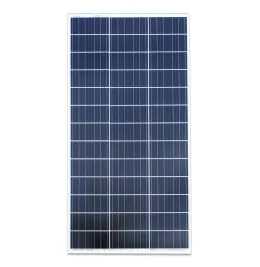
BlueSolar 190W
Rigid glass in an aluminum frame, mounted on brackets with air underneath, with a 25-year output warranty.
Low-profile crystalline flexible
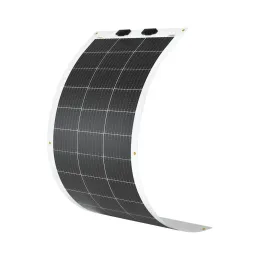
Renogy 100W Flexible
Current G3 sheet lists 5.3 lb for 100 W and a 3 mm laminate. Confirm the exact revision, roof compatibility and installation terms.
Curved roof, longer warranty
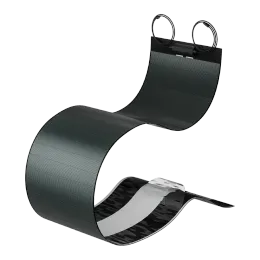
Yuma 100W CIGS
CIGS thin film with a 10-year product warranty, prorated after the first year. Long and narrow at 82 in, with a higher voltage than crystalline panels.
Questions worth answering
Do flexible solar panels have shorter warranties than rigid ones?
Within the same brand, yes. Renogy's warranty document gives its 100 W flexible panel 5 years on materials and 5 years at 90% on output, against 10 years and 25 years at 80% for its rigid 100 W. Go Power gives its Solar Flex 5 years on output and its rigid Overlander 25. Across brands it is not a rule: BougeRV's CIGS flexible carries a 10-year product warranty, longer than the 5 years on Victron's rigid panels.
How long do flexible solar panels last on an RV?
A warranty is not a prediction of service life. Renogy and Go Power list five-year output terms for the crystalline flexible models here; BougeRV lists a longer term for its CIGS panel. Heat, attachment, roof movement and damage affect actual life. We have not measured long-term durability.
How do you mount flexible solar panels on an RV roof?
Follow the exact panel and roof instructions. Renogy's reviewed manual specifies adhesive with drainage paths and restricts grommet-only use to non-mobile installations. BougeRV's adhesive Yuma uses factory backing. A general recommendation for battens is not permission to change either system. Confirm support, bend limits and roof compatibility before fitting.
Does installing a Renogy solar panel yourself void the warranty?
The manual reviewed in October states: "Installation must be performed by a licensed professional. Nonprofessional installation voids the warranty." Its product pages do not repeat the condition. If you plan to fit Renogy panels yourself, ask Renogy how it applies before you buy.
Are CIGS flexible panels better than monocrystalline flexible panels?
Compare the exact models. The long BougeRV ISE137 is 24 V at maximum power; Renogy's current RNG-100DB-H G3 sheet lists 20.7 V. Both publish a maximum-power temperature coefficient of -0.38% per degree C. Shape, installation method, voltage and warranty differ; cell chemistry alone does not settle suitability for a roof.
Can flexible solar panels be walked on?
Do not assume flexibility makes a panel a walking surface. Permission depends on the exact model and installation. Unless its instructions expressly allow it, plan access routes that avoid stepping on the panels.